

Banner
    Disproving Local Realism
    By Sascha Vongehr | May 21st 2011 09:48 PM | 19 comments | Print | E-mail | Track Comments
    About Sascha

    Dr. Sascha Vongehr [风洒沙] studied phil/math/chem/phys in Germany, obtained a BSc in theoretical physics (electro-mag) & MSc (stringtheory)...

    View Sascha's Profile

    Modern physics has disproved direct realism: There is no locally realistic description of our world possible. Although I have already explained this differently at several places, for example by refusing 'real stuff' as being a good explanation for what is ‘at the bottom’, it is worth to prove it once rigorously. Let me present the simplest established proof in the simplest possible version that I can come up with. Everybody claiming interest in the interplay between science and philosophy should have gone through this proof at least once and I did my utmost to make it as easy as possible: Only three angles are considered and probabilities almost completely avoided by instead talking about natural numbers like 50. What local realism actually refers to should become obvious along the way.

    Imagine a source of pairs of photons (quanta of light). One photon is send to Alice who resides to the left. The second photon is send to Bob, who is far away to the right. Alice has a calcite crystal that has one input channel for her photon and two output channels: One output is labeled “Horizontal” or “H” and the other output channel is labeled “Vertical” or “V”. Photons exiting these channels are horizontally or vertically polarized relative to the crystal’s internal z-axis. Every photon either comes out of the H-channel, in which case her measurement is labeled “1”, or it comes out of the V-channel, in which case her measurement is “0”.

    Bob has the same kind of crystal-thingy and so we will write every combined measurement as (A,B) with A being the value that Alice measured and B the value that Bob has gotten. So there are exactly four possibilities for every photon pair: (A,B) = (0,0), or (0,1), or (1,0), or (1,1).

    The important point to understand is: Every photon pair is prepared in such a way that if the crystal axes of Alice’s crystal is parallel to that of Bob’s, only the measurements (0,1) and (1,0) ever result!


    That such is possible has to do with the conservation of angular momentum of the photon pair and so on and is basic physics – no big mystery involved here. I am not going to somehow “prove” such basics, because you could in principle go into the laboratory and check it yourself. We accept these measurements and photon pair preparations as daily laboratory routine and go on to prove non-locality from it (not that the earth is round or that light velocity is constant or anything else, but only non-locality).


    Now it may come in handy (but it is not necessary) if you know a little optics (skip this paragraph if you like): Linearly polarized light that has its polarization axis at an angle of δ (delta) to the vertical (z-axis) and that hits a linear polarizer whose polarization axis is along the vertical, will be attenuated. Why? The projection of the electrical field vector E of the light onto the vertical is proportional to cos(δ). The orthogonal sin(δ) component is absorbed and the left over energy is proportional to the square of E. Thus, the energy left after passing the polarizer is proportional to cos2(δ).

    However, the more fundamental description rests on the fact that the discussed crystals do something very similar: If a linearly polarized photon is going into the entrance channel and the relative angle between a certain crystal axis and the photon’s polarization is delta again, the probability to exit as a horizontally polarized photon through the H-channel is cos2(δ), and the probability of going through the V-channel instead is sin2(δ). The combined probability cos2(δ) + sin2(δ) = 100%, as it of course it must be in order to account for all cases.
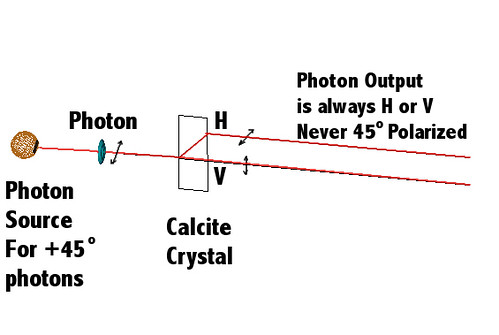
    At 45 degrees input polarization, the probability to have the photon come out horizontally polarized is 50%.


    With other input polarizations, the probability can be adjusted from zero to unity.


    Let us recall the paragraph before the previous two: If Alice’s crystal has its internal z-axis at φ0 = 0º and Bob’s crystal is aligned with φ0 = 0º, too, then only the measurements (0,1) and (1,0) ever result! If the crystals are at an angle δ = (φBob – φAlice) relative to each other (twisted along the x-axis so to say), then the outcomes depend on the relative angle δ in precisely the way you would expect from usual optics: the results (0,0) and (1,1) become possible and their occurrence counts increase proportional to sin2(δ).


    Say we do this experiment 800 times. Every experiment starts with the preparation of a pair of photons. When the photon going to the left is maybe about half way on its path to Alice’s crystal, Alice randomly rotates her crystal either so that the crystal's internal z-axis is at φ0 = 0º or at φ1 = 3π/8 = 67.5º. Similarly, after the preparation of the photon pair but before the photon going to the right is about to arrive at Bob’s crystal, Bob randomly puts his crystal either at φ1 or at φ2 = π/8 = 22.5º.


    Didactic point: No other angles will be considered. The relative δ angles’ magnitudes are thus zero, one, two, and three times φ2, but realists claim that the photons only know about locally present absolute angles, and disproving them is the main issue! This is why I label henceforth with both φ instead of oversimplifying with a single δ label.


    Alice and Bob pick the angles randomly. Each has two different angles to choose from, so there are four different combined choices, and they are all equally likely. Hence, out of the NTotal = 800 experiments, about 200 times, a quarter of all cases, Alice’s and Bob’s angles are in the configuration φAlice = φ0 while φBob = φ1. I write thus N0,1 ~ 200. The other three numbers are obviously N0,2 ~ 200, N1,1 ~ 200, and N1,2 ~ 200. Actually, since it is all random, numbers like 195 or 203 may often result instead of exactly 200. Thus, we do not use an equal sign “=” here, but a “~”, which means that the numbers will be pretty close to 200.


    What about the outcomes of the measurements? Well, lets enumerate first the N1,1 cases, because for all of them the relative angle δ = (φ1 – φ1) is zero, and that means only (0,1) and (1,0) can result. We write, in surely obvious notation, the expected numbers as

    N1,1(0,0) = 0

    N1,1(0,1) ~ 100

    N1,1(1,0) ~ 100

    N1,1(1,1) = 0

    The total is indeed 200. These numbers will not be important later on and serve merely as an introduction of the general method and its consistency. It helps to compare with the following four lines and appreciate the fact that the above four lines fundamentally result from them:

    N1,1(0,0) = N1,1 * Sin2(0)/2 ~ 200 * 0

    N1,1(0,1) = N1,1 * Cos2(0)/2 ~ 200 * 1/2

    N1,1(1,0) = N1,1 * Cos2(0)/2 ~ 200 * 1/2

    N1,1(1,1) = N1,1 * Sin2(0)/2 ~ 200 * 0


    Lets enumerate the N0,1 cases where the relative angle δ is φ1. The expected numbers are

    N0,1(0,0) ~ 200 * Sin2(3π/8)/2 = 85

    N0,1(0,1) ~ 200 * Cos2(3π/8)/2 = 15

    N0,1(1,0) ~ 200 * Cos2(3π/8)/2 = 15

    N0,1(1,1) ~ 200 * Sin2(3π/8)/2 = 85

    The total is again 200. Only N0,1(0,1) ~ 15 will be important.


    The N0,2 cases are very similar. The relative angle δ is φ2, and so the expected numbers are

    N0,2(0,0) ~ 200 * Sin2(π/8)/2 = 15

    N0,2(0,1) ~ 200 * Cos2(π/8)/2 = 85

    N0,2(1,0) ~ 200 * Cos2(π/8)/2 = 85

    N0,2(1,1) ~ 200 * Sin2(π/8)/2 = 15

    The total is again 200 and only N0,2(0,1) ~ 85 will be important.


    Lastly, we enumerate the N1,2 cases. δ is now – π/4 = – 45º. The expected numbers are

    N1,2(0,0) ~ 200 * Sin2(–π/4)/2 = 50

    N1,2(0,1) ~ 200 * Cos2(–π/4)/2 = 50

    N1,2(1,0) ~ 200 * Cos2(–π/4)/2 = 50

    N1,2(1,1) ~ 200 * Sin2(–π/4)/2 = 50


    Remember that every number counts particular outcomes in a total of 800 trials. The important end result is that N0,2(0,1) ~ 85 alone is by more than 20 occurrences larger than N0,1(0,1) and N1,2(1,1) combined, which only sum to 15 + 50 = 65.


    What we have introduced here are the facts as they are experimentally observed. The next time, we will tentatively assume that the world is real and that everything depends only on what is locally present in the vicinity; that Bob’s random decision does not influence Alice’s random choice for example. We will try to reproduce the above result “classically”, so the next time will be much easier than today (the hard part is over!). We will discuss Bell’s famous inequality [1], which states something totally obvious, namely that (N5 + N7) alone is smaller or at most equal to (N6 + N7) + (N1 + N5) combined.


    However, (N5 + N7) will equal our large N0,2(0,1) while (N6 + N7) will equal the tiny N0,1(0,1) and (N1 + N5) will equal the small N1,2(1,1). In other words: Local realism cannot possibly describe the world as it reveals itself to us in the laboratory. Put differently: Local realism demands that 85 is smaller than 15 + 50, which implies that local realism is reserved for the crazy among us and that the world is non-local and in a sense not real; it rather exists in our minds!

    (That modified realism may be a better conclusion than non-locality is discussed in Part 3.)


    -----------------------------

    [1] J. S. Bell, "On the Einstein Podolsky Rosen paradox," Physics, 1(3) 1964 pp. 195-200. Reprinted in J. S. Bell, Speakable and Unspeakable in Quantum Mechanics, 2nd ed., Cambridge: Cambridge University Press, 2004; S. M. Blinder, Introduction to Quantum Mechanics, Amsterdam: Elsevier, 2004 pp. 272-277.


    More appetite for reading about that reality does in a sense not exist? Here you go:

    Quantum Perspective of the Nonexistence of Light

    The World is not woven from Real Stuff

    Why There is Something Instead of Nothing

    If Schrödinger's Cats All Die, Do the Alive ones go to Hell?

    Comments

    polarisation is a wave property ! so how do we associate it with a particle ( photon). I find the interchange of properties between waves and particles ( angular momentum is another) confusing. Can you help?

    It is interesting that you are referencing Bell's article. You are in fact mixing "realism" and "locality", but the two do not have to be maintained or abandoned together. Bell was, I believe, a "nonlocalist realist", and so am I...

    Locality has been experimentally proven false, and there is (very probably) no way to bring it back. Realism, however, has never been proven false, and it is even not clear to me what would mean to "disprove" realism. The alternative to Realism could be Strumentalism, which certainly requires less assumptions, but also has less explicative power. Therefore, while it is not possible to prove Strumentalism false (since every "truth" for Realism is also a "truth" for Strumentalism), it is indeed possible to argue that if Strumentalism is "true", science is hardly possible, and the traditional strumentalistic interpretation of Quantum Mechanics is certainly flawed, since it relies on a concept of "complementarity" between QM and classical physics that is devoid of any meaning if there is no "reality" to give a common ground to the two theories.

    Please, especially when presenting things didactically, refrain from identifying "locality" and "realism". Reality does not need to be local.

    vongehr
    I did not identify "local" and "realism". Indeed, only one has to be modified, either "local", or "realism". Einstein locality (micro causality) is important in physics, while non-locality is already so spooky that realism is to be modified regardless.
    I've got to say I'm not a fan of the notation you have used. Wouldn't phi(n) = n/8 radians have been easier to follow? Symmetry in the tables would have made if easy to follow. Having phi one be three times phi two is a bit odd.

    Also you have a typo or arithmetic error at the paragraph 'Say the experiment happens 8000 times'. I'm assuming you mean an angle of 67.5 not 66.5 for phi one.

    Finally, in my tirade of criticism (!) I think this whole proof is missing something. The photons are prepared in a particular way so that one is an exact negative of the other in all geometric ways (polarisation, direction etc), so this relationship of the photons to each other mean that what happens to them is constrained. We are only considering possibilities where that is the case. This means their response to tampering is linked without some magic FTL communication between them.

    vongehr
    You would need n=3 without using n=2. Since later on only a=0 or 1 and b=1 or 2 is used, it may be less confusing this way. What you suggest leads to using the relative angle delta instead. That is fine as long as you already confident, but for those who are not, it is important to keep the absolute local angles, as the relative angle is something non-local. At least that was my attempt at being didactic - sure there may be other ways given the diverse audience.

    Thank you for catching the typo. Indeed it is 67.5 degrees.

    The rest of your comment I do not quite understand. This article only shows what is observed in the laboratory. The non-locality argument needs the follow-up post. The photons are not prepared so that one is "the exact negative" of the other in any deeper sense than what the measurement results are at certain angles.
    Let me get this straight.

    Two photons, polarized perpendicularly. If you set your filters parallel, then you'll always get one photon passing through and one blocked. (1,0) That, by itself, proves that they can't have a pre-existing polarization. Bell's Inequality then proves that they can't have some complex function that determines their polarization before the measurement interaction, because otherwise you'd either get different measurement ratios, including more than zero (1,1).

    Have I stated anything untrue?

    vongehr
    Sorry, but I do not get it. If your starting out with "Two photons, polarized perpendicularly." is to imply that they are already polarized a certain way, then it is wrong. Even at very small angles different from parallel filters, you can get (1,1), nevertheless, angular conservation holds in the whole setup, i.e. is assured by the total angular momentum of Alice and Bob and their filters. If you just look at the photons, angular momentum would not be conserved if they started out polarized perpendicularly yet give the result (1,1). But maybe that is what you mean by "That, by itself, proves that they can't have a pre-existing polarization."(?) So maybe you are correct here, but be aware of that the phrase "Two photons, polarized perpendicularly" at the very beginning will, if you were to teach about EPR like this, immediately send about 90% of the students onto the wrong way of thinking about it. It isn't totally wrong, in a sense it is right, but in another sense it is totally wrong because extremely misleading.
    Alright, thanks.

    I am afraid I am not convinced. Your solution is not general enough because you started with a pair of photons, which appears to be entangled. It is well known that entangled photons are not localised.

    vongehr
    Not sure what this is supposed to mean. Photons are field quanta, not objects, and Einstein locality means micro causality that does not violate the light velocity bound. These are well known, that photons are somehow localized as long as not entangled is your own interpretation.
    What if using the real number field is insufficient to explain the experiment. Real number field is one dimensional and therefore has limitations.
    Complex numbers are two dimensional, complex numbers are not a complete ordered field, and the notion of inequality takes on a different meaning. Is it possible that you're using an insufficient field to model the experiment?
    I ask this because of the dual nature of the particle wave. It seems real numbers can only account for the particle part.

    vongehr
    The disproof does not assume anything about the nature of the hidden variables. They can be anything you like - complex, octonionic - anything at all.
    If that's the case it might be difficult to determine the imaginary component.

    In any case, is this the same thing that Nick Herbert proved in three lines?

    Ralph
    "Every photon either comes out of the H-channel, in which case her measurement is labeled '1', or it comes out of the V-channel, in which case her measurement is '0'."

    (Note: by asking the questions below, I am not building up any new or strange theories, rather just trying to understand the accepted theory.)


    Here is something I've often wanted to ask: what about photons that never come out of either channel, because they get scattered or absorbed somewhere? I worry that ignoring the lost ones might create a bias of some kind.  

    I even worry about photons that never came into existence. Can the lack of a photon be considered an event too? I'm thinking about Dirac's positrons, which (I have heard) he predicted as missing electrons. Maybe counting such non-events might make the lack of local realism easier to understand. Non-photons are non-real, and who knows what a lot of them might do to reality?  

    (I really do intend this as a serious question, even though I am simultaneously joking around a bit.)

    Since microscopic events in physics are reversible, doesn't the distinction between event and non-event go away? (The concept of entropy has no meaning inside a reversible system. Otherwise the system wouldn't be reversible.) 

    Imagine if we somehow tracked the non-events, watching them propagate through the system. That might make things come out differently.
    vongehr
    You worry about the so called 'detection loophole' (DL), which is of relevance for secure key distribution in QM cryptography for example.  However, those who use DL to defend their claim of some classical physics below QM are silly.  Photons (already quantum by the way) conspiring to be not detected in just the right way so to deceive humans to believe in QM statistics is a scenario that, well, perhaps it is the truth - hey, who knows, maybe we are in the matrix - but it is certainly not the dead classical mechanism just churning on that they claim to defend.
    Ralph
    Sascha, thank you for your reply. I was not trying to suggest a loophole, nor do I believe there is "classical physics" underneath QM. I am just trying to understand entanglement -- if it is even possible to understand. 

    My only possibly unorthodox idea is that I wonder if there is something I am tempted to call "reverse causality" happening. But "reverse causality" only means to me that the future and past are linked in a way which has nothing to do with the idea of "cause and effect".

    It still bothers me that non-detection and non-existence do not seem to be mentioned in discussing these interesting systems. Maybe discussing them could enhance understanding.

    I like your post a lot and I am continuing to study it.
    vongehr
    I was not trying to suggest a loophole, nor do I believe there is "classical physics" underneath QM.
    Not you, but there are plenty who do.
    But "reverse causality" only means to me that the future and past are linked in a way which has nothing to do with the idea of "cause and effect".
    You may want to start by very carefully figuring out how to define future and past without cause and effect.
    It still bothers me that non-detection and non-existence do not seem to be mentioned in discussing these interesting systems.
    As I said, they are mentioned, too much!  It is called 'detection loophole'.  "Non-existence" is again a definition problem - what is existence supposed to mean in your own language-game; that is up to you, but you need to become clear about it.
    I like your post a lot and I am continuing to study it.
    Thank you - let me know where I fail to be clear.
    Ralph

    I like your use of the term "language game" in this context. That might help people retain their sanity. I am a big fan of Wittgenstein's later work. 

    You may want to start by very carefully figuring out how to define future and past without cause and effect.
    I don't have a way to define future and past without cause and effect. It sounds impossible.

    Inside a photomultiplier, there is a lot of cause and effect, with a clear direction of time. Inside a radioactive atom that this photomultiplier is watching for decay, there is no cause and effect, no direction of time. So causal and non-causal systems can be linked. 

    I say the all-encompassing Minkowski-like (or GR-like) picture is oversimplified. I don't believe we can define a single time axis (straight or curved) which encompasses the whole universe and works with quantum phenomena. Minkowski space was designed for special relativity, which is completely based on causality. 

    Feynman's diagrams make use of the Minkowski concept, but then Feynman ends up with the idea of an electron traveling backwards in time, which he admits does not have a clear meaning. 

    It seems to me that there exist multiple coupled Minkowski-like (or GR-like) domains, each with its own independent time dimension, and there are also non-causal domains, which do not have any time axis. We have a landscape that consists of coupled causal and non-causal spaces.

    Copenhagen amounts to the combination of all these coupled domains. It works in pieces, but it does not constitute a single, unified landscape, hence all the confusion. 

    I say there is no TOE, no all-encompassing geometry. Everything is intrinsically messy and open-ended. It is possible to build many odd gadgets by coupling together systems in cyclical or recursive ways. There would be testable predictions.

    Of course this is not an answer to your suggestion about clarifying past and future, but it is the only picture I know how to imagine.


    vongehr
    I don't have a way to define future and past without cause and effect. It sounds impossible.
    Well, that is precisely my point! You go on about that people confuse with the Minkowski picture, but perhaps you confuse.  Where you want to go, time is like temperature a higher order description.  You want to talk about causality there, about statistical correlation between alternatives, not time.  For example, when you talk about retro-causality, perhaps it is you who is hung up on the issue of time. "Retro" relative to what direction if no time is already implicitly assumed?
    It seems to me that there exist multiple coupled Minkowski-like (or GR-like) domains, each with its own independent time dimension,
    A set of different space-time branches with different CMB temperatures (= cosmic time) can be a useful description, but a splitting space-time many-world architecture conflicts with Hardy's paradox in my opinion.  My EPR resolution is a splitting model - intuitive and does what it is supposed to explain (namely the spread of actualization to many worlds), however, it is not the last answer to understanding QM for sure.


