




If the odds are in your favor, why not bet some money? There have been plenty of high profile bets in physics. Bets spice up stuff. Moreover: If nobody is willing to take your offer, they effectively publicly admit defeat.
If Laplace believes in a deterministic, classical universe, if he believes to have a method to use his knowledge to force a certain outcome, he is not only consistent when he bets his first born on that outcome. His bet could prove something about nature!
Dick knows that Brian will lose a certain bet with 99% probability, because that is what quantum mechanics tells. Dick proposes a bet, but can this bet prove anything?
Laplace’s theory predicts that he wins 100%. If he loses, his theory failed. If Dick wins against Brian, who has a silly theory that he claims beats Dick’s bet with 80% probability, then what? After all, if Dick loses the bet against Brian, quantum mechanics predicted that, too, with 1% probability! Quantum mechanics even tells us that the 1% is as “real” as the 99%. Dick will lose!
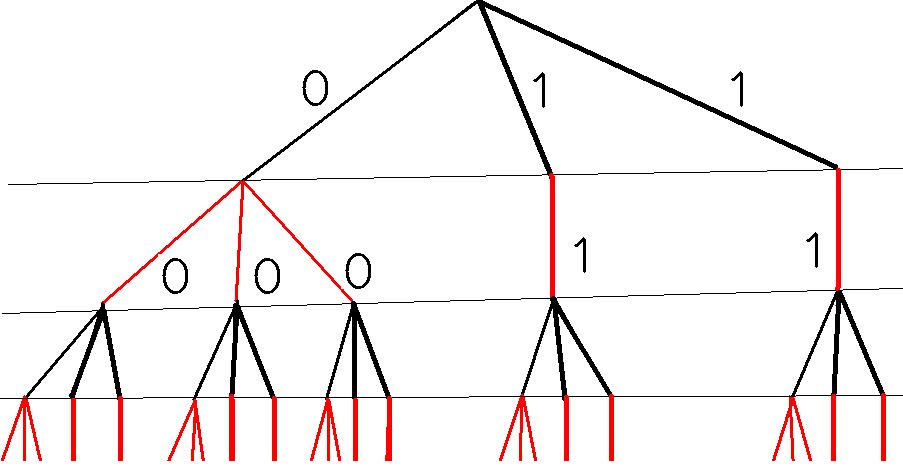
Gambling with a quantum die can be weird.
But Dick claims that as long as Brian refuses to put money on the table, Brian is a loudmouth. Dick’s friends agree, but this does not stop Brian's from claiming that Dick’s offer is unfair and not actually testing their theories but something else. The public agrees with Dick, perhaps because he may be a professor. But actually they agree with Brian, perhaps also a professor, because if quantum mechanics demands all that craziness like them parallel worlds, then nah, these physicists nowadays with their dark energy and stuff, nah gee, let's keep it “real”.
What does 99% prove? What if it were 51%? What about 52%? 80%? Who knows the threshold where scientists agree that a challenger's theory has won against quantum mechanics? Where is that number that could disprove quantum mechanics empirically and thus make it falsifiable, as many mistakenly demand for all science? There is none! Whatever the percentage, these are arbitrary numbers and as such hardly scientific. The public learns that science is about fighting for whims and personal gain, about professors belonging to an upper middle class that can gamble away a few crates of wine – all true and good to know. But surely, they will not learn about quantum mechanics, which, as far as known, is all about that there is no* such threshold.
The Quantum Randi Challenge is an example for a new type of challenge, called General Randi Challenge, which is not a bet, but specifically designed with all these problems in mind. A General Randi Challenge addresses a new generation that demands transparency over expert elites (1), it avoids dealing with pseudo-scientists (2), and it refuses to fall for their forcing the agenda (3) – all without strengthening the appearance of suppression by an establishment.
Increasingly, researchers at the cutting edge of quantum foundations discuss the Quantum Randi Challenge, but there is a certain inability to shake off preconceived notions. Many complain that the Quantum Randi Challenge has no well defined statistical criterion that, when passed, would mean that a challenger has passed the challenge.
Precisely! The Quantum Randi Challenge does not have any level where established experts grant approval, because such arbitrary thresholds are not only somewhat unscientific (A), but quantum mechanics does not provide such a criterion (B), which makes such criteria a didactic shot into the foot, and most importantly (C), a General Randi Challenge must be independent of establishment expert consensus. One of the main aims of a General Randi Challenge is that it allows refusing giving pseudoscience a platform without strengthening the pseudo-scientists’ claim about there being an establishment conspiracy against the truth.
The agenda is no longer classical physics. Quaint crackpots desperately hold on to classical physics with silly, from a modern perspective unnatural, ad hoc constructions. As bad as that is, it should not force us to focus on classical, blind mechanisms that are alive enough to conspire to deceive humans, or superluminal ghosts or whatever comes next. The Quantum Randi Challenge talks to reasonable people, to a generation that grew up with virtual reality and is already beyond naïve realism, and it tells them:
“Here is the prediction of quantum mechanics as we know it today as a reasonable, natural theory that is the underpinning of many applications vital to current technology; here is the explanation of something it does so you can follow without trusting anybody but yourself, and here is the very system that you understand one could use easily to disprove all of this in case nature were instead directly real (which includes “local”).
The challenge is to merely modify this very simple system so it proves the opposite, which would be so truly science shattering that you would hear of it in a matter of days, and hundreds of people much like yourself would check it and be convinced in a matter of days in case it truly does what it claims. So you, the enlightened individual, judge for yourself: Why has still no challenger succeeded?”
You don’t think the Quantum Randi Challenge can teach this lesson? Look into the details [here and here] and tell us why in the comments below.
Are you an IT knowledgeable person and know how to convert a trivial Mathematica code into something more widely available or perhaps even Java or whatever you feel is best to make the challenge an attractive internet application? Look at the details, go ahead and start for a couple of afternoons or so, contact me if you think you can really do it and want to do it. Attach your name to a growing, future oriented project that can only succeed.
Are you interested in illustrating the explanation of the Bell inequality that should be added to the internet application? Go ahead.
---------------------------------------------
* Unitary QM holds those 1% “real” even if they become 0.000001%. We have not found a gravity induced low probability cutoff like the Diosi-Penrose criterion, any “further fact” about consciousness in terrible quantum states, or world mangling.




Comments