

Fake Banner
    On Nymphs and Satrys: Orchids
    By Heidi Henderson | January 5th 2012 11:16 PM | 8 comments | Print | E-mail | Track Comments
    About Heidi

    Blue Planet, Explorer in Residence. Co-author of In Search of Ancient BC.

    View Heidi's Profile

     Michele Pokrandt
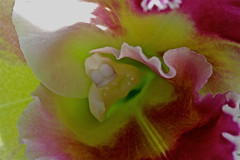
    Photo: Michele Pokrandt

    Orchidaceae get their name from the Greek ὄρχις (órkhis), which literally means "testicle", a nod to the naughty nub shape of their roots.

    In Greek mythology, Orchis was the son of an ugly nymph and a satyr who came upon a festival for Dionysios deep in the woods. 

    Liking his fermented grapes a wee bit too much, he overindulged on wine then tried to have his way with a priestess of Dionysios. As a result the Bacchanalians tore him limb from limb. His grieving father prayed to the Gods for him to be restored.

    Not that keen on men who assert themselves on unwilling young women, they turned him into a flower instead.


    Comments

    rholley
    The Greek story is quite new to me.

    It reminds me of a piece by Henry Purcell, Nymphs and Shepherds, here on a 78 rpm disc recorded by the Manchester Children’s Choir in 1929.


    Here are the words:
    Nymphs and shepherds, come away.
    In ye groves let's sport and play,
    For this is Flora's holiday,
    Sacred to ease and happy love,
    To dancing, to music and to poetry;
    Your flocks may now securely rove
    Whilst you express your jollity.
    Nymphs and shepherds, come away.
    The words are by Thomas Shadwell.
    Robert H. Olley Quondam Physics Department University of Reading England
    UvaE
    The Greek story is quite new to me.
    It's not one of the more common myths. My Robert Graves collection does not mention it, but the Orchis story does have all the sex and violent justice typical of Greek mythology.
    Fossil Huntress
    Thank you for sharing this, Robert. Just lovely!
    UvaE
    When I first learned that there are over 20 000 species of orchids, I was stunned by their diversity. Among all families it's only rivalled by the Asteracea (or Compositae), and neither family, ironically, contains many plants commonly eaten by humans.
    Could you please give credit for the photo? Michele Pokrandt. Thanks so much.

    Hank
    The flickr button in the toolbar is supposed to do that automatically.  Like many things Yahoo, it only works when it feels like working.
    Want more no-nonsense, independent science? Buy Science Left Behind
    I am actually quite honor that this picture was chosen for the article.

    Fossil Huntress
    It is a lovely photo Michele. I did a photo walk this weekend and loved all the flowers in bloom, especially the Magnolias. If you head to Vancouver we'll have to turn unleash your lens on them. Spectacular!

