

Banner
By News Staff | October 23rd 2009 12:00 AM | 8 comments | Print | E-mail | Track Comments
Antidepressants are ineffective in fully 50% of the people who take them.   It is clearly early 20th century medicine, where you keep trying things and hope something happens while pharmaceutical companies who impress doctors the most make the most money.

With so much research and money spent on depression studies, how is it possible that it is only as effective as doing nothing at all?  

1)  The cause of depression has been oversimplified.  A study from the laboratory of  depression researcher Eva Redei presented at the Neuroscience 2009 conference in Chicago this week addresses some strongly held beliefs about depression.

2) Antidepressants treat stress, not depression.  Redei, who is David Lawrence Stein Professor of Psychiatry at Northwestern's Feinberg School, says she has molecular evidence that quashes the notion that stress is generally a major cause of depression and says there is almost no overlap between stress-related genes and depression-related genes. 

"This is a huge study and statistically powerful," Redei said. "This research opens up new routes to develop new antidepressants that may be more effective. There hasn't been an antidepressant based on a novel concept in 20 years."

3) Little overlap between stress and depression genes.  Redei used microarray technology to isolate and identify the specific genes related to depression in these animals. She examined the genes in the brain regions -- the hippocampus and amygdala -- commonly associated with depression in rats and humans. 

Then she took four genetically different strains of rats and exposed them to chronic stress for two weeks. Afterwards, she identified the genes that had consistently increased or decreased in response to the stress in all four strains in the same brain regions.

Redei now had one set of depression-related genes that came out of an animal model of depression and one set of stress-related genes that came our of her chronic stress study.

Next she compared the two sets of genes to see if there were any similarities. "If the 'stress causes depression theory' was correct, there should have been a significant overlap between these two sets of genes," she said. "There weren't."

Out of a total of over 30,000 genes on the microarray, she discovered approximately 254 genes related to stress and 1275 genes related to depression, with an overlap of only five genes between the two. 

"This overlap is insignificant, a very small percentage," Redei said. "This finding is clear evidence that at least in an animal model, chronic stress does not cause the same molecular changes as depression does."
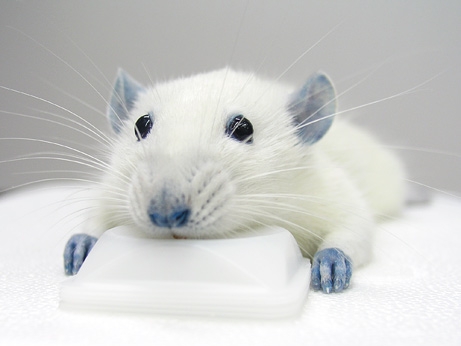

This rat is blue, literally and figuratively.

The Most Depressed Rats In The World

Redei's findings are based on extensive studies with a model of severely depressed rats that mirror many behavioral and physiological abnormalities found in patients with major depression. The rats, after decades of development, are believed to be the most depressed in the world. 

Most animal models that are used by scientists to test antidepressants are based on the hypothesis that stress causes depression. "They stress the animals and look at their behavior," she said. "Then they manipulate the animals' behavior with drugs and say, 'OK, these are going to be good anti-depressants.' But they are not treating depression; they are treating stress."

That is one key reason why current antidepressants aren't doing a great job, Redei noted. She is now looking at the genes that differ in the depressed rat to narrow down targets for drug development.

She said another reason current antidepressants are often ineffective is that they aim to boost neurotransmitters based on the popular molecular explanation of depression, which is that it's the result of decreased levels of the neurotransmitters serotonin, norepinephrine and dopamine. But that's wrong, Redei said. 

Drugs Aim at Wrong Molecular Target?

In the second part of the study, Redei found strong indications that depression actually begins further up in the chain of events in the brain. The biochemical events that ultimately result in depression actually start in the development and functioning of neurons.

"The medications have been focusing on the effect, not the cause," she said. "That's why it takes so long for them to work and why they aren't effective for so many people."

Her animal model of depression did not show dramatic differences in the levels of genes controlling neurotransmitters functions. "If depression was related to neurotransmitter activity, we would have seen that," she said. 

Her findings in depressed rats, she said, are very likely applicable to humans. 

"The similarities between these regions of the human and rodent brain are remarkable," Redei explained. "The hippocampus and amygdala are part of the so-called ancient lizard brain that controls survival and are the same in even primitive organisms."


Comments

These rats just need to grow up and quit feeling sorry for themselves.

Thanks anonymous for making it crystal clear why depressed folks have a hard time getting help.

I'll tell you why.
1.
Brain science is still in it's infancy. There is not an extensive enough foundation of science on which to base treatments. What we should be doing is identifying dis-regulations in brain circuitry that are experienced as painful, and correcting those dis-regulations. But because the science is scant, we instead put patients in symptom categories and then throw chemicals at them.

2.
These symptom categories, like depression, are unscientific, describing everything and predicting nothing:
Currently we define depression as a constellation of barely measurable and vague symptoms. What does our diagnosis predict? It predicts that certain drugs should help the person. But they don't. So instead of saying that our idea of depression lacks any predictive capacity and is therefor unscientific, we say the patient has 'treatment resistant depression', and we switch their meds.

Pharmaceutical companies LOVE the idea of depression because almost anyone can have it.
Doctors LOVE the idea of depression. It's where you put any patient that has a problem you don't understand (like fibromyalgia until recently).
For the patients though the diagnosis of depression means that you've hit the dead end of medical diagnosis and you are about to enter a world of snake oil.

Psychiatrists are trying to treat a system that they do not understand. It's like going to a mechanic who has no idea how an engine works and can only spike the gasoline with different chemicals. In fact it's much much worse, because the brain is a much more complicated system and your mental health is at stake.

Unfortunately, I have to agree with you, Tom. Besides being well read in the neuroscience of psychiatric disorders such as major depression, I have had to live with both major depression as well as "treatment resistant" severe OCD for over 30 years. Needless to say that the SSRIs thrown at them have had little effect. Right now I am taking so many pills, it's ridiculous--two of which being the the SSRI Zoloft and the norepinephrine and dopamine reuptake inhibitor, Wellbutrin.

I have learned that statistically I am far from being alone. The majority of people suffering from the most severe forms of these disorders are the ones who obtain the least, if not no benefit at all from the current regimen of psyho-pharmacopoeia that is being applied to their disorders. For me, my saving grace has been my intellectual pursuits. If it hadn't been for those, I very much doubt that I would still be alive.


Thanks, Tiff. I have seen some of the vidcast that you have posted. One in particular from, I believe, Stanford, discussing major depression was right on the money! : )

Cool! I will definitely watch it. Thanks again, Tiff. : )

Nina, I wrote the first comment, and I can assure you your interpretation of it is off from what I intended. I was attempting to point out how the fact that rats can be bred to have depressive personalities sort of reveals the idiocy of moralizing against depressives. Illusion of free will and all.

And yes, it's a very personal issue for me. As a man, I can assure you I'm quite aware of the myriad social reasons to not even admit to the problem, much less try to "get help".

My current take on antidepressants, as a non-expert, is basically that they will never work unless they actually change the patient's personality. While this may eventually be possible (but desirable...?), I seriously doubt we will see effective depression drugs that dont profoundly alter the very personhood of the suffering individual.

My experience and gut feeling tells me that just kicking around the levels of neurotransmitter cycles will never be a real long-term solution. What goes up, must come down; it's been called the "hedonic treadmill". It seems to be true with just about every psychoactive thing I've ever ingested.

rychardemanne
I refused to take medications. I did what may seem counter-intuitive: I went down the rabbit hole to see how dark the depression could get. With meditation, hard thinking and various other mental techniques I found the solution and the depression disappeared. Chemicals influence the brain which influences behaviour which influences thinking which influences behaviour which influences the brain which influences the chemicals.

Starting the process is a chicken and egg situation. I was just stubborn and believed that given the problem I could find the solution.

Add a comment

The content of this field is kept private and will not be shown publicly.
  • Allowed HTML tags: <sup> <sub> <a> <em> <strong> <center> <cite><TH><ul> <ol> <li> <dl> <dt> <dd> <img> <br> <p> <blockquote> <strike> <object> <param> <embed> <del> <pre> <b> <i> <table> <tbody> <div> <tr> <td> <h1> <h2> <h3> <h4> <h5> <h6> <hr> <iframe>
  • Lines and paragraphs break automatically.
  • Web page addresses and e-mail addresses turn into links automatically.
CAPTCHA
If you register, you will never be bothered to prove you are human again. And you get a real editor toolbar to use instead of this HTML thing that wards off spam bots.
