Banner
Pilot Study: Fibromyalgia Fatigue Improved By TENS Therapy

Fibromyalgia is the term for a poorly-understood condition where people experience pain and fatigue...

High Meat Consumption Linked To Lower Dementia Risk

Older people who eat large amounts of meat have a lower risk of dementia and cognitive decline...

Long Before The Inca Colonized Peru, Natives Had A Thriving Trade Network

A new DNA analysis reveals that long before the Incan Empire took over Peru, animals were...

Mesolithic People Had Meals With More Tradition Than You Thought

The common imagery of prehistoric people is either rooting through dirt for grubs and picking berries...

User picture.
News StaffRSS Feed of this column.

News Releases From All Over The World, Right To You... Read More »

Blogroll

A new study in
Nature Climate Change challenges the assumption in climate models that climate is the primary driver of how quickly organic matter decomposes in different regions. 

A long-term analysis conducted across several sites in the eastern United States found that local factors — from levels of fungal colonization to the specific physical locations of the wood — play a far greater role than climate in wood decomposition rates and the subsequent impacts on regional carbon cycling.

Because decomposition of organic matter strongly influences the storage of carbon, or its release into the atmosphere, it is a major factor in potential changes to the climate.

A study in Proceedings of the National Academy of Sciences says that metformin, the world's most widely used anti-diabetic drug, slows aging and increases lifespan. 

In their experiments, the researchers tease out the mechanism behind metformin's age-slowing effects: the drug causes an increase in the number of toxic oxygen molecules released in the cell and this, surprisingly, increases cell robustness and longevity in the long term.

Mitochondria – the energy factories in cells – generate tiny electric currents to provide the body's cells with energy. Highly reactive oxygen molecules are produced as a by-product of this process.

A recent analysis of voting trends of physicians has found that political contributions have gone up a lot and more of them have become Democrats; no surprise given Democratic efforts to increase federal presence in medicine.

The percentage of physicians making campaign contributions in federal elections increased to 9.4 percent in 2012 from 2.6 percent in 1991, and during that time physician contributors shifted away from Republicans toward Democrats. That trend was greater among lower paying specialties, such as pediatrics, and among women. 
Obesity often is associated with increased health related complications and death but some studies have found an 'obesity paradox' - people who are obese but otherwise healthy. Concern has been that may cause some to question striving for a normal weight.

Christian Dehlendorff, M.S., Ph.D., of the Danish Cancer Society Research Center, Copenhagen, Denmark, and colleagues sought to determine whether the obesity paradox in stroke was real or an artificial finding because of selection bias in studies. To overcome selection bias, authors only studied deaths caused by the index stroke using a Danish register of stroke and a registry of deaths.

A team of researchers has developed sperm-inspired microrobots which can be controlled by oscillating weak magnetic fields. 

The 322 micron-long robots consist solely of a head coated in a thick cobalt-nickel layer and an uncoated tail. When the robot is subjected to an oscillating field of less than five millitesla – about the strength of a decorative refrigerator magnet – it experiences a magnetic torque on its head, which causes its flagellum to oscillate and propel it forward. The researchers are then able to steer the robot by directing the magnetic field lines towards a reference point.

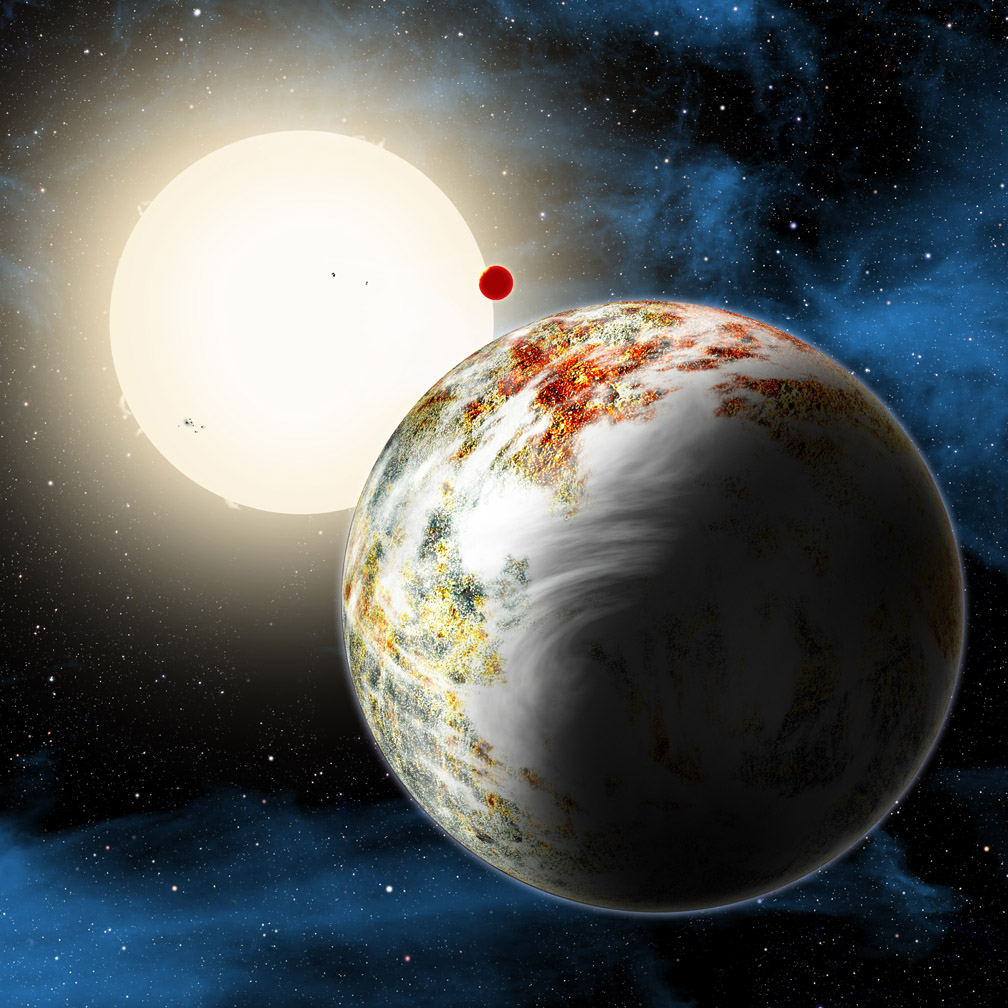
In our solar system, there are two basic kinds of planets- smaller, rocky terrestrials like Earth and Mars and then large gas giants like Neptune and Jupiter.

Though a middle ground between those two is missing locally, NASA's Kepler mission has discovered that these types of planets are very common around other stars. The aliens worlds of other systems - exoplanets - include terrestrials and gas giants, like we have, but also mid-sized "gas dwarfs" - based on how their host stars tend to fall into three distinct groups defined by their compositions.