Banner
Pilot Study: Fibromyalgia Fatigue Improved By TENS Therapy

Fibromyalgia is the term for a poorly-understood condition where people experience pain and fatigue...

High Meat Consumption Linked To Lower Dementia Risk

Older people who eat large amounts of meat have a lower risk of dementia and cognitive decline...

Long Before The Inca Colonized Peru, Natives Had A Thriving Trade Network

A new DNA analysis reveals that long before the Incan Empire took over Peru, animals were...

Mesolithic People Had Meals With More Tradition Than You Thought

The common imagery of prehistoric people is either rooting through dirt for grubs and picking berries...

User picture.
News StaffRSS Feed of this column.

News Releases From All Over The World, Right To You... Read More »

Blogroll

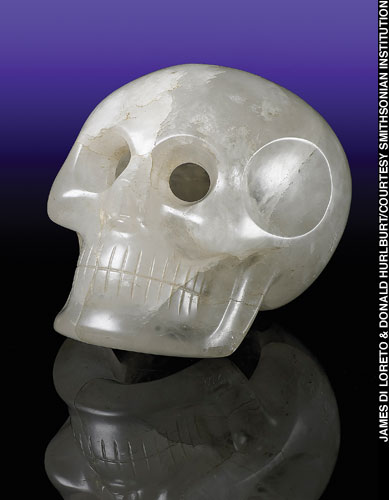
As Indiana Jones races against time to find an ancient crystal skull in his new movie adventure, he should perhaps take a moment to check its authenticity.

New research suggests that two well-known crystal skulls, in the British Museum and the Smithsonian Institution, Washington DC, did not, after all, come from ancient Mexico. Academics now believe the British skull was made in 19th century Europe and the American one even more recently.

The British Museum bought its skull, a life-size carving from a single block of rock crystal from Tiffany and Company, New York in 1897. Its origins were unknown but there were suggestions it was of ancient Mexican origin. Human skulls worn as ornaments and displayed on racks were known to have featured in Aztec art. The skull attracted a lot of public attention and speculation it was once thought to have healing powers. Crystal skulls have since featured in many books, articles and films, most recently in the new Steven Spielberg movie Indiana Jones and the Kingdom of the Crystal Skull.

Robocup 2008 will be a lot more interesting with the addition of more realistic soccer-playing robots. So realistic some can even walk like people.

Researcher Daan Hobbelen of TU Delft has developed Flame - a new, highly-advanced walking robot. This type of research, for which Hobbelen will receive his PhD on Friday 30 May, provides insight into how people walk.

If you try to teach a robot to walk, you will discover how complex an activity it is. Walking robots have been around since the seventies but some, like factory robots, are limited in flexibility. TU Delft is a pioneer in the other method used for constructing walking robots, based on the way humans walk.

The human body is home to a diverse range of microorganisms, estimated to outnumber human cells in a healthy adult by ten fold. The importance of characterizing human microbiota for understanding health and disease is highlighted by the recent launch of the Human Microbiome Project by the National Institutes of Health. This report describes the investigation of healthy human skin for microbiota diversity and establishes the basis for determining a core microbiome.

The Human Microbiome Project aims to characterize the microbial communities of several regions of the body, including skin, where determining the core microbiome is essential to understanding and developing new treatments for skin conditions and diseases such as acne and atopic dermatitis (eczema).

In this study, researchers led by Dr. Julie Segre of the National Human Genome Research Institute have generated a diversity profile of human skin microbiota by sequencing 16S rRNA, a component of the prokaryotic ribosome, isolated from a specific region of skin. “We focused this study on the inner elbow to inform future clinical studies of the extremely common inflammatory skin disorder atopic dermatitis, which affects this area of the skin and is associated with Staphylococcus infections,” explains Segre.

In investigating the intricacies of the body’s biological rhythms, scientists at Beth Israel Deaconess Medical Center (BIDMC) have discovered the existence of a “food-related clock” which can supercede the “light-based” master clock that serves as the body’s primary timekeeper.

The findings, which appear in the May 23 issue of Science, help explain how animals adapt their circadian rhythms in order to avoid starvation, and suggest that by adjusting eating schedules, humans too can better cope with changes in time zones and nighttime schedules that leave them feeling groggy and jet-lagged.

“For a small mammal, finding food on a daily basis is a critical mission,” explains the study’s senior author Clifford Saper, MD, PhD, Chairman of the Department of Neurology at BIDMC and James Jackson Putnam Professor of Neurology at Harvard Medical School. “Even a few days of starvation is a common threat in natural environments and may result in the animal’s death.”

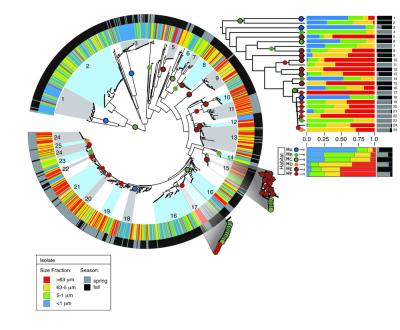
It isn't just people. Marine bacteria also organize into professions or lifestyle groups that partition many resources rather than competing for them. Microbes with one lifestyle, such as free-floating cells, flourish in proximity with closely related microbes that may spend life attached to zooplankton or algae.

This new information about microbial groups and the methodology behind it could change the way scientists approach the classification of microbes by making it possible to determine on a large scale, relatively speaking, the genetic basis for ecological niches. Microbes drive almost all chemical reactions in the ocean; it’s important to identify the specific professions held by different groups.

“This is the first method to accurately differentiate the ecological niche or profession among large groups of microbes in the ocean,” said Professor Martin Polz, a microbiologist in MIT’s Department of Civil and Environmental Engineering. He and colleague Professor Eric Alm, a computational biologist, published a paper describing their research in the May 23 issue of Science.

Alzheimer’s disease (AD), the most frequent cause of dementia, is a form of amyloidosis. It has been known for a century that dementia, brain atrophy and amyloidosis can be caused by chronic bacterial infections, namely by Treponema pallidum in the atrophic form of general paresis in syphilis. Bacteria and viruses are powerful stimulators of inflammation. It was suggested by Alois Alzheimer and his colleagues a century ago that microorganisms may be contributors in the generation of senile plaques in AD.

A number of chronic diseases are in fact caused by one or more infectious agents - stomach ulcers are caused by Helicobacter pylori while chronic lung disease in newborns and chronic asthma in adults are both caused by Mycoplasmas and Chlamydia pneumonia and some other pathogens have been associated with atherosclerosis.

The realization that pathogens can produce slowly progressive chronic diseases has opened new lines of research into Alzheimer’s disease.