Banner
Pilot Study: Fibromyalgia Fatigue Improved By TENS Therapy

Fibromyalgia is the term for a poorly-understood condition where people experience pain and fatigue...

High Meat Consumption Linked To Lower Dementia Risk

Older people who eat large amounts of meat have a lower risk of dementia and cognitive decline...

Long Before The Inca Colonized Peru, Natives Had A Thriving Trade Network

A new DNA analysis reveals that long before the Incan Empire took over Peru, animals were...

Mesolithic People Had Meals With More Tradition Than You Thought

The common imagery of prehistoric people is either rooting through dirt for grubs and picking berries...

User picture.
News StaffRSS Feed of this column.

News Releases From All Over The World, Right To You... Read More »

Blogroll

A group of British investigators headed by H. Walach has studied the psychological mechanisms of 'distant healing', a form of spiritual healing, in patients with chronic fatigue syndrome.

409 patients with chronic fatigue syndrome (CFS) were randomized from 14 private practices for environmental medicine in Germany and Austria in a two by two factorial design to immediate versus deferred (waiting for 6 months) distant healing.

Half the patients were blinded and half knew their treatment allocation. Patients were treated for 6 months and allocated to groups of 3 healers from a pool of 462 healers in 21 European countries with different healing traditions.

In 1750, Denis Diderot convinced his publisher to support a vast enterprise, the publication of the Encyclopédie gathering all knowledge into one location.

Dozens of writers worked on thousands of articles for more than 15 years to produce the first summary of all human knowledge and, despite the labour and pains of its birth, its entire contents would barely fill one volume of a contemporary encyclopaedia.

Linking communities and information into a virtual digital library is the 21st century version of the Dictionaire Raisonneé. Better, they can be organised around specific topics, creating vast repositories and networks of experts around a single problem. Best of all, it can be done on demand.

The biggest blow-up in the science community about Al Gore's "An Inconvenient Truth" was not over the 20 foot ocean rises but the images of Hurricane Katrina and the implication that global warming had a hand in it.

Scientists at the Carnegie Institution say there may be something to it, though indirectly.

The Earth’s jet streams, the high-altitude bands of fast winds that strongly influence the paths of storms and other weather systems, are shifting — it could be argued that is in response to global warming.

Is fairness simply a ruse we adopt only when we see an advantage in it for ourselves? Many psychologists have moved away from this utilitarian view, dismissing it as too simplistic, but recent advances in both cognitive science and neuroscience now allow psychologists to approach this question in some different ways, and they are getting some intriguing results.

UCLA psychologist Golnaz Tabibnia, and colleagues Ajay Satpute and Matthew Lieberman, used a psychological test called the “ultimatum game" to explore fairness and self-interest in the laboratory. In this particular version of the test, Person A has a pot of money, say $23, which they can divide in any way they want with Person B. All Person B can do is look at the offer and accept or reject it; there is no negotiation. If Person B rejects the offer, neither of them gets any money.

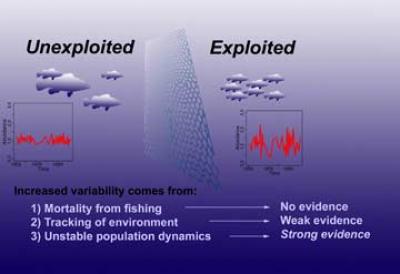
Fishing activities can provoke volatile fluctuations in the populations they target, namely by altering the “age pyramid.” Lopping off the few large, older fish that make up the top of the pyramid leaves a broad base of faster-growing small younglings and the research team found that this rapidly growing and transitory base is dynamically unstable — a finding having profound implications for the ecosystem and the fishing industries built upon it.

Imagine a container of water with a 500-pound fish. With food, it grows a little bigger. Without food it gets a bit smaller. Imagine the same container with 500 one-pound fish. They eat, reproduce and the resulting thousands of fish boom, quickly outstripping the resources and the population crashes.

True agoraphobia is an invalidating disease but a paper by Giovanni A. Fava and associates of the University of Bologna, published in Psychotherapy and Psychosomatics, questions the excessive emphasis on panic which has been attributed in the past decade and the role of pharmaceutical industry in this attribution.

In studying the phenomenology of panic attacks, Argyle and Roth noticed that truly spontaneous attacks, not preceded by anxiety-provoking cognitions, were uncommon.

Patients meeting positive criteria for panic disorder suffered from the whole range of anxiety disorders, and a unique relationship with agoraphobia was not seen. Indeed, other diagnoses (particularly social phobia and generalized anxiety disorder) frequently predated the onset of panic. This was true also for agoraphobia.