Banner
Pilot Study: Fibromyalgia Fatigue Improved By TENS Therapy

Fibromyalgia is the term for a poorly-understood condition where people experience pain and fatigue...

High Meat Consumption Linked To Lower Dementia Risk

Older people who eat large amounts of meat have a lower risk of dementia and cognitive decline...

Long Before The Inca Colonized Peru, Natives Had A Thriving Trade Network

A new DNA analysis reveals that long before the Incan Empire took over Peru, animals were...

Mesolithic People Had Meals With More Tradition Than You Thought

The common imagery of prehistoric people is either rooting through dirt for grubs and picking berries...

User picture.
News StaffRSS Feed of this column.

News Releases From All Over The World, Right To You... Read More »

Blogroll

In recent decades, manufacturers have added more and more components onto integrated circuits. As a result, the number of transistors and the power of these circuits have roughly doubled every two years. This has become known as Moore’s Law.

But the ability to easily add more components is now noticeably decreasing and further miniaturization of electronics will experience a fundamental challenge in the next 10 years.

There's hope on the horizon. Researchers at The University of Manchesterhave used the world’s thinnest material to create the world’s smallest transistor, one atom thick and ten atoms wide. How small is that? You could fit 25 million of them in an inch.

An exhibit developed by the Museum of Science, Boston, in collaboration with Lucasfilm, Ltd. explores the possibility that some of the robots, vehicles and devices of the Star Wars films are closer to reality than one might think.

The exhibition, at the Franklin Institute in Philadelphia, Pa., through May 4, discusses landspeeders and robots as engineering design challenges and highlights how researchers are currently pursuing similar technologies.

"We were surprised and delighted when we were developing the exhibit, to discover that many scientists working today were inspired by the fantasy technologies in the Star Wars movies," said Lawrence Bell, senior vice president at the Museum of Science and the lead investigator for the project. "We developed the exhibit with the goal of continuing that inspiration for the kids who will be the next set of future scientists."

Internet sites love to pounce on the latest ridiculous story, the more outrageous the better. The silliest thing this week propagated by press release aggregators and people who don't check facts was that there was a 1 in 450 chance that the Apophis asteroid will collide with Earth after the German newspaper Potsdamer Neuerster Nachrichten reported on Tuesday that student Nico Marquardt was right and NASA was wrong.

NASA, used to being the target of fringe conspiracy theorists who will believe anything they want to believe, issued the following statement in response:

The connection between music and mathematics has been widely known for centuries. Musica Universalis, "music of the spheres", emerged in the Middle Ages as the idea that the proportions in the movements of the celestial bodies -- the sun, moon and planets -- could be viewed as a form of music, inaudible but perfectly harmonious, and more than 200 years ago Pythagoras discovered that pleasing musical intervals could be described using simple ratios.

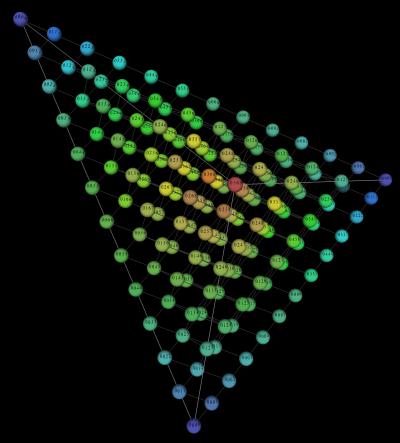
Three music professors, Clifton Callender at Florida State University, Ian Quinn at Yale University and Dmitri Tymoczko at Princeton University, have devised a new way of analyzing and categorizing music that takes advantage of the deep, complex mathematics they see enmeshed in its very fabric.

The trio has outlined a method called "geometrical music theory" that translates the language of musical theory into that of contemporary geometry. They take sequences of notes, like chords, rhythms and scales, and categorize them so they can be grouped into "families." They have found a way to assign mathematical structure to these families, so they can then be represented by points in complex geometrical spaces, much the way "x" and "y" coordinates, in the simpler system of high school algebra, correspond to points on a two-dimensional plane.

Calorie restriction is a hot topic in discussions of aging but most studies use mice that were weaned with calorie restriction as test subjects whereas humans would have to adopt that lifestyle later in life if they were to grow normally.

Research continues to see how a restricted calorie diet impacts the aging process. Working with yeast cells, University of Washington scientists have linked ribosomes, the protein-making factories in living cells, and Gcn4, a specialized protein that aids in the expression of genetic information, to the pathways related to dietary response and aging.

Previous research has shown that the lifespan-extending properties of dietary restriction are mediated in part by reduced signaling through TOR, an enzyme involved in many vital operations in a cell. When an organism has less TOR signaling in response to dietary restriction, one side effect is that the organism also decreases the rate at which it makes new proteins, a process called translation.

Mars, Venus, Uranus. They're all still planets. So it goes with the human brain and gender. While males and females might sometimes act as though they come from different planets, a new study in flies suggests the brain is largely unisex.

By artificially triggering the neurons responsible for singing —normally a male only activity - researchers have made female flies play their first tune.

Male flies work hard to convince females to mate with them, often by showing a talent such as sticking out one wing and vibrating it to produce sound. Earlier studies had identified the neurons responsible for the male singing behavior but it seemed that females had that circuit too, even though they don’t sing.