Banner
Pilot Study: Fibromyalgia Fatigue Improved By TENS Therapy

Fibromyalgia is the term for a poorly-understood condition where people experience pain and fatigue...

High Meat Consumption Linked To Lower Dementia Risk

Older people who eat large amounts of meat have a lower risk of dementia and cognitive decline...

Long Before The Inca Colonized Peru, Natives Had A Thriving Trade Network

A new DNA analysis reveals that long before the Incan Empire took over Peru, animals were...

Mesolithic People Had Meals With More Tradition Than You Thought

The common imagery of prehistoric people is either rooting through dirt for grubs and picking berries...

User picture.
News StaffRSS Feed of this column.

News Releases From All Over The World, Right To You... Read More »

Blogroll

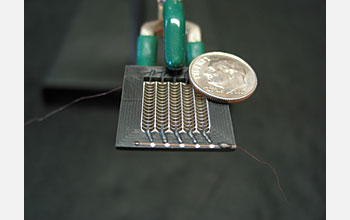
A silent, ultra-thin, low-power and low maintenance cooling system for laptop computers and other electronic devices has been developed based on silent air purifier techniques.

The compact, solid-state fan is the most powerful and energy efficient fan of its size. It produces three times the flow rate of a typical small mechanical fan and is one-fourth the size.

Dan Schlitz and Vishal Singhal of Thorrn Micro Technologies, Inc., of Marietta, Ga. will present their RSD5 solid-state fan at the 24th Annual Semiconductor Thermal Measurement, Modeling and Management Symposium (Semi-Therm) in San Jose, Calif., on March 17, 2008. The device is the culmination of six years of research that began while the researchers were NSF-supported graduate students at Purdue University.


Researchers have developed a new micro-fan only slightly larger than a dime. The new fan can generate winds on the same scale as a laptop computer fan, but uses far less energy and should require far less maintenance. Credit: Dan Schlitz and Vishal Singhal, Thorrn Micro Technologies

When viruses enter cells they manufacture proteins to assist in growth and replication but the body’s immune system recognizes and attacks these non-native proteins. Human Papillomavirus (HPV)(1), which causes several types of cancer but is particularly associated with cervical cancer, has developed sneaky ways of hiding in the body, but researchers at the University of Leeds have found that its ability to trick the body’s first line of defence leaves it vulnerable to counter-espionage from a second defence system.

Professor Eric Blair(2) of the University’s Faculty of Biological Sciences and Dr Graham Cook(3) from the Leeds Institute for Molecular Medicine have been specifically looking at one of the proteins produced by HPV, called E7, and have discovered that it suppresses markers on the cell surface, making infected cells much less visible to T cells, one of the body’s key defense systems.

"March Madness", the annual tournament in college basketball to determine the national champion, impacts more than just sports fans. College basketball teams that make this year’s cut for the 'Sweet 16' may boost the number of students applying to their schools by as much as 3 percent next year, while the winner of the tournament, may see a 7 percent to 8 percent jump in applications, according to a new study.

Jaren Pope, assistant professor of agricultural and applied economics at Virginia Tech and his brother Devin Pope, an assistant professor at The Wharton School of the University of Pennsylvania, have co-authored a paper in Southern Economic Journal that finds a link between college sports success and college admissions around the country.

Experts estimate that $9 in productivity, health and other benefits are returned for every dollar invested in installing toilets for people in countries that today are off-track in meeting the UN Millennium Development Goal (MDG) for sanitation.

Achieving the sanitation goal – to simply halve the number of people without access to a toilet by 2015 – would cost $38 billion, less than 1% of annual world military spending. That investment, they say, would yield $347 billion worth of benefits – much of it related to higher productivity and improved health.

According to UN figures, meeting the sanitation MDG target would add 3.2 billion annual working days worldwide. Universal coverage would add more than four times as many working days.

A recent survey by the Harvard School of Public Health (HSPH) and Harris Interactive, as part of their ongoing series, Debating Health: Election 2008, finds that Americans are generally split on the issue of whether the United States has the best health care system in the world (45% believe the U.S. has the best system; 39% believe other countries have better systems; 15% don’t know or refused to answer) and that there is a significant divide along party lines.

Nearly seven-in-ten Republicans (68%) believe the U.S. health care system is the best in the world, compared to just three in ten (32%) Democrats and four in ten (40%) Independents who feel the same way.

A polyphenols-rich diet keeps the heart younger, according to a study by the FLORA Project, a European Commission funded research studying the effects of flavonoids, a variety of polyphenols, on human health.

"The biological and protective activities of various flavonoids have been extensively studied in vitro, on cell- based assays," says Marie-Claire Toufektsian, leading author of the study. "Nevertheless, this kind of approach has a major limitation: it is extremely difficult to assess precisely the nature of all flavonoids absorbed following consumption of plants present in a given meal. In other words, laboratory cultured cells alone are not sufficient to study a complex mechanism such as that of absorption of food flavonoids. That is why we need to turn attention on other features. The most obvious solution appeared to be to study the effects of this kind of polyphenols on experimental animals. The turning point started from plants: those rich in flavonoids made the case of researchers."