Banner
Pilot Study: Fibromyalgia Fatigue Improved By TENS Therapy

Fibromyalgia is the term for a poorly-understood condition where people experience pain and fatigue...

High Meat Consumption Linked To Lower Dementia Risk

Older people who eat large amounts of meat have a lower risk of dementia and cognitive decline...

Long Before The Inca Colonized Peru, Natives Had A Thriving Trade Network

A new DNA analysis reveals that long before the Incan Empire took over Peru, animals were...

Mesolithic People Had Meals With More Tradition Than You Thought

The common imagery of prehistoric people is either rooting through dirt for grubs and picking berries...

User picture.
News StaffRSS Feed of this column.

News Releases From All Over The World, Right To You... Read More »

Blogroll

Bacteria are ubiquitous on Earth. They've been found from the upper reaches of the atmosphere to miles below the ocean floor. Because of their ubiquity, scientists have long believed bacteria to be cosmopolitan, having similar genetic histories across the globe.

Curing cancer with 'natural' products used to be dismissed as shaman quackery but many chemotherapies that fight cancer in modern medicine are natural products or were developed on the basis of natural substances. Thus, taxanes used in prostate and breast cancer treatment are made from yew trees. The popular periwinkle plant, which grows along the ground of many front yards, is the source of vinca alkaloids that are effective, for example, against malignant lymphomas. The modern anti-cancer drugs topotecan and irinotecan are derived from a constituent of the Chinese Happy Tree.

Looking for new compounds, doctors and scientists are increasingly focusing on substances from plants used in traditional medicine. About three quarters of the natural pharmaceutical compounds commonly used today are derived from plants of the traditional medicine of the people in various parts of the world. The chances of finding new substances with interesting working profiles in traditional medicinal plants are better than in common-or-garden botany.

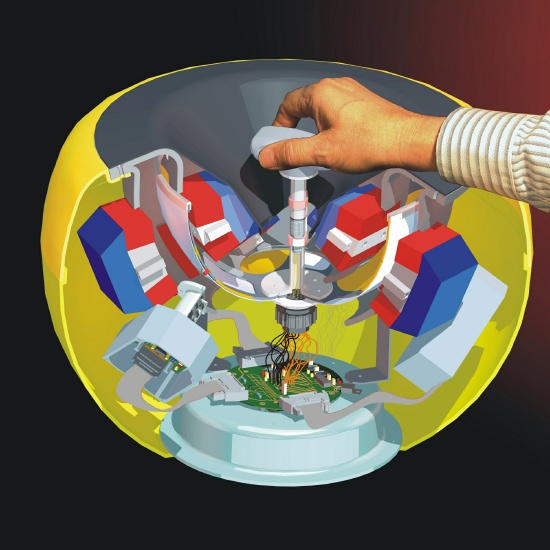
Computers are commonly used as tools to design and manipulate three-dimensional objects but soon they may provide people with a way to sense the texture of those objects or feel how they fit together, says the creator of a haptic, or touch-based, interface at Carnegie Mellon University.

Most haptic interfaces rely on motors and mechanical linkages to provide some sense of touch or force feedback but the device developed by Ralph Hollis, research professor in Carnegie Mellon’s Robotics Institute, uses magnetic levitation and a single moving part to give users a highly realistic experience. Users can perceive textures, feel hard contacts and notice even slight changes in position while using an interface that responds rapidly to movements.

Happiness in life is as much down to having the right genetic mix as it is to personal circumstances according to a recent study.

Psychologists at the University of Edinburgh working with researchers at Queensland Institute for Medical Research in Australia found that happiness is partly determined by personality traits and that both personality and happiness are largely hereditary.

The exchange of genetic material between two closely related strains of the influenza A virus may have caused the 1947 and 1951 human flu epidemics, according to biologists.

The findings could help explain why some strains cause major pandemics and others lead to seasonal epidemics. Until now, it was believed that while reassortment – when human influenza viruses swap genes with influenza viruses that infect birds – causes severe pandemics, such as the ‘Spanish’ flu of 1918, the ‘Asian’ flu of 1957, and the ‘Hong Kong’ flu of 1968, while viral mutation leads to regular influenza epidemics.

But it has been a mystery why there are sometimes very severe epidemics – like the ones in 1947 and 1951 – that look and act like pandemics, even though no human-bird viral reassortment event occurred.

Biologists at the University of Pennsylvania and Harvard University have examined the complete genomes of viruses that infect the bacteria E. coli, P. aeruginosa and L. lactis and have found that many of these viral genomes exhibit codon bias, the tendency to preferentially encode a protein with a particular spelling.

Researchers analyzed patterns of codon usage across 74 bacteriophages using the concept of a "genome landscape," a method of visualizing long-range patterns in a genome sequence.

Their findings extend the translational theory of codon bias to the viral kingdom, demonstrating that the viral genome is selected to obey the preferences of its host.