Banner
Pilot Study: Fibromyalgia Fatigue Improved By TENS Therapy

Fibromyalgia is the term for a poorly-understood condition where people experience pain and fatigue...

High Meat Consumption Linked To Lower Dementia Risk

Older people who eat large amounts of meat have a lower risk of dementia and cognitive decline...

Long Before The Inca Colonized Peru, Natives Had A Thriving Trade Network

A new DNA analysis reveals that long before the Incan Empire took over Peru, animals were...

Mesolithic People Had Meals With More Tradition Than You Thought

The common imagery of prehistoric people is either rooting through dirt for grubs and picking berries...

User picture.
News StaffRSS Feed of this column.

News Releases From All Over The World, Right To You... Read More »

Blogroll

The rushing floodwaters in Evan Almighty, the heaving seas of the latter two Pirates of the Caribbean movies and the dragon's flaming breath in Harry Potter and the Goblet of Fire all featured computer-generated fluids in spectacular action.

The science behind those splashy thrills will be recognized Feb. 9 with an Academy Award for Ron Fedkiw, associate professor of computer science at Stanford, and two collaborators at the special effects firm Industrial Light and Magic (ILM).

"The primary work started a few years ago when we developed a system designed for the female liquid terminator in Terminator 3," Fedkiw said. "Almost immediately after that it was used in the first Pirates of the Caribbean movie to simulate the wine that the pirate skeleton was drinking out of the bottle in the moonlight. Things like the sinking ship in Poseidon and the large water whirlpool in Pirates of the Caribbean 3 are good examples of the system in action."

COX-2 inhibitors are having a tough year. Vioxx was withdrawn voluntarily a few months ago and now Celebrex, the arthritis drug that blocks pain by inhibiting the COX-2 enzyme, has been shown in laboratory studies to induce arrhythmia, or irregular beating of the heart, via a pathway unrelated to its COX-2 inhibition.

University at Buffalo researchers discovered this unexpected finding while conducting basic research on potassium channels.

Celebrex (Celecoxib) has been taken by over 27 million patients since its approval by the FDA in 1998. The new research found that low concentrations of the drug, corresponding to a standard prescription, reduced the heart rate and induced pronounced arrhythmia in fruit flies and the heart cells of rats.

Rapid evolution of a protein produced by an immunity gene is associated with increased antiviral activity in humans, a finding that suggests evolutionary biology and virology together can accelerate the discovery of viral-defense mechanisms, according to researchers at Fred Hutchinson Cancer Research Center.

These findings by Julie Kerns, Ph.D., a postdoctoral researcher in the Hutchinson Center’s Basic Sciences Division, present a striking example by which evolutionary studies can directly lead to biomedically important discoveries in the field of infectious diseases.

An endoscope is a flexible camera that travels into the body's cavities to directly investigate the digestive tract, colon or throat. Most of today's endoscopes capture the image using a traditional approach where each part of the camera captures a different section of the image. These tools are long, flexible cords about 9 mm wide, about the width of a human fingernail. Because the cord is so wide patients must be sedated during the scan.

A fundamentally new design has created a smaller endoscope that is more comfortable for the patient and cheaper to use than current technology.

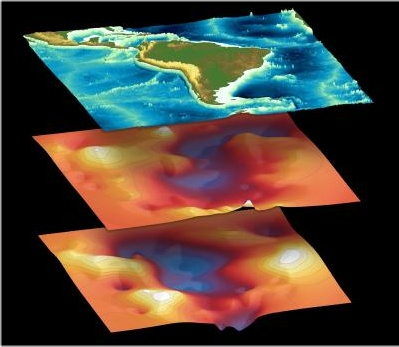
Since we can’t sample the deepest regions of the Earth, scientists watch the velocity of seismic waves as they travel through the planet to determine the composition and density of that material.

A new study suggests that material in part of the lower mantle has unusual electronic characteristics that make sound propagate more slowly, suggesting that the material there is softer than previously thought.

The results in the January 25, 2008, issue of Science call into question the traditional techniques for understanding this region of the planet.

Old people generally mellow with age. They are less likely to be confrontational and more likely to reflect on the world. They are also more likely to have families they care about and thus something to lose.

That goes for terrorists also, according to a new theory by Mark Haas of Duquesne University in the latest Public Policy & Aging Report (PP&AR). It says several hotbed areas in the world that offer the motive and opportunity for political violence are due to stabilize by the year 2030 because current young people will be old.