




The authors used the Rutgers University Global Snow Lab Northern Hemisphere Weekly Snow Cover Extent Data Record to determine whether snow cover across the Northern Hemisphere is increasing or decreasing. Then their two-state Markov chain model with periodic dynamics was used to analyze snow cover and found that significantly more areas are losing snow cover than gaining it.
And the seasons were changing.
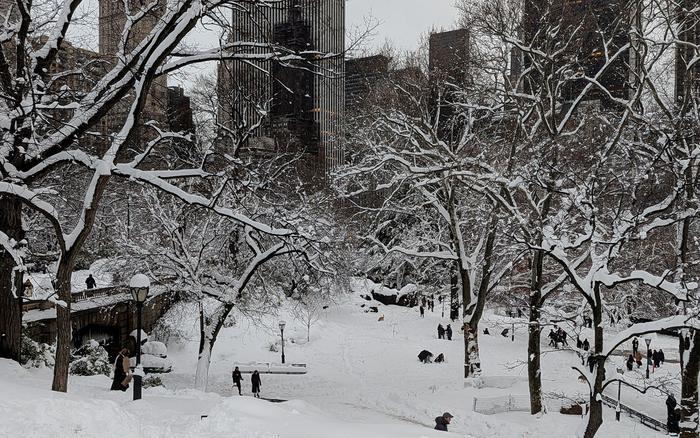
Central Park in New York City. Credit: Mary Pollitz
They say about 24 percent of regions they analyzed showed declines in snow-covered area compared to about 9 percent showing increases, with a noticeable seasonal shift. While observed snow cover has slightly increased in late summer and early fall in some areas, it is declining beginning in March, suggesting an earlier spring melt.
They found that the strongest overall declines occur in Europe and central Asia, while parts of central Canada and the northern Great Plains showed increases. Additionally, the southern edge of seasonal snow cover is retreating in many areas, indicating a general shift toward less persistent snow across much of the hemisphere.
Citation: 'Regional Analysis of Snow Presence Trends in the Northern Hemisphere', Jonathan Woody, Penelope Prochnow, JiaJie Kong, Jamie Dyer, Journal of Hydrometeorology, 30 Jan 2026, https://journals.ametsoc.org/view/journals/hydr/aop/JHM-D-25-0061.1/JHM-...





Comments