




What they found in the Early Pleistocene site of Calio reset the date for colonization of the island; seven stone artifacts. Because this was near a river channel, the researchers believe this would have been the hub for hominin tool-making and other activities such as hunting.
The Calio artifacts consist of small, sharp-edged fragments of stones (flakes) that the early human tool-makers struck from larger pebbles that had most likely been obtained from nearby riverbeds. The team used palaeomagnetic dating of the sandstone itself and direct-dating of an excavated pig fossil to confirm an age of at least 1.04 million years.
Which pushes the date of settlement of the Wallacea archipelago back another 200,000 years.
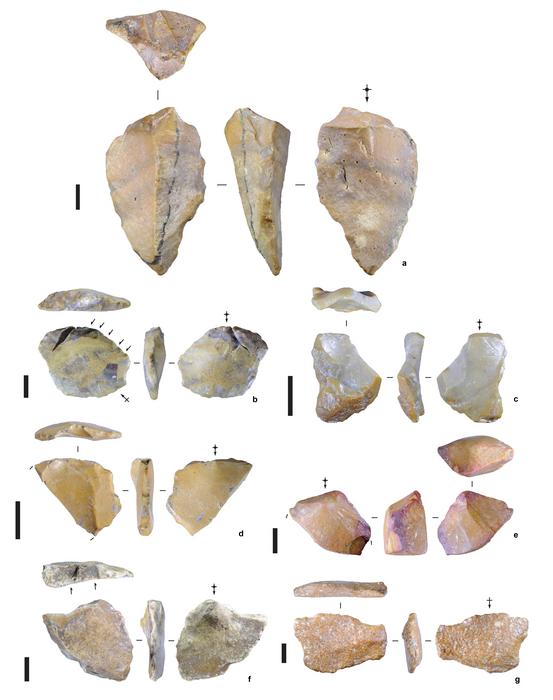
The tools excavated from Calio, Sulawesi. The scale bars are 10 mm. Credit: Credit: M.W. Moore/University of New England
The island of Luzon in the Philippines to the north also had evidence of hominins, from around 700,000 years ago, but what is still undiscovered is the people themselves. Evolution sometimes happens in parallel, sometimes it has to happen differently many times, as we know with the eye, and there are various forms of primitive humans currently known, we are the only ones who survived, but this could be another one. If evidence can be found.
There are tools, they were clearly there, and farther out after continents broke apart unique species evolved in isolation, but this was reachable.
Yet their identity remains a mystery. We do know something of their neighbors, though. Homo floresiensis (the ‘hobbit’) and subsequent 700,000-year-old fossils of a similar small-bodied hominin on Flores, mean it could have been Homo erectus that traveled the dangerous marine barrier between mainland Southeast Asia and this small Wallacean island and over the next hundreds of thousands of years underwent 'island dwarfism'.
This island is 12 times the size of Flores, at over 174,000 square kilometers it's the 11th largest island in the world, so it lacked the same environmental pressure. And that means we may again find something completely new.
“Sulawesi is a wild card – it’s like a mini-continent in itself,” says Professor Adam Brumm from Griffith University. “If hominins were cut off on this huge and ecologically rich island for a million years, would they have undergone the same evolutionary changes as the Flores hobbits? Or would something totally different have happened?”





Comments