

Banner
    New Tevatron Higgs Limits Got Worse, But The 115 GeV Excess Is Growing!
    By Tommaso Dorigo | November 19th 2009 02:44 PM | 34 comments | Print | E-mail | Track Comments
    About Tommaso

    I am an experimental particle physicist working with the CMS experiment at CERN. In my spare time I play chess, abuse the piano, and aim my dobson...

    View Tommaso's Profile

    It happens in the best families, so they say. Two experiments work 24/7 to produce an improved result on the Higgs search, and the result is disappointing, to say the least.

    I am talking about the Tevatron, of course. For a little while longer, CDF and D0 will have the exclusive on Higgs boson searches. Last March, we all rejoyced when we saw that the Tevatron was starting to become sensitive to a high-mass Higgs, and indeed it excluded its existence in a range of masses between 160 and 170 GeV. We were waiting for more exclusions for the winter conferences of 2010, when more data would be used to produce improved results. Instead, no improvement, but actually, a retractatio. How is that possible ??

    It so happens that the March 2009 results -an exclusion of the range 160-170 GeV of Higgs boson masses- had been produced by a downward fluctuation of backgrounds. Nothing strange, of course: when you are testing the existence of a tiny signal on top of a large background, a fluctuation one way or the other is bound to happen sooner or later. But what does feel strange is that the same data which had produced the downward fluctuation, increased by maybe 30% or 40%, now recedes and produces no exclusion: the added data have a fluctuation of the opposite sign, and results are now in line with expectations; and expectations, tragically, are that the Tevatron data is insufficient to exclude the 160-170 GeV region: indeed, the new result is a 95% C.L. exclusion only in the 163-166 GeV region, as the figure below shows.
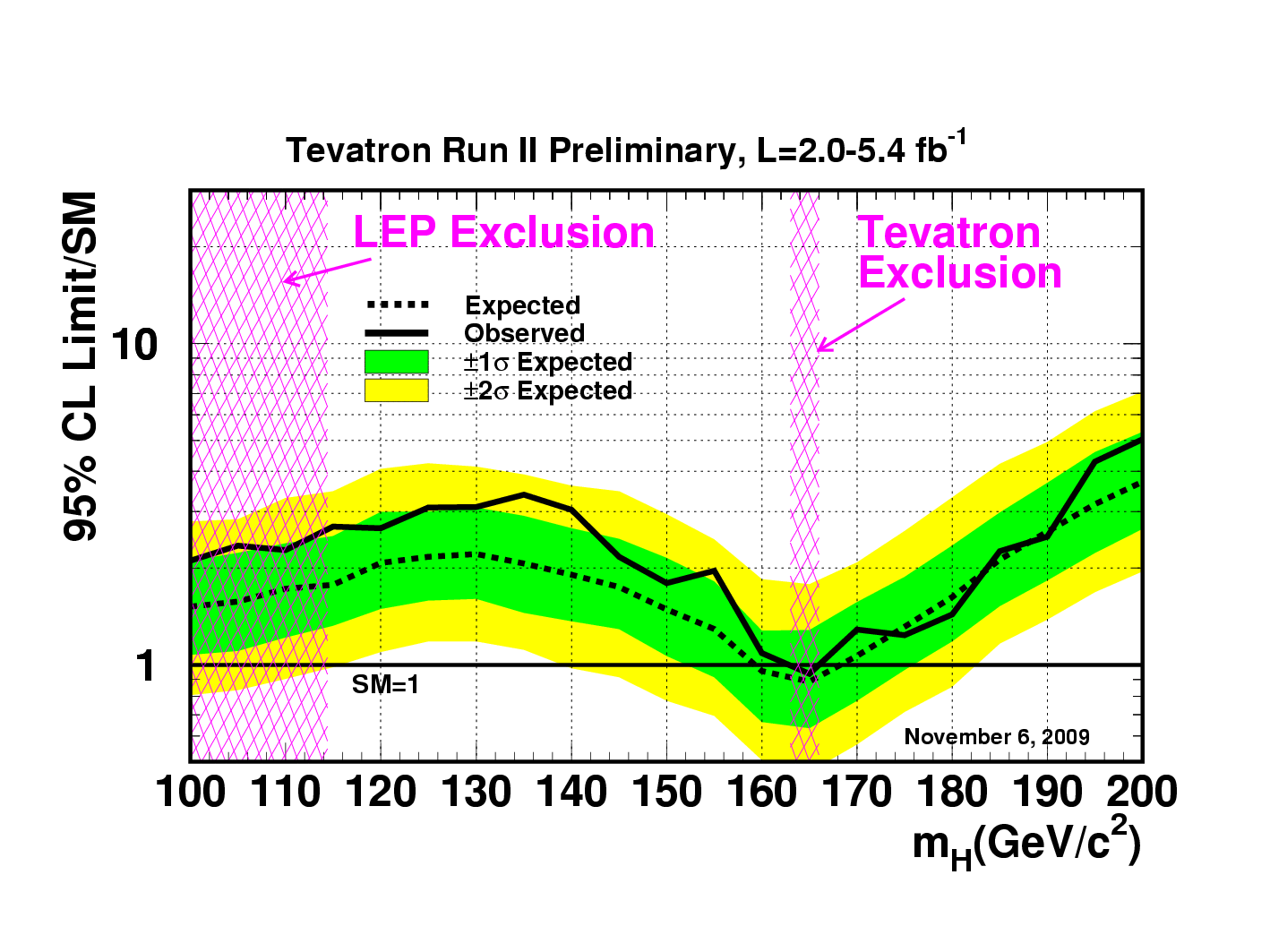


    So what should you get home, at the end of the day ? Is a 161 GeV Higgs still allowed ? Why something that had been declared dead last March is resurrected now ?


    The problem is not in the results of the Tevatron, of course, but in their interpretation. Last March, the data were showing that a 160-170 GeV Higgs was less than 1-in-20 likely, now, it is more likely, if only marginally. No xx% CL. limit can ever exclude with certainty anything: in fact, xx, if smaller than 100%, is just a degree of belief about how unlikely it is that the particle is in the excluded range. Still, it does feel strange to hear that the limit has shrunk.

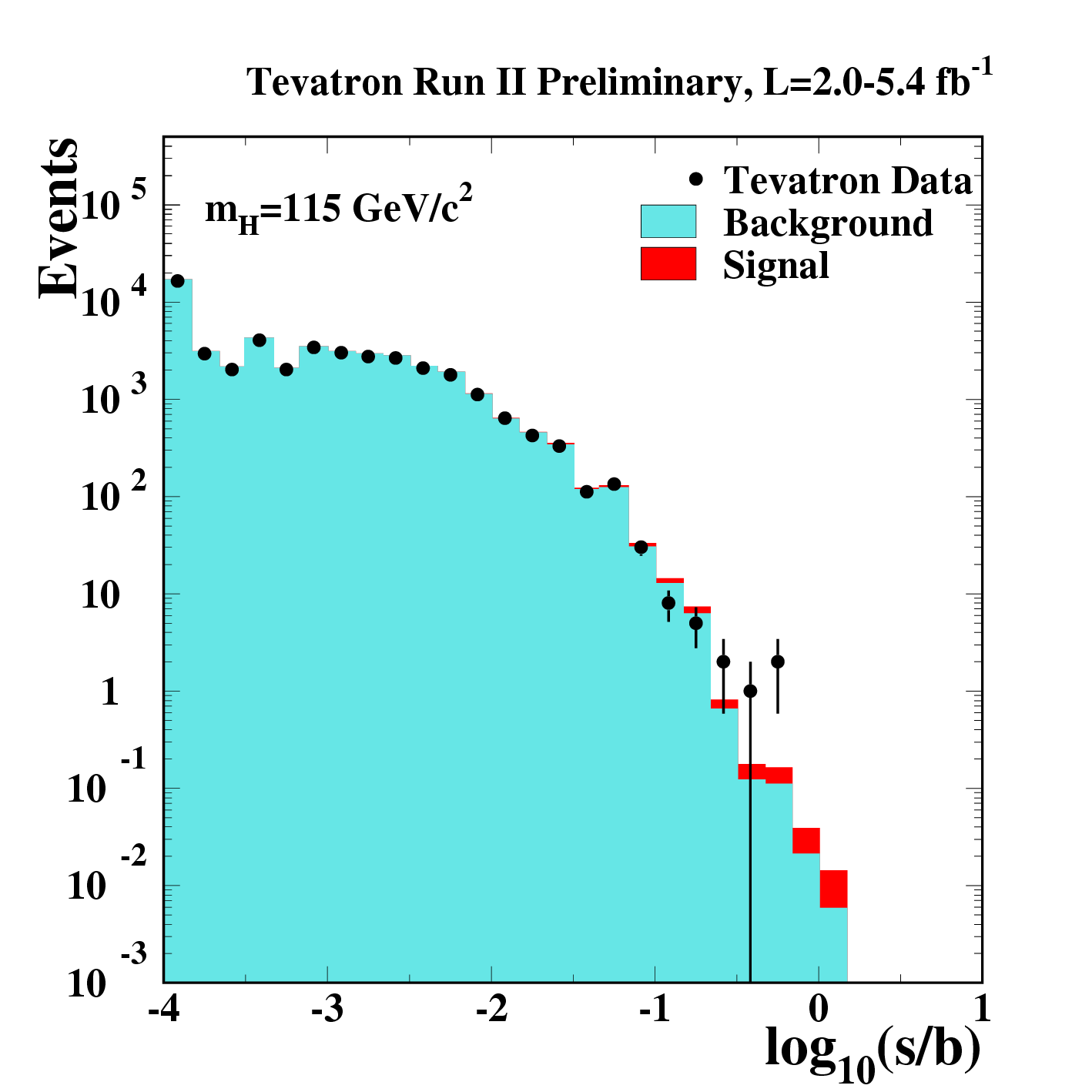
    Rather than feeling let down by the Tevatron, let us instead try and get excited about the chance that there is something going on at lower mass: in fact, the Tevatron is seeing a definite excess of events in Higgs searches geared towards a low Higgs mass: for 115 GeV, there is a just less than 2-sigma upward fluctuation of the data! Is this the first scent of Higgs we get to smell after the LEP2 1.7-sigma result of eight years ago ?


    Well, it is. Take a look at the picture below: there is an excess of events at the highest values of discriminant, in the searches for a light Higgs! And the excess is even more marked than if there was a standard model Higgs there!


    The result can best be discussed by having a close look at the Log-Likelihood ratio plot below, which shows what the Tevatron experiments should see if there was (black dots), or if there was no (red dots), Higgs boson. The discriminating variable on the vertical axis is a log-likelihood ratio, but you need not be concerned with its precise definition: let us just say it is a value which can tell apart the two hypotheses.

    The two curves are only mildly separated at low mass, where the Tevatron has limited sensitivity; they part significantly only at about 160 GeV, where indeed, if a Higgs was there, the CDF and D0 experiments would have seen it by now, at over two standard deviations significance. Instead, for 115 GeV the expectation for the two hypotheses are only separated by about one standard deviation. But the data (represented by the thick black line) not only agrees more with the signal+background hypothesis: it goes even further, showing to be even more signal-like than expected, for 115 GeV!
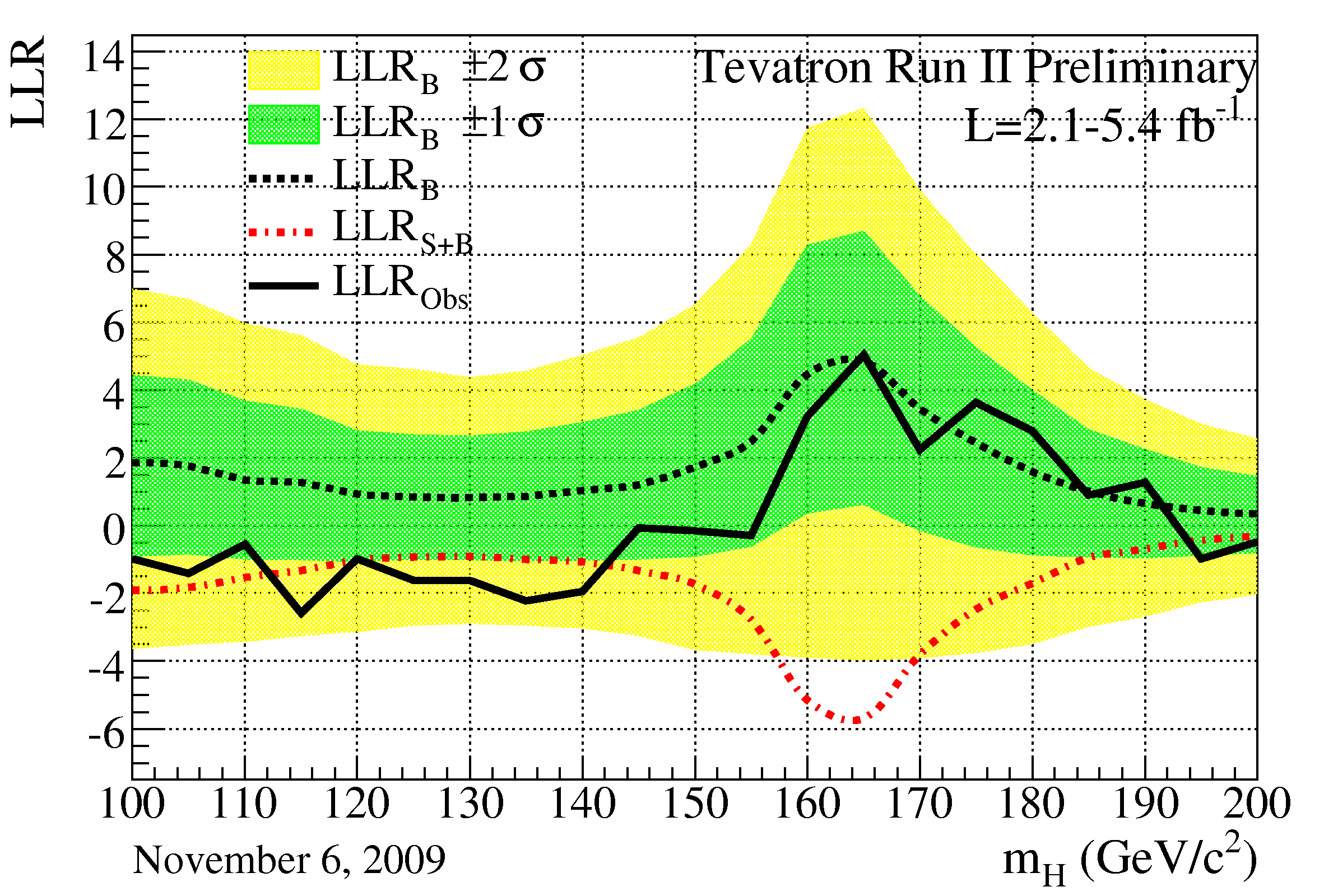

    In summary, the whole region 115-140 GeV is much more signal-like than it is background-like in the data that CDF and D0 are disclosing today. This might very well be the first indication that a Higgs boson is being produced at the Tevatron, if only in very small amounts, and that the signal is producing its first observable effects.

    I am blogging from a remote location with limited internet connectivity, so I have to stop this post here now; but you may well imagine that the new Tevatron results are definitely more exciting than disappointing: while the 160-170 GeV window of exclusion has shrunk, the 115 GeV abundance has become a definite excess, not yet significant but worth keeping a very close eye on! Expect a more careful discussion on this issue shortly.


    Comments

    Hfarmer
    Very interesting.  So if I understood correctly, what happened was the background noise changed, and this changed the signal you all had detected.  Kind of like tuning a tv in the old days, the picture could be crystal clear, until someone turned on a nearby vacuum cleaner and introduced more static.   The tevatrons luminosity ... the intensity of it's beams is not great enough, to generate enough events, to produce enough data, to filter out such fluctuations? 

    Forgive me if the above sounds incoherent.  The work of experimental particle physicist is mystifying to me.

    By the by your graphics aren't legible. :-)
    Science advances as much by mistakes as by plans.
    Whereas your graphics is legible perfectly... ;-)

    Hontas, they already have a bunch of data and now they are crunching it. The data is such that it is right on the border of a line such that if there was a Higgs with a mass in the 160 to 170 GeV range then a data set like they had looked at would have appeared less than one in twenty times. That is an arbitrary number that is used to say a region is "excluded". When more data was recently added to the analysed pile that less than 1 in 20 became just over 1 in 20 for the combined data, still almost the same very small change, but it crosses back over the arbitrary line. Basically this stuff still generally looks like what would be there with no Higgs with that value of Mass. It is just slightly less unlikely that there is a Higgs there.

    Similarly on the other side, in the range of 115-120 GeV a set of data that looks like this would appear only about 1 in 10 times or so (roughly, 2 sigma or so) if there was no Higgs with that mass. Thats sounds like a big signal, but really it isn't, it is complicated because of reasons Tommaso has and will likely explain again, but think of it this way, if we take 5 ranges of this size then even if there is no Higgs anywhere we are likely to have one of those ranges with this kind of look.

    So this is just slightly suggestive in that it is what it would look like if there is a Higgs there. So it doesn't rule anything in or out but is something to watch.

    step by step instructions for posting in word press
    http://twurl.nl/muaomh

    My gut feeling is there won't be a Higgs....

    tomaso,

    thanks for the nice post but your figures are unreadable (aspect ratio of 10:1 or so) - or is that just my browser?

    thanks again,

    chris

    Dorigo, Thanks for your prompt post on Tev combination. Can you elaborate on how the fluctuations occur in background and also how one understands where exactly the observed limit gets placed on the basis of these fluctuations. It is a bit confusing how the limit has shrunk down (at the same confidence level). Thanks in advance.

    dorigo
    Hello hep,

    well, the analysis is quite complicated because it includes many different results from two separate experiments. Let us imagine a single search in one experiment instead. Your Standard Model simulation of all background processes predict a certain shape for your "discriminant" variable, which is information distilled from the observed kinematics, tuned to separate as much as possible those backgrounds from a Higgs signal. Now, you compare the shape and normalization of the data on this discriminant to what you would expect from backgrounds, for example by performing a two-component fit, one component being the known backgrounds, the other the tentative signal. The fit returns the fraction of the data you may attribute to the signal. This is a number compatible with zero, or larger. Depending on its value, you end up putting an upper limit on the max number of signal events in the data. A background fluctuation may produce events which look like the signal, and in that case you will place a worse upper limit on the signal size.
    What happened is that with 4/fb last summer the experiments did not see a signal-like excess, but actually a dearth of events where the signal should populate the sample: they could  thus exclude a larger chunk of masses - 160 to 170 GeV - than they were expecting to exclude, on average. Now, with added statistics, the downward fluctuation in the signal region has been reduced, and observations are in line with expectations, so while the experimental sensitivity has improved sligthly (the hatched line in the first plot has gone down a bit), the observed line has came back up a bit, to match the expectation. So what was once excluded is now not excluded any more -but close to it.
    Hope that helps,
    Cheers,
    T. 
    Thanks again. So we have to take these limits with the utmost care. I guess it's good to know that we are improving our expected significance so that we are confident about our sensitivity of Higgs searches. I don't know what to make out of observed limits as it may keep on changing (or fluctuating) depending on our luck!

    Hi there,
    indeed the region between 115 and 140 GeV is much more interesting in the new Tevatron results than the
    one around 165 GeV. To me there are two relevant points here:

    1) The Tevatron analyses are done with higher and higher luminosities. Consequently, the line of the
    expected limit goes down. Once it crosses the 1-line the SM is ruled out for that MH value (as it happened
    around 165 GeV). The observed line, on the other hand, should show an upward fluctuation (which still is
    at the 1 sigma level). But it is exactly as strong as one would expect from a Higgs boson.
    One should keep in mind that also LEP saw exactly as many Higgs-like events as one could expect from
    a SM Higgs with MH = 116 GeV. LEP was just not sensitive enough for such high masses.

    2) Why does this upward fluctuation happen not for a single mass bin, but for the whole mass range from 115 to
    140 GeV? Is it because of the bad mass resolution? Is it because of correlations? Or is it because CDF and D0
    got some background wrong. The latter I doubt since many channels are going into this mass region.
    Tommaso: maybe you have a break down of this result to the various channels used by the two experiments?

    Cheers, Sven

    dorigo
    Hi Sven,

    concerning your question on point 2 above: of course, the Higgs mass resolution is not  good enough to make the points of the black line uncorrelated with one another. On the contrary: if a few events with mass of 120 GeV are in the data, they will bring the line down in a wide mass range. One should not forget that the plot shows a very misleading thing: it in fact answers twenty different questions at once, i.e. "what is the likelihood that the signal is in the data at a mass M=x?", for x = 110, 115, 120, ...
    No, I do not have a breakdown available as of now (am on vacation). Will look into that.
    Cheers, and see you soon.

    T.
    It takes me a little while to understand the second plot, which uses an very interesting way to present the result. What concerns me is that the bins around log10(s/b)~0 show data is not only "signal like", it's even higher than number of s+b events. May this simply suggest it should be an upward fluctuation that happens to 115GeV, given the small total number of events.

    dorigo
    Anon, there is an upward fluctuation of signal-like events in the 115 GeV searches, indeed. This does not mean much, since the total sensitivity of the Tevatron there is at the level of 1-sigma (see third plot, where you should look for the distance between hatched black and red curves, in units of the width of the green band).
    Cheers,
    T.
    dorigo
    Anon, there is an upward fluctuation of signal-like events in the 115 GeV searches, indeed. This does not mean much, since the total sensitivity of the Tevatron there is at the level of 1-sigma (see third plot, where you should look for the distance between hatched black and red curves, in units of the width of the green band).
    Cheers,
    T.
    dorigo
    And to all: sorry if I do not answer your questions in detail - am on vacation with very limited internet connectivity. Will resume detailed discussions next week.

    Cheers,
    T.
    First, thanks, for this posting, indeed it clarified things a lot for me. Just to make sure I really understand: where you wrote, "...if there was (black dots), or if there was no (red dots), Higgs boson", should be read the other way round, right?

    Interesting (even though I personally am sure Higgs boson does not exist ;) but I have one question, you say "The result can best be discussed by having a close look at the Log-Likelihood ratio plot below, which shows what the Tevatron experiments should see if there was (black dots), or if there was no (red dots), Higgs boson," but then on the plot red dots are marked as S+B and black as B and from your description I gather those stand for signal + background and background. Isn't that a mistake? Shouldn't the colors be exchanged in the first sentence quoted above?

    dorigo
    Yes, I stand corrected. Will modify the text when I have a chance. Cheers, T.
    Tommaso, you said in a reply to Sven:
    "... the Higgs mass resolution is not  good enough to make the points of the black line uncorrelated with one another ... if a few events with mass of 120 GeV are in the data, they will bring the line down in a wide mass range ...".

    The TEVNPH Working Group paper FERMILAB-CONF-09-557-E said:
    "... ... The sixth CDF channel is a new low dilepton mass ( m l+ l- ) channel, which accepts events with m l+ l- less than 16 GeV. This channel increases the sensitivity of the ... analyses at low mH, adding 10% additional acceptance at mH = 120 GeV. ...".

    Could the increase of acceptance at mH = 120 GeV account for the difference in the results between the March 2009 analysis and the November 2009 analysis ?

    Tony Smith

    dorigo
    Hi Tony, have not looked into the details yet, will let you know (am on vacations). Cheers, T.
    Hi,
    I have question about the luminosity used here.
    In the first two plots we see L=2.0-5.4 fb^-1.
    Does this mean that only data of the last 3.4 fb^-1 has been used? If yes, why? (if no, its confusing).
    In the former analysis of march 09 we had L=0.9-4.2, which would then imply that 3.3 fb^-1 were used, i.e. roughly the same as now.
    I know that 1fb^-1 now is more than before because you understand the machine better, but the new exclusion limits still look as if they used significantly more data.
    Cheers,
    Federico

    dorigo
    Hi Federico,
    no, 2-5 means that some analyses use 2/fb, others use 5.4, others still some other number in-between.
    Cheers,
    T.
    I don't understand why you call it the 115 GeV excess.

    dorigo
    Armonyous, please refer to the second figure in the post above.
    Of course, the same data produces an excess at large values of discriminant also for other hypothesized values of the Higgs mass; but things of course vary albeit slightly. The "excess" is just a silly fluctuation for now, but I must say I attach this one more weight than the dozen 2-sigma excess of supersymmetric particles we have seen in the past decade.The reason is simple: electroweak fits say the Higgs must be there, if the model is correct. While the "prior belief" for SUSY is zero virgola many zeroes, chez moi.
    Cheers,
    T.
    Tommaso,
    since the paper FERMILAB-CONF-09-557-E says that it has up to 4.8 fb-1 of data analyzed at CDF and up to 5.4 fb-1 at D0, and 4.8 + 5.4 = 10.2,
    it seems that our Strega bet criterion of
    "... when Fermilab analyses data going up to and including 10/fb ..."
    has been met,
    and
    since the two valleys in the March 2009 black LLR Obs curve pointing down around 130 GeV and 146 GeV
    now in November 2009 seem to be in a broad region including points at 135 GeV and 140 Gev
    and
    since 135 GeV is outside the Strega bet criterion of 130 +/- 3 GeV
    and
    since 140 GeV is outside the Strega bet criterion of 146 +/- 3 GeV

    I think that you win the Strega bet,
    so,
    while still on vacation, get a bottle of Strega
    and send me by email instructions on how to pay for it.

    Congratulations and Happy Vacation.

    Tony Smith

    dorigo
    Hi Tony,

    I object. The Tevatron's 10/fb criterion is 10/fb per experiment in my opinion, or at least that's how I perceived it...
    Of course I do not object to a drink for free either ;-)
    Cheers,
    T.
    If the Higgs does have a low mass, what are the features of the LHC that will make it better suited than the Tevatron for finding the Higgs? Will it have better luminosities or are their features of the detectors that are different?

    Let's see if I know! The LHC does have an advantage over the Tevatron for finding a high-mass Higgs, but not for low mass. The Tevatron looks for low-mass Higgs with the decay H -> b-bbar. However the background for this grows rapidly with energy, so the LHC is forced to rely instead on H -> photon pair or tau lepton pair. Consequently, low-mass Higgs are difficult for both colliders.

    dorigo
    Bill, good answer, although not complete.
    While it is true that backgrounds at LHC for the bb final state are much larger comparatively, the cross section for Higgs production is larger across the board by a few tens. In addition, the data LHC expects to collect is one order of magnitude larger than that at reach of the Tevatron, or larger. This means that LHC will eventually produce about a thousand times more Higgs bosons. This makes the LHC at advantage whatever the Higgs mass. But if the mass is light, it is going to take time, and more data, than what can be collected in one year or two of low-luminosity running.

    Cheers,
    T.
    Tommaso, I am happy for the Strega bet resolution to wait until
    "... The Tevatron;s 10/fb criterion ... 10/fb per experiment ..."
    is reached. When do you think that might be?

    In the meantime, I am very interested in whether the increase of acceptance in the sixth CDF channel for dilepton events around 120 GeV could account for the downward fluctuation in backgrounds from March 2009 to November 2009
    since, as you said, resolution is such that "a few events with mass 120 GeV" can "bring the line down in a wide mass range.

    Since, based on theoretical grounds, I have long been in favor of interpreting some 120-140 or so GeV dilepton events as a "light" state of T-quark,
    and
    since dilepton events in that range have been lurking around in various data sets going back to the days of Dalitz-Goldstein-Sliwa,
    I have particular personal interest in the situation.

    Tony Smith

    dorigo
    Hi Tony,
    I am away from office for a while longer, will get back to this issue later this week...
    Cheers,
    T.
    Tommaso, do you have any further thoughts about the increase (in November analysis over March analysis) of the acceptance for dilepton events around 120 GeV?

    Tony

    dorigo
    Hi Tony, have a look here: http://www-cdf.fnal.gov/physics/new/hdg//Results_files/results/combcdf_n...
    If you scroll down a bit from the top of the page, you will find the cross section limit of each of the contributing analyses by CDF that enter in the combination, with the integrated luminosity of each.

    It takes time to clearly pinpoint what was the increase of luminosity of each of these many different searches, but all the information is in the page (and in the corresponding one by Dzero).

    Cheers,
    T.
    Tommaso, thanks for the link to details about increases in acceptance etc,
    but
    already in public the TEVNPH Working Group paper FERMILAB-CONF-09-557-E (arXiv 0911.3930) has said:
    "... The sixth CDF channel is a new low dilepton mass ( m l+ l- ) channel, which accepts events with m l+ l- less than 16 GeV. This channel increases the sensitivity of the ... analyses at low mH, adding 10% additional acceptance at mH = 120 GeV. ...",
    and
    my question to you is:

    What is your opinion as to whether or not the increase of acceptance at mH = 120 GeV between the March 2009 and November 2009 analyses
    might account for the difference in the results between the March 2009 analysis and the November 2009 analysis,
    particularly
    in light of your statement in your comment reply to Sven:
    "... if a few events with mass of 120 GeV are in the data, they will bring the line down in a wide mass range ..."
    ?

    Tony Smith
