




The notitia criminis is a new search for resonances in the dielectron mass spectrum, recently published by the DZERO collaboration. The results of the DZERO analysis had a roller-coaster effect on me today. So, in the absence of other sources of excitements in the peaceful island from which I am currently blogging, let me try to convey the same sort of high I got from pondering on the new result -twice. Before going to the DZERO search, however, it is necessary to summarize an older result.
Prelude: The CDF 3.8-sigma bump
A search for resonances in the dielectron mass spectrum was carried out by CDF in 2.5 inverse femtobarns of proton-antiproton collisions last year.
(If the word "femtobarn" has you wondering whether you belong here, the answer is still yes: this post is for everybody -I do not intend to discuss much physics here. Inverse femtobarns are a perverse measurement unit to count collisions, and 2.5 of them amount to about two hundred trillion collisions. As for "dielectrons", it is a nickname for "electron-positron pairs". As for "resonances", well... Resonances are particles which exist for vanishingly short instants of time. Now read on.)
Such a search is one of the few things that are mandatory at a hadron collider experiment: when you select events with two high-energy electrons coming out of a proton-antiproton collision, you know you are looking for the crème de la crème of your data. A new particle heavier than the Z boson but otherwise behaving exactly like it would be very easy to spot in its electron-positron decay, because the signature is extremely clean: almost no physical process can fake a bump in the distribution, and -what is more important- all the nasty quantum chromodynamical processes involving quarks and gluons are automatically kicked out of the window, because they just cannot produce events with two electrons and nothing else around. Backgrounds are coming from weak interactions, and we know how to compute those pretty well.
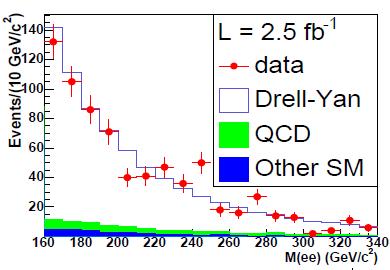 So what did CDF find ? They found something puzzling. Overall the mass distribution was very well modeled as the sum of the main contributing processes: essentially, just the process called "Drell-Yan", whereby a quark-antiquark pair annihilates into an electroweak mediator (a photon or a Z), which subsequently materialize the dielectron pair. However, a nagging excess was found for dielectron masses around 240 GeV. The tentative signal is shown in the plot on the right: a fluctuation of computed backgrounds was estimated to correspond to a statistical effect of 3.8 standard deviations -in more scientific terms, a pretty darn rare occurrence!
A careful study taking into account the fact that the signal could have appeared anywhere in the studied spectrum (a fact which decreases the rarity of the observation of a fluctuation happening somewhere) brought CDF to assess the probability of the fluctuation to 0.6%, thus slightly less than a "3-sigma evidence", but still quite intriguing. CDF has not yet updated this result by adding more of its data to the dielectron mass distribution this year, despite the fact that by now they should be sitting on twice as many events as those published. Whether you want to interpret this as a sign that the fluctuation is going away in the new data or whether instead you figure that something is cooking in CDF's kitchen, is up to you.
The new DZERO result
Meanwhile, CDF's cousin did not sit and watch. The competing experiment has now produced their own search for dielectron resonances using 3.6 inverse femtobarns of Run II data -over 40% more statistics than last year's CDF result. Unfortunately, while CDF considers both central and forward electrons in its study, DZERO only looks at pairs of electrons both landed in the central region of the detector: this reduces the acceptance significantly. Because of that, do not be surprised by seeing the DZERO histogram below being half as populated as the one of CDF shown above.
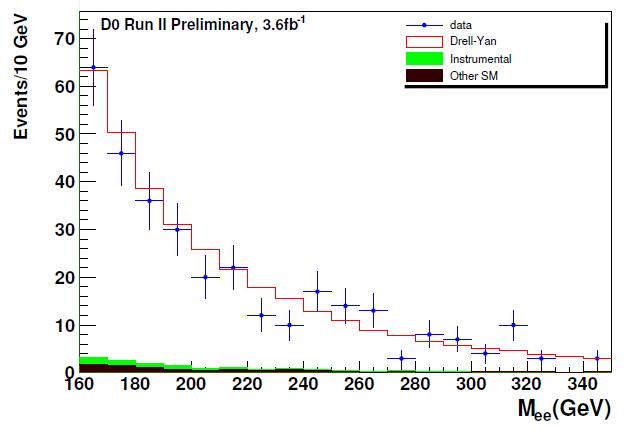
You can see in the distribution above that DZERO's dielectron sample is just as clean as the one produced by CDF (backgrounds other than the Drell-Yan process are represented by the black and green chickenshit lying at the bottom). The mass spectrum shown is the part which contains the region where CDF saw an excess last year (in fact, DZERO produced the graph explicitly to check the CDF signal). No big signal at 240 GeV is apparent, although some upward fluctuation is visible there. In their paper, DZERO address the issue:
"The search for high mass resonances decaying to di-electrons, conducted by CDF, using 2.5/fb of data, showed the largest discrepancy with the expected background at m_ee = 240 GeV. Figure 3 [the one shown above] shows our results for the region of the excess reported by CDF. Good agreement in that range between the data and the expected total background is observed."
Sure, but... How about the fact that at 240 GeV DZERO predicts they see 12.7 events (a number I desume from the plot) while they observe 17 ? The paper does not mention this, but the data is there to tell. Now, while it is of course true that 17 is compatible with 12.7 within statistics (and I am not even getting into a discussion on what is the uncertainty on that background prediction), it still is higher by 4.3 counts.
Fantasizing about a new resonance at 240 GeV
Now, let us crunch some numbers in a quick and dirty way, just for the sake of it. CDF has a smaller luminosity -2.5 against 3.6 inverse femtobarns- but a much larger acceptance thanks to forward electrons; however, we are not enabled, by the information in the released papers, to estimate correctly the ratios of efficiencies. What we can do is read off the effective cross section for Z production at the peak from the CDF and DZERO plots. One can see about 100,000 Z events in the 80-100 GeV region of the CDF plot, and about half as many are present in the same region of the DZERO data. Therefore, if a new Z-like signal produces 22.5 events of excess in the 240-250 GeV bin of the CDF mass distribution, as shown in the first figure shown above, we expect an excess of about 14 events above background in the DZERO plot at the same mass.
The "excess" of 4.3 events in the 240-250 GeV bin of the DZERO mass spectrum is thus rather underwhelming; however, imagine that a tentative new signal were predicted to produce 16 events in CDF and 8 in DZERO: a fluctuation of those counts to 22.5 and 4.3 would then look not at all that unlikely... Also, consider a subtlety here: if a new signal produced more forward electrons than the Z decay (such could be the case, for instance, if the resonance had different spin and decay properties), it would then appear much more strongly in the CDF data than in DZERO data, because DZERO would cut it out more with its central-electron requirement than what it does with the Z.
All in all, we cannot say much more about those numbers. What we can do, however, is to take the data and predicted background from the two experiments, and combine them in a single histogram: for once, they plot their data with the same binning! The result of this exercise, which -I should stress it here- is my own concoction and is not approved Tevatron material, is shown below.
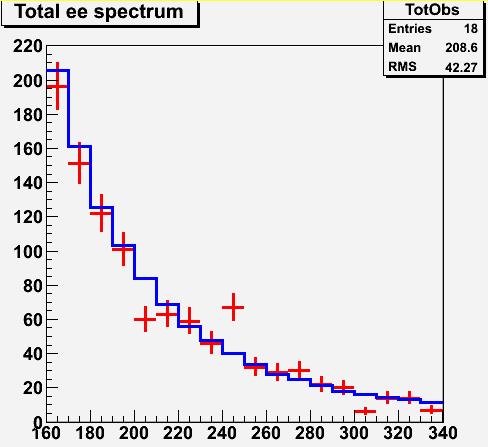
"Duh," I can almost hear you say, "anybody can add two numbers, so what is the reason of such a pedantic remark?". Well, Italians would say "I know my chicken": there are people in my experiment who even managed to make a fuss of my publishing here, a couple of years ago, a zoomed-in version of an approved plot (details are always obscene, I agree). And I do not want to upset anybody. The plot above is therefore "just for fun". Among the caveats of adding "two and two" in a carefree fashion I could list:
- the experimental resolution on the dielectron mass is (slightly) different in the two apparata, so it is not entirely appropriate to display events from the two experiments with the same binning;
- the angular acceptance is different, as already mentioned; other details also make the two datasets not strictly comparable (for instance, DZERO does not explicitly require the two electrons to have opposite charge; I am not sure, but I suspect that CDF enforces the requirement -I will find out and update this here);
- backgrounds are different, have different systematics, are normalized with different prescriptions;
and so on. But let us not be troubled by such details, since this article is not a rigorous analysis but a speculative piece. Let us instead get back to what my figure shows: you see that the addition of DZERO data on top of CDF ones sort of "smoothens" the distribution, leaving the 240 GeV point sticking out head and shoulders from the slowly falling background (smart-assed readers might also point out that a similar fluke, although a downward one, is present at 200 GeV, but let me go on). Is the significance of the 240-GeV bin larger now that we have increased the effective statistics by about 50% thanks to DZERO ? Well, yes and no.
Again, remember I am eyeballing here: CDF did a careful assessment of the significance of the excess in the region around 240 GeV, while here I just pick one single bin and compare with the claimed background. In the CDF plot we had 50 events at 240 GeV, on top of 27.5 expected from background sources. Neglecting everything else (neighboring bins, background uncertainty, "look elsewhere" effect), and using not more paper for the computation than the back of an envelope, one could say this was at most a (50-27.5)/sqrt(50) = 3.18 standard deviation effect. With the addition of the small excess seen in that bin by DZERO we instead now have (67-40.2)/sqrt(67)=3.27 standard deviations. Apparently, the effect has not gone away, as DZERO seemed to imply between the lines!
So, is there a new resonance at 240 GeV, decaying into electron-positron pairs? We do not know yet, but it is pretty clear that if it is anything real it is a rather elusive particle: among the half-a-dozen different theoretical models that predict the existence of a heavier partner of the Z boson (so-called Z-prime boson), all of them have been ruled out for masses below 600 to 800 GeV, as the DZERO plot shown below best illustrates.
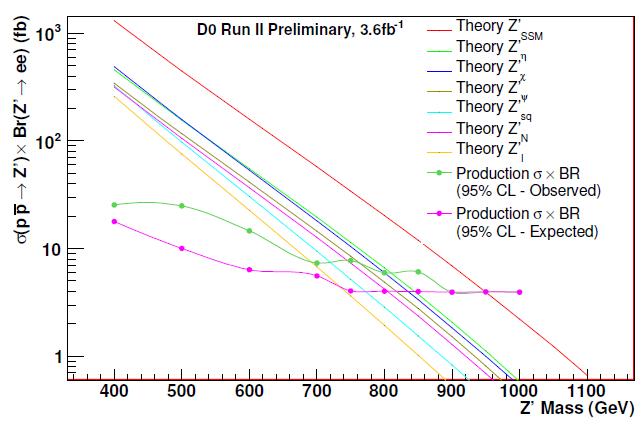
In the figure, you can see in different colors the expected rate of resonance events as a function of the resonance mass, for different Z' models. The green curve shows instead the upper limit extracted by the DZERO mass spectrum: as long as the limit is staying below the expected theoretical rates (which happens anywhere below 700 GeV for all models), the corresponding resonance masses are excluded.
One last note has to be made on the possible existence of a Z' resonance: it would be really, really strange that such a particle decayed to electrons and failed to decay to muon pairs too! Indeed, CDF did search for resonances in the dimuon invariant mass distribution last year, and they published a search which showed no hint of an excess anywhere in the spectrum. Check it out in the figure below, which displays the inverse of the invariant mass for muon pairs (a perversion justified by the fact that on this variable the resolution is constant across the horizontal axis, so the bin widths can be kept equal):
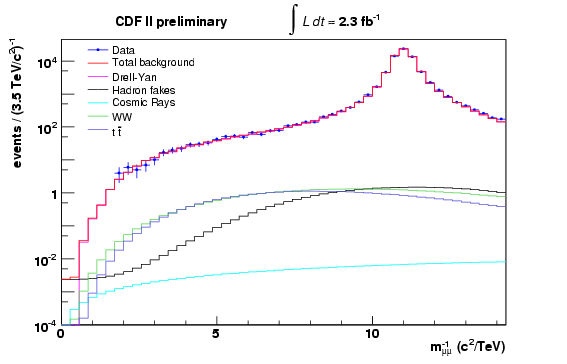
A resonance with a 240 GeV mass would show up as an excess at about 4/TeV in the plot -just above the fourth tick mark on the x axis-, but obviously the sum of all known processes and the observed counts match very well there, and everywhere else in the spectrum. Now, while this does not a priori kill the dielectron excess, it does cast a very serious doubt on its nature (or, for skeptics like me, it confirms expectations): lepton universality is at least as strong a dogma as the non-existence of heavy partners of the Z, so suggesting the existence of a heavy partner of the Z which also violated lepton universality, by choosing to decay only to electrons and never to muons, we would have a double-dare speculation. Too much for me, so I will archive the above high bin for what it is -a fluctuation.
Back to high again
Just as I thought my excitement for the new DZERO paper was placated by the exercise of adding up the bins of the two Tevatron experiments in the 240 GeV region, I noticed that DZERO spends quite some space at the end of their paper to discuss their highest-energy event, a beautiful dielectron explosion, whose estimated mass is 760 GeV. Below you can see a two-dimensional histogram showing the energy deposits due to the two electrons in the DZERO calorimeter, which for display purposes has been "rolled off" its azimuthal dimension. The height of each bar is proportional to the energy deposited there by particles produced in the collision.
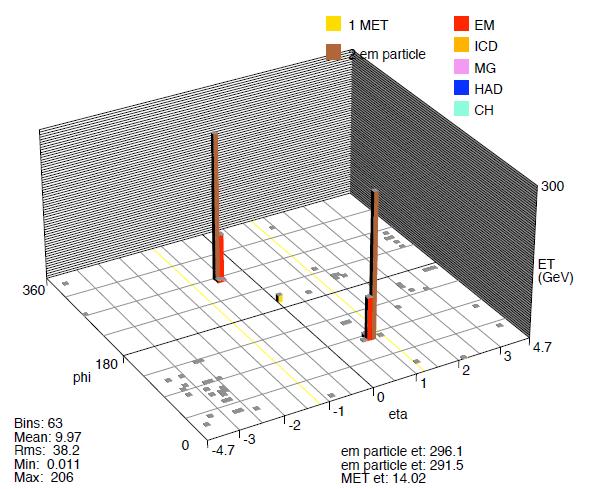
760 GeV is only an indicative value: the mass resolution of such high-energy electron pairs is of the order of 25 GeV, so this could quite likely be a 700 GeV or a 800 GeV particle decay, if it was a particle decay. This got me thinking. CDF has a few outliers at high mass in its dielectron mass spectrum too. Let me show the full mass distribution published last year by CDF below:
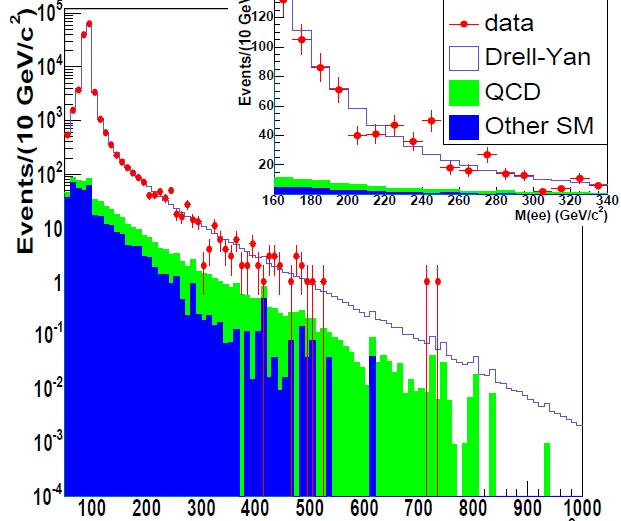
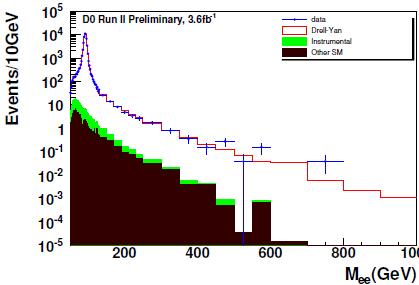 There are indeed two events with a mass above 700 GeV, in a region where backgrounds only predict at most half an event! What is more striking is that both CDF and DZERO have no events above 600 GeV except those three: for a full 100-GeV range of mass above 600 GeV backgrounds die out, and neither experiment sees anything; then, between 700 and 760 GeV, three events, and then nothing more again (see the DZERO high-mass distribution on the right). Is this not suggestive ? The 700-ish GeV "signal" cannot be easily dismissed by observing that the dimuon search of CDF saw nothing in that region, because dimuons were sought only in the central region of the detector, and with a smaller luminosity (2.3 inverse femtobarns): two events in the dielectron sample could well go hand in hand with zero events in the smaller dimuon sample, without the latter killing the former. All in all, I value this 700-GeV clustering as even more interesting than the 240 GeV "0.6%" effect produced last year by CDF.
Conclusions
I hope you have enjoyed this rather incorrect and scandalistic summary of the ongoing searches for Z' bosons going on at the Tevatron collider. Of course, when one searches for a bump in a mass distribution, things are very likely to get exciting at some point. Some experience in high-energy physics, however, dampens the enthusiasm for the elusive fluctuations that appear, and then disappear, here or there in the spectrum.
I think it is interesting to note, at the end of this rather long article, that if indeed a Z' boson of some kind exists and has a mass in the 700 GeV region, the Tevatron is risking big, for it could just fall short of catching it by the tail: such a Z' signal is in fact one of the sweetest dreams of the CMS and ATLAS experiments at the LHC, since it would show up almost instantaneously (well, sort of) in their data, as soon as the accelerator turned on. In that case, the Tevatron would be left biting the dust, and the tradition in high-energy physics that bosons are discovered in Europe would keep going strong!



Comments