

I've been busy with proposal work instead of Calliope. I have to fund this satellite somehow, and earning money writing corporate proposals is enjoyable work. Proposal writing is also a strange world. Whether for business, for government, or for grants alike, it's just not quite human.
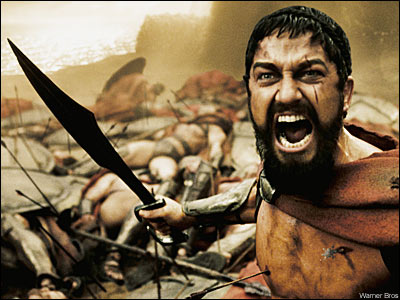
In face to face conversation, a deal is pretty simple. "I need you to defeat Henry V." 'We can do it-- we just bested the Persian Army.' "Deal!" But not so lucky in proposal world.
Response to customer Request for Proposal "Conquer England" by Spartans&Co.
Spartan&Co (Spartan) is a best-of-breed fighting force and best-fit match for the Phase 1 task in Conquering England (CE). CE as a whole is a task consisting of defeating the resident King, Henry V (Phase 1), then allowing an occupation force to occupy England in a power maintenance stance (Phase 2). We are specifically bidding on Phase 1, with the idea that the customer will choose an approprating teaming partner to complete Phase 2.
Spartan provides a small number/high yield field unit solution based on our experiences learned in our successful defeat of the Persian Army. We are well positioned to face larger forces by levering our superior tactical capability using our Pair Bond Management (PBM) to maintain high morale in all the expected combat situations. We present a Risk Table (Table 1-1-1) explaining how our approach eliminates or mitigates the risks experienced by the customer in previous CE awards.
Spartan offers to ship our troops, defeat Henry V, and await the arrival of the Phase 2 contractor to provide a seamless transition to occupation status. By using our small, cost-effective conquest approach method (CAM), the customer will achieve their CE goals on a quick timescale with minimal risk to your existing infrastructure, enabling you to succeed in your future England-based development plans.
Table 1-1-1: Risks and Mitigation
Risk: English weather often impedes progress.
Mitigated: Spartan forces travel light and are acclimated to difficult terrain, ensuring no weather delays.
Risk: English archers have good track record against conventional cavalry forces.
Mitigated: Spartan PBM focuses on rapid non-mounted forces to circumvent standard engagement defenses, reducing losses in a systematic and measureable way.
Risk: Hunchback traitors may know secret paths that provide ambush.
Mitigated: Lessons learned by Spartan enriched our culture of respect and diversity, mitigating the risk of defection and ensuring hunchback-related secrets are preferentially available to our own forces with no additional cost to customer.
Risk: Rain of arrows may blot out sun.
Mitigated: We will fight in the shade.
Alex
Launching Project Calliope, sponsored by Science 2.0, in 2011
News every Tuesday at The Satellite Diaries, every Friday at the Daytime Astronomer

In face to face conversation, a deal is pretty simple. "I need you to defeat Henry V." 'We can do it-- we just bested the Persian Army.' "Deal!" But not so lucky in proposal world.
Response to customer Request for Proposal "Conquer England" by Spartans&Co.
Spartan&Co (Spartan) is a best-of-breed fighting force and best-fit match for the Phase 1 task in Conquering England (CE). CE as a whole is a task consisting of defeating the resident King, Henry V (Phase 1), then allowing an occupation force to occupy England in a power maintenance stance (Phase 2). We are specifically bidding on Phase 1, with the idea that the customer will choose an approprating teaming partner to complete Phase 2.
Spartan provides a small number/high yield field unit solution based on our experiences learned in our successful defeat of the Persian Army. We are well positioned to face larger forces by levering our superior tactical capability using our Pair Bond Management (PBM) to maintain high morale in all the expected combat situations. We present a Risk Table (Table 1-1-1) explaining how our approach eliminates or mitigates the risks experienced by the customer in previous CE awards.
Spartan offers to ship our troops, defeat Henry V, and await the arrival of the Phase 2 contractor to provide a seamless transition to occupation status. By using our small, cost-effective conquest approach method (CAM), the customer will achieve their CE goals on a quick timescale with minimal risk to your existing infrastructure, enabling you to succeed in your future England-based development plans.
Table 1-1-1: Risks and Mitigation
Risk: English weather often impedes progress.
Mitigated: Spartan forces travel light and are acclimated to difficult terrain, ensuring no weather delays.
Risk: English archers have good track record against conventional cavalry forces.
Mitigated: Spartan PBM focuses on rapid non-mounted forces to circumvent standard engagement defenses, reducing losses in a systematic and measureable way.
Risk: Hunchback traitors may know secret paths that provide ambush.
Mitigated: Lessons learned by Spartan enriched our culture of respect and diversity, mitigating the risk of defection and ensuring hunchback-related secrets are preferentially available to our own forces with no additional cost to customer.
Risk: Rain of arrows may blot out sun.
Mitigated: We will fight in the shade.
AlexLaunching Project Calliope, sponsored by Science 2.0, in 2011
News every Tuesday at The Satellite Diaries, every Friday at the Daytime Astronomer





The authors proposal an ambitious strategy to Conquer England using a two phase approach. The plan is certainly at the cutting edge of conquest right now, and the track record of the authors is unquestioned. Despite this obvious strengths, there are numerous problems with their presentation and approach that deserve scrutiny.
First, there is no broader impact statement for this project. This is required for all NSF proposals. We can assume that the authors wish to profit from looting and pillaging a new country. However, why England? Wouldn't Denmark, Egypt, or Spain make better targets? The context of how this will become a self-sustaining enterprise are only tangentially mentioned, and the reasons for the deposing Henry V are not justified.
Second, the authors rely too heavily on their previous record and only have a outline the plan for actually conquering England. The Persians were very different than the English in both wartime capability and temperament. The transition between these two combat theaters is not clearly delineated.
Third, the risk analysis presented by the authors seems in sufficient considering the size and scope of the proposed operations. Although Hunchback traitors have proven to be a problem in previous projects, there is no indication that they would pose a similar risk in this operation. At the same time, the risks associated with a maritime operation or not even touched on. According to one reviewer, maritime operations could be a major issue, particularly if the English have learned the secrets of Greek fire.
Fourth, there is no data management plan for this proposal. This was of particular concern to one reviewer who believes the data generated found in Abbey's during the conquest will be considerable. Also, the data management plan is a required section for all proposals now.
Fifth, although funded proposals are listed in the "current and pending" section of the proposal, there is no paragraph describing how this work relates to the current work. This is also a required section of the proposal.
Finally, the reviewers do not believe that this proposal fits well in the National Science Foundation's Extragalactic Astrophysics Announcement of Opportunity. Despite the interest by the panel members in looting and pillaging, the panel feels it might be better suited for another program and recommend the authors resubmit there proposal to NASA.
Strengths:
1) Ambitious plan to conquer England, at the cutting edge of current conquests
2) Strong record of proposal team
Weaknesses
1) No context or justification for invasion
2) Ambiguous plans for sustaining the enterprise once it has begun
3) Insufficient risk analysis, particularly in maritime operations
4) No data management plan
5) No paragraph explaining the use of current funding in this context
6) Poor fit to NSF Extragalactic Astronomy program.
3.5/5.0 Good