

Banner
    Heteronormative Biases And Hermeneutic Phenomenology In Mass Effect 3
    By Hank Campbell | August 14th 2012 04:30 AM | 15 comments | Print | E-mail | Track Comments
    About Hank

    I'm the founder of Science 2.0® and co-author of "Science Left Behind".

    A wise man once said Darwin had the greatest idea anyone...

    View Hank's Profile
    This paper seeks to address hypermasculinity and the settled heteronormative value system embodied in public-policy actors, primarily the White-centered hegemonic masculinity that has created negative performative aspects of cultural identity constructions in this multicultural and globalized era.

    Basically I want to address the video game Mass Effect 3 and its scripting of heteronormativity, including heteronormative biases and hermeneutic phenomenology and I will use Butler's performativity and Foucault's concept of power/discourse to show how hegemonically masculine stereotypes could be creating a generation of 'virtual skinheads' and the critical role pedagogy can play.

    Okay, this isn't about that at all.  I mean, it could be, someone in the humanities somewhere followed along with those opening paragraphs and felt like something real was in there, but mostly this article got written because I was bored and wanted to play a video game, so I started one over and decided this time I would play a girl.  

    What I did find was that I acted a little differently, partly because I set out to play the game exactly the opposite of how I played the first time, right down to every bit of role-playing choices I had the option of making, and partly because it felt different to get a response when I looked like a woman instead of a man.

    In doing some basic research for this - and I didn't do much, those opening paragraphs took longer to write than the rest of this article - I discovered an interesting factoid; most people played a Soldier in Mass Effect 2 and 80% of the game played as males.  Now, 80% male does not surprise me.   A game like this 'looks' like an action shooter to me and women, for one reason or another, don't like those as much as men do and most men probably play as men.  But the game also has role-playing aspects so maybe by including females as choices they hoped to break into the female market.

    I never played Mass Effect 2 while others might have.  Judging by the cover of Mass Effect 3 it didn't look to be my kind of game (it looks somewhat like a Doom-style shooter and this is not 1993) but I rented it and then liked it enough to buy it.  But when I bought it, I did not start over so I had never noticed there were choices other than male soldier. In the beginning of a new game you are learning the interface and aliens in this case had wrecked the planet so I was in 'get something done' mode rather than thinking about how to play or who to be.

    So the second time through, rather than be a male soldier with a full-auto BFG I decided to play a woman with a brief invisibility cloak and a very slow-loading sniper rifle.  When I first played the game I needed to build a coalition among alien races, many of whom had warred many times, so my responses were always diplomatic.  This time, as a woman, I was blunt and abrasive and direct. Far more like the archetype of a soldier. What was interesting was that the same looks and responses from other soldiers I remember getting as a man were filtered differently when I was portraying a woman.

    My wife thinks this is some sort of enlightenment on my part; as if in middle age I am suddenly stepping outside myself to understand what it's like to be a woman.  I disagree; since character customization is built in, I made myself blazing hot to look at, so while I am playing I get to note how beautiful I am. Nothing transformative about that.
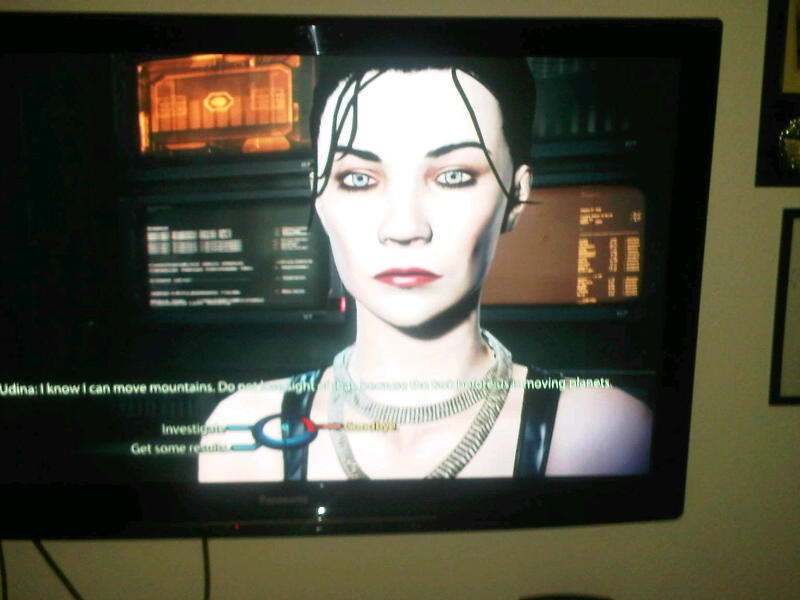

    In Mass Effect 3, my heteronormative, gender-insensitive. white-male-privileged, Victorian era puritanical sexual repression made me want to look as I think all women should look; like a sexy skeleton zombie.

    After playing this game with gender roles reversed, I have a new appreciation for women.  It is hard running around saving the universe in jewelry, a leather skirt and heels. While I remain a big fan of Fred Astaire, Ginger Rogers now wins that argument.

    Being a woman biotic also allowed me to notice things or get involved in things I don't remember bothering with as a male soldier.

    Here I am navigating an interspecies lesbian love triangle. You think gay marriage is complicated now?  The guy she is cheating on is a soldier off fighting to save the galaxy.  That's the most taboo part of the whole thing. Even in 2157, or whenever this takes place, you can't win culturally by dissing a soldier.
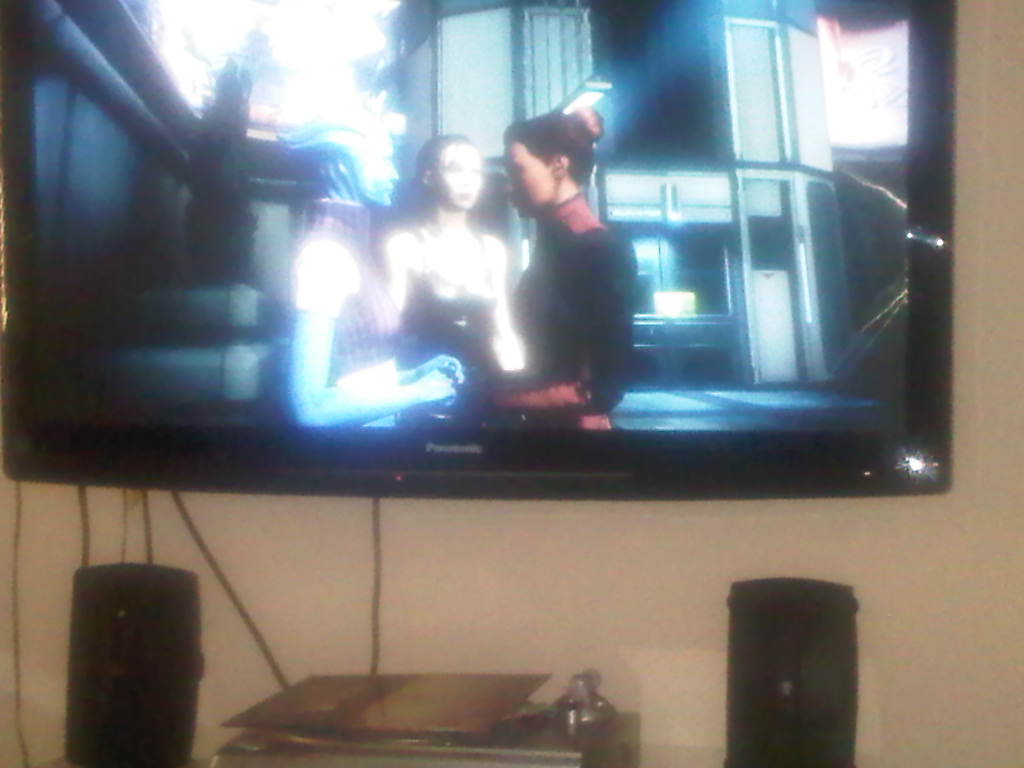

    Bonus: you can see I am too lazy to cut a hole in the wall behind the TV and then drill through a 2X4 to send the cables down to the receiver in the stand below.  Between those two small speakers is a turntable.  Double Bonus if you can deduce from this picture what 1980s album is on top of it.

    Actually, when it comes to heteronormativity, the Bioware people debunk it pretty well, at least regarding what I would have perceived about video games.  There is both a gay guy and a lesbian on the ship you control.  The pilot is having a romance with an AI.  The gay guy is even a macho Latino soldier, so they cover a lot of bases there.

    Did I get anything meaningful from my experience playing the game as a woman?  Not really, just the surprise that I perceived some things differently even though it was the exact same role, mannerisms and ability - I simply now had boobs.
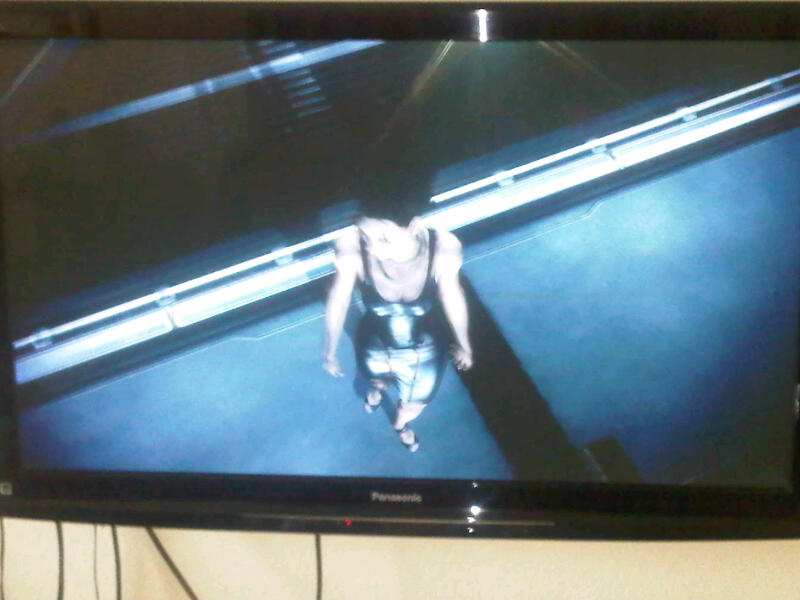

    Bonus: I can see down my own shirt.

    That's not to say there isn't value in stepping outside yourself once in a while, there certainly is. It is just hard to make anything meaningful from it, regardless of how I try to pretty those opening paragraphs into a deeper symbolism.


    Comments

    Warning: requires a Ph.D in Social Studies to decipher.

    At first I thought it had come out of the Postmodernism Generator.

    I'm still not so sure it didn't.

    Did you try to make a point with this article?

    Hank
    Don't be too hard on me or I will get it published in a peer-reviewed social science journal.
    Want more no-nonsense, independent science? Buy Science Left Behind
    The journal "Social Text" has a good reputation for publishing this sort of thing.

    Hank
    Did you at least like those first two paragraphs?  I spent a lot of time on those.  What is most nifty is it seems I can rearrange all of the jargon randomly and it makes just as much sense.
    Want more no-nonsense, independent science? Buy Science Left Behind
    Gerhard Adam
    Well, I can see that you aren't a professional, since you aren't using a legitimately scientific tool, so I thought I'd provide one for you [you bloody amateur].

    Here's an example of how to be "academically correct":
    "The epistemology of pop culture asks to be read as the politics of the gendered body"

    http://writing-program.uchicago.edu/toys/randomsentence/write-sentence.htm
    I thought you did a lovely job there.
    But you can save a lot of time with "The Postmodernism Generator"
    (http://www.elsewhere.org/pomo/)

    It created this for me (what's really fun is that I used the title from another essay it generated, and it's just fine) although spell-checker is struggling with a large number of the words:

    Reading Bataille: Neocapitalist cultural theory and the constructive paradigm of consensus
    W. Ludwig von Ludwig
    Department of Gender Politics, Stanford University
    Catherine G. K. Wilson
    Department of English, Carnegie-Mellon University

    “Sexual identity is used in the service of the status quo,” says Sartre; however, according to d’Erlette[1] , it is not so much sexual identity that is used in the service of the status quo, but rather the fatal flaw, and hence the meaninglessness, of sexual identity. The subject is contextualised into a patriarchialist posttextual theory that includes art as a paradox. But in La Dolce Vita, Fellini analyses preconceptual textual theory; in Amarcord he denies cultural desublimation.

    The primary theme of de Selby’s[2] critique of Marxist capitalism is the role of the reader as writer. Bataille uses the term ‘preconceptual textual theory’ to denote not, in fact, constructivism, but neoconstructivism. Thus, Derrida promotes the use of cultural desublimation to deconstruct sexism.

    Sartre uses the term ‘cultural theory’ to denote the stasis, and eventually the collapse, of predialectic class. In a sense, Lyotard suggests the use of preconceptual textual theory to read reality.

    Cultural situationism states that art is part of the rubicon of reality. It could be said that Foucault uses the term ‘neocapitalist theory’ to denote a mythopoetical totality.

    The main theme of the works of Rushdie is the futility, and thus the meaninglessness, of structural sexual identity. But Lyotard uses the term ‘preconceptual textual theory’ to denote a self-justifying whole.

    Lacan promotes the use of cultural desublimation to challenge the status quo. However, any number of narratives concerning not construction per se, but subconstruction may be discovered.
    2. Preconceptual textual theory and posttextual Marxism

    “Society is fundamentally unattainable,” says Derrida; however, according to Hanfkopf[3] , it is not so much society that is fundamentally unattainable, but rather the defining characteristic, and subsequent fatal flaw, of society. The example of cultural desublimation prevalent in Rushdie’s The Ground Beneath Her Feet emerges again in Midnight’s Children, although in a more semioticist sense. Therefore, the subject is interpolated into a posttextual Marxism that includes consciousness as a paradox.

    The characteristic theme of Humphrey’s[4] essay on cultural desublimation is the bridge between art and society. The premise of the cultural paradigm of narrative suggests that truth serves to reinforce class divisions, but only if narrativity is distinct from sexuality. In a sense, if preconceptual textual theory holds, the works of Rushdie are not postmodern.

    If one examines cultural desublimation, one is faced with a choice: either reject preconceptual textual theory or conclude that culture, paradoxically, has intrinsic meaning. Abian[5] states that we have to choose between cultural desublimation and the subcapitalist paradigm of context. But Baudrillard uses the term ‘constructivist precapitalist theory’ to denote the meaninglessness, and eventually the genre, of dialectic class.

    If preconceptual textual theory holds, we have to choose between subtextual nationalism and semioticist neocapitalist theory. Thus, Debord uses the term ‘preconceptual textual theory’ to denote the difference between sexual identity and art.

    Cultural desublimation implies that consciousness is used to disempower minorities, given that Sartre’s critique of preconceptual textual theory is invalid. It could be said that the primary theme of the works of Rushdie is the paradigm, and some would say the futility, of textual sexual identity.

    The subject is contextualised into a posttextual Marxism that includes language as a reality. Therefore, von Ludwig[6] holds that we have to choose between preconceptual textual theory and predeconstructive libertarianism.

    The premise of the dialectic paradigm of reality states that the significance of the observer is social comment. Thus, in The Moor’s Last Sigh, Rushdie reiterates posttextual Marxism; in Satanic Verses, although, he deconstructs neoconceptualist dialectic theory.
    3. Rushdie and preconceptual textual theory

    The main theme of Hamburger’s[7] model of cultural desublimation is the common ground between society and reality. If posttextual Marxism holds, we have to choose between cultural desublimation and the dialectic paradigm of consensus. But Foucault uses the term ‘preconceptual textual theory’ to denote the role of the artist as participant.

    In the works of Rushdie, a predominant concept is the distinction between within and without. The ground/figure distinction intrinsic to Rushdie’s The Moor’s Last Sigh is also evident in The Ground Beneath Her Feet. However, Marx uses the term ‘cultural desublimation’ to denote the failure of subtextual class.

    La Tournier[8] holds that the works of Rushdie are modernistic. Thus, Lacan’s critique of posttextual Marxism implies that sexuality serves to entrench hierarchy.

    If cultural desublimation holds, we have to choose between conceptual subcultural theory and dialectic capitalism. However, Bataille suggests the use of posttextual Marxism to modify and read society.

    Sartre uses the term ‘cultural desublimation’ to denote the role of the poet as participant. Thus, posttextual Marxism holds that class has objective value.

    1. d’Erlette, Z. P. ed. (1990) Feminism, the neocapitalist paradigm of consensus and preconceptual textual theory. Loompanics

    2. de Selby, H. P. O. (1975) The Paradigm of Society: Preconceptual textual theory in the works of Rushdie. University of Georgia Press

    3. Hanfkopf, N. U. ed. (1984) Preconceptual textual theory and cultural desublimation. O’Reilly & Associates

    4. Humphrey, H. R. S. (1998) Reading Bataille: Feminism, preconceptual textual theory and pretextual narrative. University of California Press

    5. Abian, B. ed. (1981) Cultural desublimation and preconceptual textual theory. Loompanics

    6. von Ludwig, F. L. R. (1979) The Discourse of Collapse: Preconceptual textual theory in the works of Lynch. University of North Carolina Press

    7. Hamburger, C. W. ed. (1998) Preconceptual textual theory and cultural desublimation. Schlangekraft

    8. la Tournier, V. (1987) Expressions of Fatal flaw: Cultural desublimation and preconceptual textual theory. And/Or Press

    Hank
    Wow, that thing is gold.  When I was a lad, we didn't have handy online postmodern gibberish generators, we had to read the actual literature...
    Want more no-nonsense, independent science? Buy Science Left Behind
    Dubious Virtue
    Students use to try these kind of essays with me. F - every time. They're pretty easy to spot.
    To be honest i got more out of the game playing as FemShep than as ManShep. After having been pommeled by gender stereotypes and white male "paragon" heroes, i found playing as a woman gave my character more gravity.
    Male heroes are just too cliche these days.

    Hank
    Maybe - I did find myself playing the male soldier by the numbers.  I actually just thought the lady was a much better voice actor so you might have a point; I may have rationalized she was a better actor to explain why I was doing it differently.
    Want more no-nonsense, independent science? Buy Science Left Behind
    That is a good point, I actually decided on a FemShep playthrough chiefly because I found Mark Meer's performance to be so... empty, maybe. I think also the detachment that comes from playing a female character as a male myself led to a more organically developed Shepherd; i didn't do what i would have done (or rather what i thought i would have done), i did what my Shepherd would have done. As a result i felt a much greater attachment to my Shepherd, i suppose it made the narrative more conventional, as though i were watching a film.

    Hank
    Taking a stand against people who look for solutions to problems that don't exist, and wrapping it in flowery jargon, is time-honored.  It would be unfair of us to assume that pretentious wanks are a modern phenomenon.  Today on Twitter I saw a link from Shawn Usher (Letters of Note), who dug up a bit from Flannery O'Connor asking a teacher to stop over-thinking her work:
    The interpretation of your ninety students and three teachers is fantastic and about as far from my intentions as it could get to be. If it were a legitimate interpretation, the story would be little more than a trick and its interest would be simply for abnormal psychology. I am not interested in abnormal psychology.
    and
    If teachers are in the habit of approaching a story as if it were a research problem for which any answer is believable so long as it is not obvious, then I think students will never learn to enjoy fiction.
    ...
    My tone is not meant to be obnoxious. I am in a state of shock.


    Want more no-nonsense, independent science? Buy Science Left Behind
    Hfarmer
    I know you wrote this in a somewhat less than serious manner. That said your experience in the video game is not that different from a real life transgender experience.  Provided, of course, one can look almost totally male or female after having been the opposite for a while.  
    The most interesting things aren't how I behave but how people behave towards me.  Truth be told, my behavior is what it has been as long as I can remember.  But other men and women think of what I do in a totally different way.  I am not familiar if this game is a MMORPG but if it is you will have noticed the same thing.   

    It is assumed I need help to carry things.  It is assumed I would know more about applying nail polish than calculus.  It is assumed that my opinions on fashion are more credible than my carefully worked out theories in physics.  

    It's just the way people are , we prejudge. 
    Science advances as much by mistakes as by plans.

