

Banner
    Uh Oh: Member Turnover And Diversity Essential For Online Communities
    By Hank Campbell | March 8th 2010 01:51 PM | 6 comments | Print | E-mail | Track Comments
    About Hank

    You've probably heard of Science 2.0® but never heard of me - "Oh, you're that guy" is the comment I get most frequently at a talk or conference...

    View Hank's Profile
    If you want to have staying power on the Internet, you need to have turnover, says a new analysis published in the Proceedings of the 2010 ACM conference on Computer supported cooperative work.

    Not only do you need to be 'heterogeneous', you need to be diverse.   

    Folks, we may be in trouble.   We only write about science and no one ever leaves which means we are doomed to fail.   Obviously you are wondering how it is possible to even study such a thing as an online community.   Something like 4Chan should not work at all, because it is complete chaos and a leftist Internet hate machine and everyone knows Republicans control all the media.  No study could have predicte 4Chan or there would be a lot of rich professors out there.

    But sometimes you have to pick a methodology and take your shot.   Daphne Raban of the University of Haifa, along with  Mihai Moldovan and Quentin Jones of the New Jersey Institute of Technology, did just that and set out to dispel belief that online communities could not be effectively studied so instead of focusing just on group size and activity, they established a metric with social characteristics, such as the group's homogeneity and heterogeneity - homogeneous when member turnover is small and the members who established the group are still the main members, while if the group has turnover and new members are continuously joining it, it is heterogeneous.   Whew.  New people join every day so we may be out of the woods.

    Here is the tricky part - the method.   They sampled 282 chat channels "born" in the same month - born being when at least three members had exchanged at least four messages in 20 minutes - and then followed them for 6 months and did a survival analysis.   A channel was considered "dead" when it had no activity for four weeks.

    They examined activity two hours after 'birth', the first day of activity, the first week of activity and the first two weeks of activity.  What they gathered was that member turnover was the key thing, not how many people posted comments or how many actual members it might have.  But turnover must mean different things to sociologists than it does to you and me.  I think of turnover as a corporate suit does - people lost and people replacing them.   They only mean people gained.

    So here is our 'turnover for the last three weeks:
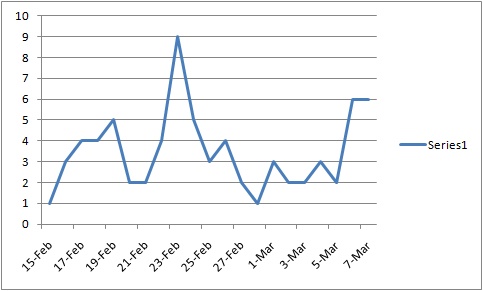


    So new people are 'in' every day but were there any people 'out'?   I have no idea.  Because people are not contracted writers they come and go and never actually 'leave'  - someone could be gone for a year and not write and that is no issue and when they come back they write just like they were here yesterday.

    It can't tell an outsider anything about our ability to survive, since most new members do not contribute content or even comment, membership just makes the articles and blogs easier to track and allows chat and other social things anonymous people cannot access.  Chat rooms may be more valid in that kind of study since the barrier to entry is much lower, though 4 weeks to be declared 'dead' seems awfully long.

    What might explain our success is the number of messages that are posted between members, which the researchers also regard as a good barometer - we are not talking at the audience, we are also part of the audience, and their analysis stated that the number of messages between members correlated to higher chances or survival.

    But if the ratio between the number of messages and the number of members remains the same after two weeks of the community's activity, the chances of "death" become higher.   Irregularity helps, it seems, and neither increasing ratio of messages between members nor decreasing made much difference. 

    "Prediction of an online community's survival chances cannot be based on quantitative data relating to the size of the group or even to its growth rate alone. A social predictor, on the other hand, can much better predict its chances," said Raban.

    So we may never be Facebook size but we aren't doing too badly either.

    Comments

    Mark Changizi

    Nice piece. And if SB became FB, then SB would be SB no more!

    Also, although there are community aspects to SB, it is not the paradigm example of a community. It's not quite club-like in the sense I thought they were considering. No?
    Another way of thinking about this study, as it relates to online education, is that online courses represent a homogenous group of people. If there are 35 students or 50 students taking a online course in sociology or biology, they are engage in discussions that relate specificially to the course material. All the while, brining in to the discussion outside source material and articles of interest with the reference to a hyperlink, as you have hyperlinked the 4Chan website. The individual reading the particular sentence with the hyperlink, can click on the hyperlink or even choose to ignor it while reading the presentation or discussion. As somethings may have meaning to the person who references an outside web source or link, the reading or moderator of an online class might know understand why the individual posted the specific link, if they don't explain what the purpose is in their writing.

    The same is true in the social networking areas, such as facebook. An individual can post a particular webpage or youtube video. Even so, the various friends may or may not be interested in the article or youtube video but then again they could be.

    Yet, Hank, even with the technology and individuals being able to share information across various platforms without a discussion the webpage itself may be vague or have no meaning to others. There are several purposes in posting or making a reference to another source on the web:

    1. Sharing information on some topic.
    2. Out of the multitude of people, some will have something to say. Hence, a brief dialogue occurs.
    3. If a dialogue does occur, then in sharing knowledge another topic may occur for further writing or creating a new article with new dialogue to occur.

    It is interesting that these metric are occuring because of the social aspects and measurements of online communication with people in various groups. Even in online courses, a student participation or viewing of course material is actually counted (time wise) spend in learning activities. How would a professor actually guage a students ability otherwise?

    In the larger sitting or online environment, we live in a Global Village where an individual can read what is occuring in London or Mexico City. That information in the social networking sites can be uploaded or "Share it" Facebook style with many individuals. It is a modern way for individuals who have simular interests or diverse interest to share with one another across physical distances and space of many years.

    Excellent article and thought provoking, thanks for the great discussion.

    adaptivecomplexity
    I don't get it. What's a channel in this context?
    Mike
    rychardemanne
    I've written for a number of online writing websites and, from what I've seen, there is a difference between having a community and feeling part of one. The layout of the site is important. Here at SB the Dashboard and Homepage have a lot of information on one page without feeling cluttered. I can see what's going on at a glance and can pick and choose what I'm interested in. This is in contrast to some sites where one has to make an effort to see what's going on as that info is on different pages. Hence my seemingly paradoxical statement that the site as a whole may be active but the individual (especially a new member) can feel isolated.

    The only thing I can't see at a glance are New Articles and New Blogs - maybe those tabs could be added to the What's Happening box. I know friends' new stuff is highlighted, which is good.

    People tend not to unsubscribe; they just drift away.

    I think the ambition is not to become Facebook but rather see similar traffic to Nature or New Scientist or Discovery or Scienceblogs (I know, the PZM-effect!) I've just joined but the bit of promotion I have done (and not just to my articles, although I have no way of measuring traffic to other writers on SB) seems to be paying off. Getting those links into SB is important in bringing fresh members. I had a look and under 30% of traffic comes from search engines, which means there are already good links coming in from other sources, but the sites linking in (about 1,500) are relatively few.

    So... do we have a target? Top 5,000 spot on Alexa? I know, am starting to sound like an SEO marketing salesman! A lot of SEO is BS, the rest is obvious. Just that doing the obvious also takes time, but works. Hank, if you'd like any help let me know - just glad to have found a science writing community.


    Hank
    Mike, a 'channel' is a chat room based on some sort of interest.  Dog grooming or traumatic insemination by paragenitals of African bat bugs or whatever.

    Richard, we absolutely do want help.   We show up well in Google because the contest is strong but anyone out there promoting their articles helps everyone else also.
    Tree

    New here, and 'testing the waters' still before I do a lot of inviting or linking.
     Feeling somewhat uncomfortable here, due to how others (members) would treat someone with a GED vs. PhD being on this site (something I'd consider a natural negitive response among "some" and that may be enough for me to loose interest in coming back).

      I do agree with Rycharde, SEO work on sites does pay off, but only as part of an integrated whole part of SEO. I tend to devise SEO formulas for my clients, based on competitive sites for their terms.

    Some of this may be basic, but stating in case it is not:

     Incoming links for the sake of incoming links is not good SEO, some can 'drop' your site for its term(s) they need to be quality links (4+PR), topic orientated sites, good use of keywords for the anchor text, and the list goes on, but I've often had little issue (getting #1 for high comp. terms) with even a few "quality" links, if the content is good and page titles and content match, if the page are indexed, and much of that tends to be software and site architecture related. Even great sites, can have 90% of SEO right, but even a few key things wrong, set the sites below 1000 in Google, even with great content, great links, still paying PPC because 5 or less percent of the SEO items are doing damage not good.

    A good place for referance, is the google patents.

    If I am here for the "diversity" interest, I dont know yet how much I'm willing to contribute, until I understand the atmosphere here better. Not that I dont feel I have something of value to contribute, when College Professors come here from the east coast, pay me for my time just to talk to me and keep smiling at me calling me "Teacher", when I did not ask for any of that, but only wanted to share things I've learned. If not for things like that, I'd just be doing what I do here most, reading, gathering data I'm looking for to upgrade some computer programs for climatology and some other areas of special interest to me.

    ( Climatology: My neighboring property owner on my mountain is Will Steger, he was among those to get the ice core samples Al Gore used the resulting graph of. I had it well before Al Gore. I write programs and have been doing that for decades inclusive of climate programs).

    Sorry if I act a bit uneasy while I test the waters, but I still tend to view humanity from a distance, like a wild animal does, and about as uneasy at times as a wild animal would be in a city.
    Partially raised by wolves, is not said, figuratively. And sometimes if tense I'm sure its going to show in my writing, and not something I want to do, I'd rather someplace I feel more comfortable I'm (and topics/posts) not going to be attacked. Reason for being here is knowing what I have to offer, and this place by description is where it most belongs. Even if sometimes that means also seeing humans quite differently, like through the eyes of a wolf.

    What is known is so much less than there is to know, and to that precise extent, I understand that to many here, I am going to be less, that who I truly am.

    Best of intentions and wishes for success.
    Tree


    Add a comment

    The content of this field is kept private and will not be shown publicly.
    • Allowed HTML tags: <sup> <sub> <a> <em> <strong> <center> <cite><TH><ul> <ol> <li> <dl> <dt> <dd> <img> <br> <p> <blockquote> <strike> <object> <param> <embed> <del> <pre> <b> <i> <table> <tbody> <div> <tr> <td> <h1> <h2> <h3> <h4> <h5> <h6> <hr> <iframe><u><font>
    • Web page addresses and e-mail addresses turn into links automatically.
    CAPTCHA
    If you register, you will never be bothered to prove you are human again. And you get a real editor toolbar to use instead of this HTML thing that wards off spam bots.


