Fake Banner
Environmentalists, What Are You Asking From Dedmoroz Lenin For Earth Day This Year?

Tomorrow is Earth Day. It is also Lenin's birthday. That's not coincidence. The leader of...
How Ancel Keys Went From MAHA Hero To MAHA Villain

If a lot of the food and health claims you read and hear today seem like things left over from...
Are Baseball Pitchers Faster Today?

On September 7, 1974, pitching for the California Angels, Nolan Ryan, known for his velocity, became...

Ground-Nesting Bee Populations Don't Get Publicity But They're Everywhere

Honeybees get attention in environmental fundraising campaigns because people don't understand...

User picture.
picture for Tommaso Dorigopicture for Heidi Hendersonpicture for Fred Phillipspicture for picture for Hontas Farmerpicture for Atreyee Bhattacharya
Hank CampbellRSS Feed of this column.

I founded Science 2.0® in 2006 and since then it has become the world's largest independent science communications site, with over 300,000,000 direct readers and reach approaching one billion. Read More »

Blogroll
If you've watched any World Cup matches at all (and statistically, if you have not, you are not reading this article) you have been aware of an omnipresent drone in the background - and you might believe it is the biggest swarm of mutant bees you ever imagined or perhaps South Africa's revenge for Apartheid-based boycotts in the 1980s.  

Instead, it is a horn South African fans like to use.  They call it a vuvuzela - I call it a B flat plastic trumpet from hell.   And I am not alone.   
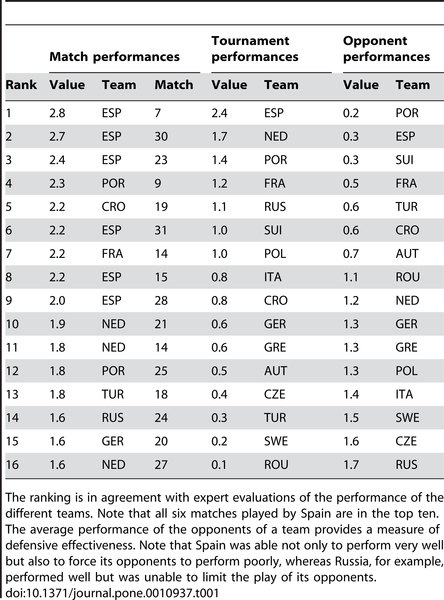
In team sports it is often difficult to determine the value of an individual.   Some sports can do it easily enough, like baseball(1) or basketball, but during the World Cup, casual fans who hear commentators talk about the quality 'form' of a player are lost when the game is 0-0.

Jordi Duch, Joshua S. Waitzman and Luís A. Nunes Amaral of Northwestern University say they may have an answer.  
I have nothing against BP.  BP was our biggest advertiser last year.  I think BP is generally one oil company that generally cares about the future of energy and reasonable use of the planet's resources.

But it must be at the VP level and down that people have a clue.  Because at the top they are Klondike Kops.

BP chairman Carl-Henric Svanberg, not learning any lesson at all from Tony ("I want my life back") Hayward's many public relations misfires, decided to rescue his company's reputation by responding to a reporter about President Obama's comments that BP should "keep in mind those individuals, that they are desperate, may lose business that have been in their families for two or three generations" by saying ...

"We care about the small people." 
People who have been around a long time know the somewhat convoluted history of Science 2.0 in general and Scientific Blogging in specific but the top question I get after people say, "Oh, you're that guy!" is "Why did you call it Scientific Blogging?"

Why not Science 2.0?   Well, there's a practical reason and a philosophical one.  The practical reason is that the way domain names work it isn't really possible.   In order to make Science2.0.com I would have to make Science2 a subdomain of 0.com and that has been in existence since 1985.   Yes, 1985, well before Tim Berners-Lee blessed us with an elegant way to make a World Wide Web.  VeriSign owns it and they are unlikely to give it to me.
Extinction is nothing new; more than 99% of all species that have ever lived we will never know about.  Extinction is entirely natural and, if you've ever watched someone's car weaving on the highway while they talk on the phone and drink a coffee, you have probably hoped it will remain a fundamental process of evolution.

But survival of the fitter(1) can be a fickle mistress.  Why, after 800,000 years of successful survival did the Hundsheim rhino (Stephanorhinus hundsheimensis) suddenly and irrecoverably disappear?
It's no secret social media is big - every marketing group latches on to the latest fad (even us - we gots the Tweetypages, we gots the Faceyspaceys) and people are using it more and more.   But in the recent past, for many the Internet was just another way to get 'traditional' news, preferably for free.