

Consider three physicists: Feynman, Weinberg, and Hawking.
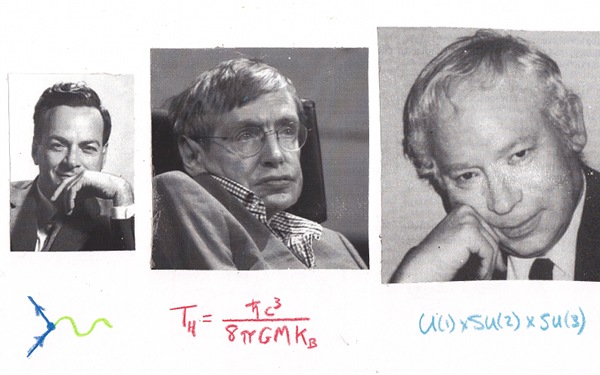
All are so far better in depth and breadth of their understanding of general relativity and quantum field theory than you are I (in particular) will ever be. They devoted much effort toward this goal but have yet to resolve the gap.
Here are five possibilities for the chasm that remains despite diligent work on the subject:
1. GR and QFT are right. A new bridge must be constructed between the two.
2. GR is wrong or incomplete and QFT is right. A new theory for gravity is needed that shares a long list of properties with GR.
3. GR is correct and QFT is wrong or incomplete. A new theory for atomic processes is needed that shares a considerably longer list of constraints put in place by QED and QCD.
4. GR and QFT are wrong or incomplete in the scientific sense of needing to be replaced by proposals that are only ever so slightly better in specific technical situations than GR or QFT.
5. Other than the above, because right or wrong does not feel like the right way to characterize the issues between GR and QFT.
Please feel free to cite the numbers in the comments. Where would one place work on strings? Loop quantum gravity? Non-commutative geometry?
A two strike rule is in place for those who wish to claim they have figured out everything already. I would prefer that if you are of that opinion of your work, you should sign up and start blogging at Science20.com. That's what I did and now I don't have a theory on the table, which is better than selling t-shirts that are wrong.
Doug
Next Monday/Tuesday: 4-Parameter Analytic Animations, Solid Man





One of the best things to come out of my collection of retractions is an appreciation of how any proposal to replace GR has to be absurdly close as a metric theory - something I knew from working through Taylor and Wheeler's two books on Special Relativity and Exploring Black Holes - but also must be absurdly close to the linear theory known as gravitomagnetism. I can see spending a few months fishing for a different Lagrangian that ends up at the same field equations. The nice thing about such a quixotic quest is a Mathematica notebook can tether the work to the real world.
I know Feynman was not a happy camper about the process of regularization and renormalization. There are too many constraints to propose something like QED is wrong. Instead, it might be incomplete in the following way. There is an emphasis in physics on symmetries. Perhaps we need to strike a balance between symmetries and conserved things with things that don't have nice symmetries and are not conserved. A complete set of equations has those terms that are conserved and those that are not. The first equation I ever looked at constructed with quaternions had that property, the square of a quaternion:
The first term is the Lorentz invariant interval of special relativity fame. The other three terms are, what, quaternion detritus? [My dad was a fan of fancy word choices, in this case detritus "is rubble or debris and detrition is erosion by friction"]. I have derived the Schrödinger equation, the Klein-Gordon equation, and the Dirac equation, each time generating extra quaternion debris. There might be platinum it those equations-with-no-names, but I am well aware of the limits of my skills to extract such works.