Banner
    The Ontology of Quaternions as an 8 Dimensional [Proto-]Vector Space
    By Doug Sweetser | June 25th 2012 10:42 PM | 116 comments | Print | E-mail | Track Comments
    About Doug

    Trying to be a semi-pro amateur physicist (yes I accept special relativity is right!). I _had_ my own effort to unify gravity with other forces in...

    View Doug's Profile
    [I changed the title of this blog to prepend Proto to vector space since a vector space is defined over a mathematical field.  While I explored the possibility that the positive real numbers might make up a mathematical field, that effort did not pan out.  In a subsequent blog, I will show how many properties of a vector space are shared by the positive real numbers over the group Z2.]


    My research quest is to understand the nature of quaternions and how much of their structure is reflected in physics.  This blog will tell the tale of how I fooled myself three different ways on this journey.  My resolution of these particular problems struck me by surprise.  Ontology is a fancy word for why.  Hopefully I can show that physics makes the odd math reasonable.

    A Fool for History

    A quaternion as defined in the King James version of the Bible (Acts 12:4, whatever that means), is four Roman soldiers.  Four biblical quaternions were sent to bring Saint Peter to be crucified, a bit of history I missed in my church going days.  Quaternions and crucifixion go together, how ironic.  I inherited a bit of numerology about quaternions, that they should involve four numbers.  Before blogging at Science 2.0, I created a clay and pipe cleaner model of quaternion multiplication:
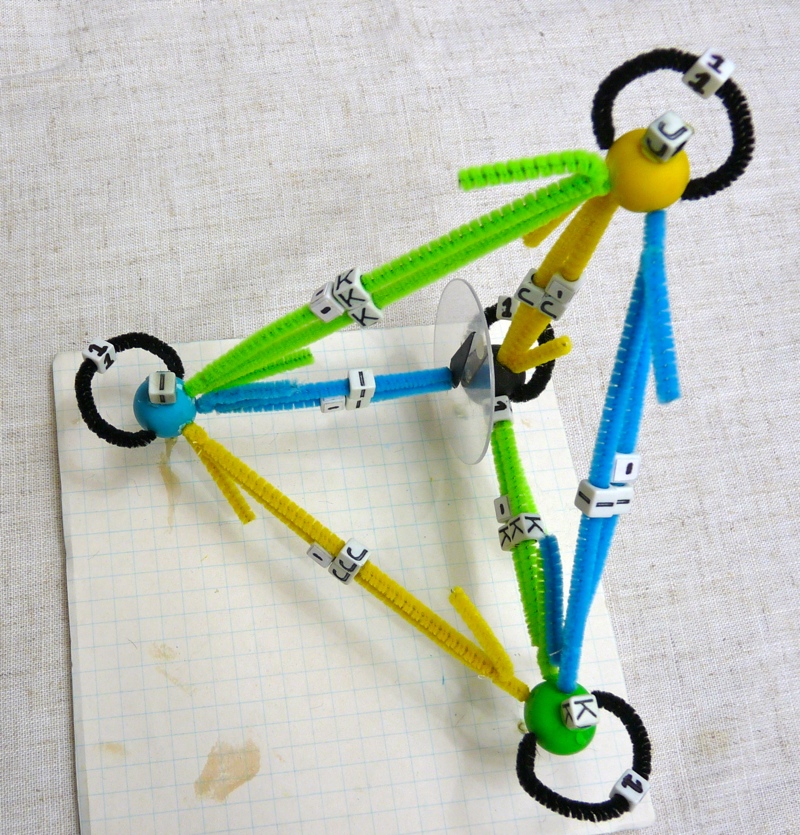
    My second blog here on March 14, 2011 featured a discussion of this graph.  I thought this graph represented all the ways to form quaternion products.

    Eleven months later, David Halliday pointed out that the model was not up to the task:
    It may help you to recognize that the picture on the left is not a representation of Q8—or any group, for that matter.

    If you actually want to make a model of Q8 you will need eight (8) balls (nodes).  Using the vertices of a cube, for the eight elements of Q8, where you have two concentric tetrahedra inscribed within the cube (in the two possible orientations for such), you will have connections through the major diagonal (multiplication by -1), connections through the diagonals of the faces of the cube, and connections along the edges of the cube (and loops at each vertex for multiplication by the identity).
    No matter how many times I re-read the critique, it always sounded right.  My toy model was too small to do the job.

    It took one month and $225 to construct the upgrade:

    Another five revisions were required before I could say that I was confident that the cube was a physically accurate representation of the quaternion group Q8.  I got the message about quaternions and eight.  Not really.

    A Fool Falls in the Woods Without Making a Sound

    I announce the new and improved model for quaternion multiplication in March, 2012 , a year after blog #2.  This line was in the first paragraph:
    A few months ago, David Halliday and I started talking about the finite group Q8, which over the real numbers becomes the quaternions.
    This sounded reasonable to my ear.  The real numbers are the simplest mathematical field I am aware of where one can do calculus.  The basis elements of Q8 are easy enough to list:


    Here the e's are general.  To be honest, I gravitate to (1, -1, i, -i, j, -j, k, -k).  Consider the basis vector e0 over the real numbers.  It can represent everything that the basis vector -e0 can over the real numbers, with no exceptions.  If I demand that the basis vectors are linearly independent, I am obligated to avoid the real numbers.  Just to check I was using the correct lingo, I looked it up:
    In linear algebra, a family of vectors is linearly independent if none of them can be written as a linear combination of finitely many other vectors in the collection. A family of vectors which is not linearly independent is called linearly dependent.
    The family of 8 vectors is linearly dependent over the real numbers, but linearly independent over the positive real numbers.

    To be a vector, one must be able to add them and multiply by a scalar.  Adding them up is straightforward.  What is questionable is multiplying by a negative scalar.  Since every plus becomes a minus and visa versa, this should be fine.  Just a bit odd.

    The New Idea Fool

    I felt a need to work over the positive real numbers and zero so a vector with a basis of +e0 would be different from one with a basis of -e0.  The positive real numbers (without 0) with the multiplication operator form a group:
    1. One member times another always creates a third (2*3=6).
    2. There is an identity element (1).
    3. Every member has an inverse (8 * ⅛ = 1).
    4. Products are associative ( 2 * (3 * 4) = (2 * 3) * 4)
    The problem is with the addition operator over the positive real numbers and zero.  It is manifestly obvious that the additive inverse does not exist.  All the additive inverses are in the set of negative real numbers.

    Many people give up after spotting one manifestly obvious problem.  This is where the fun begins for me.  Is there any way to make things work?  Multiplication as repetitive addition was suppose to be the difficult case.  My initial tries in the comments section failed to pass the associative property needed by groups.

    This raised a question for me: what does the associative property do?  In evaluating any expression, there can be several orders of operation.  For example:


    means a adds to b first, then sum that with c.  While


    indicates that b adds to c first, then sum that with a.  The associative property says these must be equal:


    This certainly is a nice property, one I have used since my first days with algebra.  Yet, is it necessary?  Imagine doing algebra where parentheses were not allowed, ever.  Could you proceed?  It can be done with a rule that one works left to right.  Banishing parentheses makes associative and distributive laws moot.  It is a tautology that:


    but a question remains open if:


    With addition, both sides are the same.  But addition will not have any additive inverses in the set of positive real numbers.

    This is where I turned to physics in order to step outside the box.  A photon not only is a particle, but it is its own antiparticle.  Could I cook up a scheme where a number was its own additive inverse?  That could be done by treating addition, the "+", more abstractly.  It is just a binary operator after all.  To George Orwell's slogans: "WAR IS PEACE", "FREEDOM IS SLAVERY", and "IGNORANCE IS STRENGTH", I add my own: "PLUS IS MINUS".  With the Orwellian plus, every number is its Orwellian additive inverse.

    The Orwellian plus requires one more component to do its job: take the magnitude of the result.  Since I think of the positive real numbers and zero as magnitudes, taking a magnitude appears to be a reasonable thing to do.  Taking the magnitude defines the set.  Let's do a few calculations to see we are on the same page:

    8 "+" 8 = 0
    8 "+" 10 = 10 "+" 8 = 2
    8 "+" 3 "+" 1 = 8 "+" 1 "+" 3 = 4
    3 "+" 1 "+" 8 = 6


    Do the positive real numbers and zero with the Orwellian plus form a group?  The answer is no because the associative property is not there (4 does not equal 6 in the above calculation, so the order does matter for the Orwellian plus).  What of the other three properties?
    1. One element "plus" another always makes a third positive real number or zero.
    2. There is an additive identity element, zero.
    3. Every element has an additive inverse, itself.  
    There might be a bit of jargon to label this three out of four situation, but let me not muddy the waters: the positive real number and zero with the Orwellian plus is not a group because it is not associative.  Can one still do important things like taking a derivative? There are slight changes in how to write things out:


    This definition should generate the expected results over the positive reals and zero.

    WHY an 8D Vector Space?

    My first reaction to try and embrace the eight-ness of quaternions was: WTF???  For years I had talked about spacetime, three dimensions for space, one for time, the total is four.  I claim to suffer from Minkowski vision.  I'l n'y a pas espace sans temps, pas de temps sans espace is a bit of French I see every morning.

    A few blogs ago, I admitted complete and utter defeat on an issue as happens to me.  It was about time, that it is a vector having a positive definite value called the magnitude and a direction.  One direction is positive, the other negative.  How can one interpret those two directions?

    The past is negative.  The future is positive.  The past is not the future.  More than that, no elements of the past can mix with the future.  The past is separate from the future.  More technically, the past is orthogonal to the future. [CORRECTION: I should have written, the past is linearly independent of the future for an 8D vector space over the positive real numbers and zero.  This blog only deals with the addition operator and multiplication by a scalar.] Calculus describes the past's relationship to the future where change can only happen now.

    Left is not right.  Left is a mirror reflection of right.  Mirror reflections never meet.  That separation of mirror reflections is built into the basis vectors of 8D spacetime.

    Up is not down.  One can again use mirrors, but there is always a separation between the two.  Likewise, near is not far.

    As I worked through the details of the 8D spacetime vector proposal, I saw the logic of the Orwellian plus.  I interpret the origin as the home of the observer.  Go out in time or in space from the origin.  What can be Orwellian added is something that is closer to the origin.  One ends up describing things that are closer to home.

    Anyone wishing to discuss dot or cross products will have to wait until next week.  The rules are all there in the quaternion group Q8 over the positive real numbers and zero.

    Doug

    Snarky Puzzle

    What property of physics makes the 8D spacetime vector space sound unreasonable?  Let Lord Kelvin be your guide.

    Next Monday/Tuesday: The 8D Multiplication Table
    [Update: That will be July 9.  Dance camp and a death in the family are the cause of the delay.]

    Comments

    "More technically, the past is orthogonal to the future."

    This came up with the inner product discussion earlier. I don't think you know what that word means.
    Please define orthogonal, as you are using it.

    Since you started by discussing the time basis vector when describing spacetime, it sounds like you are trying to claim the vectors (- e_0) and (+ e_0) are orthogonal. They are not.

    "This definition [of a derivative] should generate the expected results over the positive reals and zero."

    I assume that is written in your strict left-to-right avoiding parentheses notation.
    And what are the "expected results"?
    Note that since you are defining your plus operator with an absolute value, you can't write the fundamental theorem of calculus with your definition of the derivative. Was that part of your expected results?

    Also, as brought up before, there is a problem with calling your "8 dimensional vector space" quaternions: Do (1,1,0,0,0,0,0,0) and (2,2,0,0,0,0,0,0) represent different quaternions? What quaternions do they represent? There is not a one-to-one mapping between your "vector space" and quaternions. These manipulations are not teaching you anything about the usefulness of quaternions in physics.

    I don't understand why you insist on trying to modify everything before you learn it. Every piece of math David tries to teach you, you seem to distort before following through on learning it. Take the time to learn a topic before trying to extend or modify it. Despite the complaints of lack of precision, the articles lately are becoming more and more like, as someone said before, a random word salad of math and physics terms.

    The Stand-Up Physicist
    I should NOT have used the word "orthogonal" in the blog.  With only the "+" operator defined, the most I should have talked about was the basis vectors being linearly independent over the positive real numbers and zero.
    The Stand-Up Physicist

    Here is the definition from wikipedia

    Orthogonality comes from the Greek orthos, meaning "straight", and gonia, meaning "angle". It has somewhat different meanings depending on the context, but most involve the idea of perpendicular, non-overlapping, varying independently, or uncorrelated.

    In mathematics, two lines or curves are orthogonal if they are perpendicular at their point of intersection. Two vectors are orthogonal if and only if their dot product is zero.[1] In computer science, orthogonality has to do with the ability of a language, method, or object to vary without side-effects.[2] When two statistics vary independently of each other, they are considered orthogonal.[3]

    I am using the non-overlapping sense of orthogonal.  Think of the typical picture of the real number line.  Zero sits in the center, with the negative numbers on the left while the positive number are on the right.  There is no overlap between the negative real numbers and the positive real numbers.  There is a one-to-one and onto mapping between the negative and positive real numbers.

    Since I did not define the dot product in this post, I will have to wait until next week to see how that works in this context.

    As far as calculus is concerned, I was thinking about functions like x2, that its derivative will be 2x.  I will give some thought to x-3 whose derivative is -3x-4.  That could be a problem, not sure.

    I see no reason why (1, 1, 0, 0, 0, 0, 0, 0) or (2, 2, 0, 0, 0, 0, 0, 0) should be a problem.  The vectors represent two different spacelike separated events in space-time.  In a 4D representation, that would be the events (1, 0, 0, 0) and (-1, 0, 0, 0), as well as (2, 0, 0, 0) and (-2, 0, 0, 0).

    Living without the real number line is odd, no question about that.

    Halliday
    Doug:

    Actually, since your Orwellian "reals" are not just the positive Reals, but the positive Reals with zero (or the non-negative Reals) you actually do have "overlap":  They overlap at zero.

    David

    The Stand-Up Physicist
    Everyone shares zero, a nice idea.  So the pattern I am working on is:
    Z2 over the positive real numbers and zero, the "+" and "*" operators -> almost* the real number mathematical field
    Z4 over the positive real numbers and zero_, the "+" and "*" operators -> almost* the complex number mathematical field
    Q8 over the positive real number field and zero, the "+" -> and 8D vector space.  If I figure out how to do "*", then I would have a division algebra.


    * The Orwellian "+" means that operator is not associative.  This is going to be a pain in the arse.
    Halliday
    Doug:

    Even with simple functions like x2, you had better be very careful with what you mean when x is replaced by x + h.  Remember, you don't have the distributive "law"!

    David

    The Stand-Up Physicist
    I am still struggling with this one, so let me add a few observations...

    The real numbers with the subtraction operator do not form a group because the minus operator is not associative.  The real numbers have closure under subtraction, it does have the identity element 0, and every element is its own inverse (-3 - (-3) = 0).  Not a group, but "close" in the way the Orwellian plus is close.  The same story can be said about the real numbers excluding zero and the division operator.  It has closure, and identity element (1), and every number is its own inverse (3/3=1).
    Halliday
    Doug:

    With these Orwellian "reals" (positive Reals with zero [non-negative Reals] using the Orwellian "plus"), please do tell, what was/is the answer to the issue you raise:  "Multiplication as repetitive addition was suppose to be the difficult case"?

    David

    The Stand-Up Physicist
    The math I learned in second grade:
    3 + 3 + 3 = 3 * 3 = 9

    I learned addition first, then multiplication.

    With the Orwellian plus, to be logically consistent, I may need to go this direction with an Orwellian product:

    9 "+" 3 "+" 3 "+" 3 = 0 
    9 "*" 3 = 3

    MULTIPLICATION IS DIVISION.  A consistent theme.
    I don't understand your analogy and notation here.

    With your analogy, wouldn't
    9 "*" 3 = 9 "+" 9 "+" 9 = 9

    9 "*" 4 = 9 "+" 9 "+" 9 "+" 9 = 0

    and so on?

    Taking some time to clearly define orthogonality may be worthwhile. Especially if later we are going to discuss spacetime, which can have light-like vectors with null inner product. David, any guidance on definitions here?

    However, I'd hope we can all agree that given a basis vector e_0 the vector (+e_0) is NOT orthogonal to (- e_0). Doug can we please at least agree on that?

    "I am using the non-overlapping sense of orthogonal. Think of the typical picture of the real number line. Zero sits in the center, with the negative numbers on the left while the positive number are on the right. There is no overlap between the negative real numbers and the positive real numbers."

    So by your defintion, EVERY vector is orthogonal to EVERY OTHER vector, since they all occupy non-overlapping locations in the vector space. That is not a very useful concept, and that is not what orthogonal means.

    Doug, please use the usual mathematical sense of a word if you are going to use the term in math discussions.

    "I see no reason why (1, 1, 0, 0, 0, 0, 0, 0) or (2, 2, 0, 0, 0, 0, 0, 0) should be a problem. The vectors represent two different spacelike separated events in space-time. In a 4D representation, that would be the events (1, 0, 0, 0) and (-1, 0, 0, 0), as well as (2, 0, 0, 0) and (-2, 0, 0, 0)."

    Wait a minute! Now you are claiming one of your 8 dimensional vectors stands for TWO quaternions!?
    This is why we want you to be precise.
    I thought you were trying to represent a SINGLE quaternion in some 8 dimensional vector space. Now it turns out you are trying to represent certain PAIRS of quaternions.

    Are you saying your representation is (a,A,b,B,c,C,d,D) --> quaterions (a,b,c,d) and (A,B,C,D) ?
    Note that this means you can never include a quaternion like (+1,-1,0,0).

    If you were more precise, I think you'd be able to evaluate these ideas critically yourself and catch these things problems early. Please put effort into clearly defining things, and if you run into contradictions don't just change the definitions on the fly.

    Halliday
    Anonymous:

    (+e0) and (-e0) can be orthogonal, or, at least, linearly independent, even over the full Real number field.  Of course, we don't get the Quaternions, then.  ;)

    David

    Let's not lose sight of the issue that led us here.

    Doug was having trouble understanding that in 4D spacetime, the four basis vectors all have direction. He thought only the parts describing space could have direction, and therefore four-vectors were really just a scalar plus a three-vector since the 'scalar' couldn't possibly have a direciton. Many people tried, and you finally succeeded, in getting Doug to understand that the spacetime four-vectors are a four-dimensional vectorspace and any basis vector you choose has a direction. Unfortunately you finally got him to see this by saying there is a difference between going forward versus backwards in time. So he seems to _only_ see this as a sign issue currently. Considering lorentz transformations where new basis vectors are made from a combination of the old time and spatial basis still doesn't seem to help him see direction in spacetime in a more general sense. He seems to refuse to actually think things out, but is willing to bow to your authority. So when you step in, we all breathe a sigh of releaf, but in actuality it didn't solve the problem Doug was having since he only added a new sentence to memorize instead of taking the time to understand the content.

    Because the understanding is quite tentative, can you please help Doug build a foundation before trying to come up with ways we could find a more complicated mathematical structure that could better match what doug is saying when he misunderstands something?

    I would enjoy discussing these math things with you, as I could learn a lot more too, but I feel it is harming Doug's quest because he grabs esoteric things before learning fundamentals. I think you know exactly what I meant, but to make it more clear for everyone: Using a nice inertial cartesian coordinate system for spacetime as Doug likes, the four-vectors (1,0,0,0) and (-1,0,0,0) are NOT orthogonal. They are also clearly linearly dependent.

    Halliday
    Anonymous:

    I understand your concern.  However, the fact that (+e0) and (-e0) can be orthogonal, or, at least, linearly independent, was already brought up with Doug many 'blogs ago (back about the time he was trying to come to grips with why his four dimensional Quaternions had an eight element discrete group underlying it rather than a four element group).  Since that time, there has been at least one time where Doug tried to misuse that information.  On the other hand, it has usually been reasonably easy to stop such misuse in their tracks.  (Usually, he simply needed some reminders of what would lead to his Quaternions vs. what would lead to something altogether different.  In a sense, his present musings, with these Orwellian "reals", is another twist on that old song.)

    I have, at many different points in our association, questioned whether or not to share extra information with Doug that may prove to be a "distraction" for him, or, worse, that he may misuse or abuse.  In all cases that I can remember I have decided to error on the side of full honesty.

    Yes, that can mean having to "clean up" some messes that Doug gets himself into.  It can mean significant detours as he comes to grips with the meaning, ramifications, and limitations of new information.  However, I also suspect that the honesty is part of what makes the relationship work.  Ultimately, he learns more, though he also has times of forgetfulness as well.  (Actually, for many, such as children learning to speak, such patterns of new knowledge causing seeming loss of older knowledge is not uncommon.  It seems to be part of the process of knowledge assimilation.)

    David

    P.S.  As to whether "the four-vectors (1,0,0,0) and (-1,0,0,0) are NOT orthogonal. They are also clearly linearly dependent."  You are correct in any vector space, since vector spaces always are over (mathematical) Fields, such as the Real numbers.  However, Doug is now investigating the question of whether he even needs to have all the features of a (mathematical) Field, or whether he can "make do" with something less (just as the Quaternions are not a Field, but can still be useful).

    When one investigates things that are like vector spaces, but without having the scalars belonging to some (mathematical) Field, one must be prepared to find that some of the things one came to "know" about vectors may no longer be true.

    On the other hand, the issue of whether (+e0) and (-e0) can be orthogonal, or, at least, linearly independent, is quite independent of (even orthogonal to) any issue of using (mathematical) Fields.  As was explained way back in another 'blog, even though (-e0) looks like -1*(+e0), there need be no such relationship, since the two can also be considered simply as labels for vary different elements.  Basically, appearances can be deceiving.  ;)

    Thank you for the frank reply. I agree making mistakes is part of learning, and so understand where you are coming from. But I've been taking some time to read back through older articles because I was curious how the discussion evolved here. There is a recurring theme of Doug just dropping things, often for bizarre unrelated reasons to the actual issues, and moving on before learning from any of it. Do not conflate the discussion "evolving" with the discussion moving "forward". Very few issues appear to actually be resolved. (And apparrently particularly distressing to some other posters, who I tend to agree with on this point, is the lack of any evidence that Doug is even trying to learn to think more critically so he can more appropriately evalute ideas himself. This is where I feel your let-students-flounder approach fails. It assumes students will boot-strap themselves up with some knowledge handed to them and learning from their mistakes, till they can teach themselves. Some students can't achieve this without an aweful lot of guidance. Doug can't even admit there is a problem, so there is no hope he can address the problem himself. Only guidance can do it.)

    Anyway, some comments for discussing Doug's article.
    There is an 8 element group which Doug wants to build a "vector space" with. As I pointed out earlier, Doug still needs to make it clear how he is relating a vector in this space to a quaternion. To prevent notation confusion such as, does (-e0) equal (-1*e0), how about we all try to use the abstract basis:
    e0,e1,e2,e3,e4,e5,e6,e7,e8
    which under multiplication these element obey the Q8 group rules.
    THEN we can discuss whether we equate "e1" with "-1*e0" without any notational confusion.

    Does that notation sound good to everyone?

    Halliday
    Anonymous:

    Your observation that Doug often seems to "thrash about" is correct.  However, since Doug is not my student I am most certainly not taking a "let-students-flounder approach".

    I have tried to more fully guide him, in the past, by trying to suggest directions for him to pursue that would be more fruitful.  However, Doug simply would not take such suggestions.  He is far too independent than that.  However, he does learn, at his own pace and in his own way.

    I can respect that, and I can work with that.  I have taken a more mentor/adviser/guide sort of role.  I guide him about as much as I can, without doing his work for him.

    I, like others, have been trying to get Doug to do a better job of thinking critically about his own ideas.  I, like many others, have tried to get Doug to slow down, to truly work through a given issue before moving on to the next "shiny bauble".  Unfortunately, he has set himself a 'blogging schedule that interferes with such.

    For an example, he has, for some reason, now chosen to go to a full 8-dimensional "vector space" by simultaneously developing a non-negative Real "number system".  Definitely outside-the-box.  Definitely ambitious.  But fraught with pitfalls and dead-ends.

    Basically, Doug has set himself a course that involves laying out many, if not all, of his missteps, false starts, and other "floundering" right here, for all to see.  This is why he is unable to set forth a complete set of definitions and such before he even begins, because he is, indeed, "making it up as he goes along".

    While this is decidedly unconventional, and "painful" to many (since most of us are so adverse to "letting it all hand out", especially with our own weaknesses), it also affords a rather rare look into the creative process.

    Will his present course lead to any great new approach?  I doubt it.  (It already looks unwieldy, almost ready to collapse under its own weight.)

    However, I expect Doug may gain a better appreciation for (mathematical) Fields.

    I have already shown Doug how Z2 over the Reals relates to the Reals; Z4 over the Reals relates to the Complex numbers; and how Q8 over the Reals relates to the Quaternions.  Right now, it would appear, Doug seems to want to investigate an alternative pathway.

    What should I do?  Stamp my feet, waggle my finger, and shout at Doug to "STOP THIS NONSENSE"?  That has little chance of succeeding.  Even if he were to stop, for now, he would likely just feel that he had been kept away from some potential treasure, and be drawn all the stronger to it at some later time.

    No.  I shall continue to prod and guide Doug as much as he will allow me.

    Perhaps if others here would view this more as a sneak peak at the creative process (even if not an especially fruitful one, to many), rather than some presentation of finished products, maybe people could be more tolerant of the "thrashing about", "floundering", missteps, false starts, and "making it up as he goes along".

    While I quite agree that one critical part of the (fruitful) creative process has been woefully missing in Doug's "letting it all hang out" process (namely evidence of his own critical thinking applied to his own work),* I think a shift in peoples' expectations of Doug's work may help.

    David

    *  I think part of the problem is that when one "let's it all hang out", there is not much time between "putting it out there" and being able to "find the holes", before others "jump in" with their own assessment of "flaws".  This can lead to a distorted assessment of the author's ability to catch their own mistakes and missteps.  This is especially true if the author has other commitments, so their own time constraints can stretch the time between "mistake" and "correction".

    The Stand-Up Physicist
    Let's look at this one again:
    I have already shown Doug how Z2 over the Reals relates to the Reals; 
    I would like the basis elements, {-1, 1} to be linearly independent (that statement works over the set).  If I use these over the real numbers, then the basis elements are linearly dependent, since 3 {-1} is the same as -3 {1}.  Perhaps linear dependence is a good thing in this situation because I know the real numbers are about as useful a mathematical field as can be constructed.  If I want the basis elements to be linearly independent, that involves using the positive reals and zero.  Sure they share zero, but there would be no way to write 3 {-1} with the basis element {1}.
    Halliday
    Doug:

    Do you remember when I showed you "how Z2 over the Reals relates to the Reals"?

    If you will recall, one may allow the two elements of Z2, {-1,1}, to be either linearly dependent ("3 {-1} is the same as -3 {1}"), or linearly independent (so -1{-1} is completely independent of {1}).

    In the former case, one easily obtains the Reals (though one really doesn't gain anything new from Z2).  In the latter case, one does not get the Reals.  In fact, in the latter case, one doesn't even get a mathematical field.

    Now, as I mentioned to Anonymous, you appear to be trying another tack for obtaining the Reals from Z2, but with something that is not the Reals, but your Orwellian "reals".

    One "problem", however, is to devise a workable definition of these Orwellian "reals", regardless of whether you wish to combine them with Z2, Z4, or Q8.

    The other (orthogonal) problem is how to interpret new numbers like (1, 1) in terms of the Reals.

    If your previous responses to the corresponding question for Q8 and the Quaternions is any indication, you would seem to think that (1, 1) would map to both 1 and -1, in the Reals.  Is that truly what you want?  Do you really think that a multivalued mapping is "wise"?

    David

    The Stand-Up Physicist
    It certainly would be easier to slap a RETRACTION on the title, go and do a retreat to Z2 over the reals.  There are a few things that are stopping me from that far easier path.
    In the former case [linearly dependent ("3 {-1} is the same as -3 {1}")], one easily obtains the Reals (though one really doesn't gain anything new from Z2).
    I agree with the assessment, and the assessment bothers me.  If one doesn't gain a thing from Z2, delete any mention of it for the sake of brevity.  That pattern continues up the line, for Z4 over the reals and Q8 over the reals.

    I agree that that the properties of the real numbers are too valuable to shortchange.  A path needs to be constructed.  I was unable to find an Orwellian x2 that made any sense.  Without the polynomials, I would have nothing.

    In the spirit of creating things in the open, let me revisit closure.  I have two basis vectors, {-1, +1} over the positive real numbers and zero.  What I said in the blog was something along the lines of isn't it obvious I don't have the negative real numbers, so no additive inverse?  But if I have a magnitude, the positive definite value, say 4, then over Z2, I could have either 4{-1} or 4{+1}.  Add those two vectors together using the standard rules of vector addition, and the result would be zero.  It is the vectors that point in different directions, the magnitude is the same.  In this way, Z2 is doing some useful work.

    I can see I was getting confused on the tuple notation.  Something better is more like this:

    a0 e0 + a1 e1


    Using that as a start point:

    3 {-1} + 2{+1}

    would map to one real number, -1.  My confusion over the tuple (1, 1) gets rewritten as:

    1 {-1} + 1{+1}


    which would be zero.  I am pretty sure this is what I argued initially, and someone disagreed with it, so I explored other possibilities (in public), but the mapping to multiple points looks like a can of worms.
    "the mapping to multiple points looks like a can of worms."

    Yes, so follow through on that thought.
    Take one quaternion, for instance (0,0,0,0). How many of your 8D vectors does this map to? Multiple. Actually, infinite.

    That was the original point. There is not a one-to-one mapping. It is confusing that you can circle back to your original definition, AND agree with the complaint, yet somehow still sound like you feel circling back fixed the problem.

    The Stand-Up Physicist
    The same story applies for the reals, but takes less typing.

    Every real number has an additive inverse.  The way one writes this as a 1D vector space over the reals is like so:

    a{+1} + (-a){+1} = 0

    The real number a can take on any value, there are infinitely many of these.

    The way one writes this over the 2D Z2 vector space over the positive real numbers is like so:

    a{+1} + a{-1} = 0


    So a can take on any value, there are infinitely many of these.  This is not a problem, it is the same statement as every real number has an additive inverse, written as vectors meaning a magnitude and a basis written in bold.  I explored alternatives because you did not accept this answer which I did not write as clearly as I have this time around.  Vector = magnitude {basis}.  I hope this notation helps.  It is unfortunate the tuple notation clouded the discussion, but I can see why it happened.
    Halliday
    Doug:

    Yes.  'Tuple notation involves a great deal of ambiguity, due to how much it leaves as implicit.  (The minimal case of ambiguity due to implicit information is with "number manifolds", to use John D. Norton's terminology in his "Geometries in Collision: Einstein, Klein and Riemann".)

    I'm glad you are recognizing that issue, and moving to a more explicit (basis based) notation for clarity.

    I think it's also helpful that you appear to recognize that being more explicit/rigorous not only helps communication, but it can help one's own thinking as well.

    Now, lest some get too caught up in the many-to-one mapping from a "vector space" like representation to a mathematical field (like the Reals or the Complex numbers), or a division Ring like the Quaternions:  People should consider that even using Z2, Z4, or Q8, over the Reals, one has a similar many-to-one mapping.  The way this is more rigorously handled is by way of equivalence classes:  All equivalent elements are considered to be simply elements of an equivalence class, and the equivalence class, as a whole, is what is considered to come into play in the isomorphism.

    (Beware:  Abuse of "equivalence classes", even by way of simple ignorance, cannot be tolerated.  ;)  )

    David

    Doug,
    I still don't think you are understanding. Let's make everything explicit so there is no chance of confusion regarding minus signs.

    In your 2D Z_2 vector space over the positive real numbers, you have two basis {e0} and {e1a{e0} + a{e1} = 0 {e0} + 0 {e1}

    in tuple-notation, with this basis, you are saying (a,a) = (0,0).

    This means you have equated:
    {e0} = -1 {e1}
    This is a CHOICE you made. David has been trying to explain that you could have chosen to consider {e0} and {e1} as linearly independant.

    --- #1: Do you understand the choice David is referring to here? Are you aware you made this choice now? ---

    Now, moving forward with your choice.
    You write:
    "So a can take on any value, there are infinitely many of these. This is not a problem, it is the same statement as every real number has an additive inverse"

    It is not the same statement.
    That statement shows, unlike the 1D case, there are an infinite number of identify elements in the group operation. Alternatively, each elment in your set of 2D objects has an infinite number of additive inverses.

    This breaks another requirement of the group structure.

    Better notation is appreciated. But you just stated the same mistake, in new notation, and still come to the conclusion through incorrect logic that there isn't a "multiple mapping" problem here.

    It is unclear why you think that "this is not a problem" just because "every real has an additive inverse". There is no logic connecting these statements. Better notation aids in communication, but doesn't change the underlying facts. It doesn't make the many-to-one mapping issue disappear just because you used a different notation.

    --- #2: Do you understand that rewriting the statement in different notation didn't change the underlying issue of lack of one-to-one mapping? ---

    If you understand those points now, let's move forward. David is suggesting a much more appropriate way to go from Q8 -> quaternions, if you insist on using all 8 group elements as a basis. If you use 8 basis and say they are linearly independent, then considering this over the reals, and taking an equivalence class, you can get the quaternions. In taking the equivalence class, you've effectively reduced back to a 4D vector space. If all you care about is the final object, you might as well just stick to your vector space of 4-tuples.

    Halliday
    Anonymous:

    While you are correct that Doug's statement ("So a can take on any value, there are infinitely many of these. This is not a problem, it is the same statement as every real number has an additive inverse") is not completely, technically correct,* you then go on with an issue with

    That statement shows, unlike the 1D case, there are an infinite number of identify elements in the group operation. Alternatively, each elment in your set of 2D objects has an infinite number of additive inverses.

    Did you miss my point with the following?

    Now, lest some get too caught up in the many-to-one mapping from a "vector space" like representation to a mathematical field (like the Reals or the Complex numbers), or a division Ring like the Quaternions:  People should consider that even using Z2Z4, or Q8, over the Reals, one has a similar many-to-one mapping.  The way this is more rigorously handled is by way of equivalence classes:  All equivalent elements are considered to be simply elements of an equivalence class, and the equivalence class, as a whole, is what is considered to come into play in the isomorphism.

    So, the group properties are taken care of at the level of the equivalence glasses.

    Of course, it should go without saying that this reduces the "2D" case of Z2 over the Reals (or the Orwellian "reals", if they can be defined appropriately [of which I have my doubts]) to a 1D system.  (Similarly, it reduced the 8 dimensional case of Q8 to a 4 dimensional system, etc.)

    By the way, I was most certainly not advocating what you say I was, in your statement (of course, the very last sentence, of the quote, applies just as well to what I truly was advocating):

    ... If you use 8 basis and say they are linearly independent, then considering this over the reals, and taking an equivalence class, you can get the quaternions. In taking the equivalence class, you've effectively reduced back to a 4D vector space. ...

    The reason I was not advocating this is because it simply doesn't really, technically work—not to get the Quaternions from Q8 (or the Reals from Z2, or the Complex numbers from Z4).  However, if you sort of "factor" the algebra that results from the use of the linearly independent 8D (or 2D, or 4D) basis over Z2 (which does involve equivalence classes in the process, of course), then, I'm reasonably certain, you should get there as well.  (However, I haven't worked through this to make certain this works.  On the other hand, just thinking about it, it seems likely to work.  In a sense, one makes the linearly independent basis linearly dependent, after the fact.)

    In notational terms, if we designate the algebra given by Q8 over the Reals (R) as RQ8, then the latter methodology would be expressed as RQ8/Z2 (or something similar), and, provided it works the way I think it may, it would yield the Quaternions.

    Of course, maybe this was what you were actually thinking of.

    David

    *  The problem is that they are not "the same statement", of course.  However, I have taken that statement in a different (perhaps simply more charitable) light.

    Huh? part of my post got mangled. Trying again
    --------------------------
    In your 2D Z_2 vector space over the positive real numbers, you have two basis {e0} and {e1}.

    a{e0} + a{e1} = 0 {e0} + 0 {e1}
    --------------------------

    The Stand-Up Physicist
    I am avoiding tuples, sticking with magnitude{basis} notation.  A vector has a magnitude and basis element.  As basis elements, I have chosen quite deliberately Z2 which has {-1, +1}, which are bold to indicate the are vector.  Let the two numbers a and b be positive real numbers.  A vector c in this two dimensional vector space is:
    c = a{-1} + b{+1}

    The vector c corresponds to one real number (b-a).  There are an infinite number of ways to do this for any one particular real value c, but this is where one would need to invoke the equivalence classes David referenced.  The set of basis elements is linearly independent by construction.  What that means is that no positive real number a times its basis element {-1} can also be represented by the positive real number b with its basis element {+1}.  

    One can chose to work with different assumptions.  I have worked with Z2 over the real numbers.  Then the set of basis vectors is linearly dependent.  That is what bugs me.  Granted it can be managed with equivalence classes (3{-1} is the same thing as -3{+1}, but one gets more formal about "the same thing")  The group Z2 looks to my eye like the way to introduce negative numbers to a set that only consists of positive numbers.  That work is unnecessary for the real numbers.
    "The set of basis elements is linearly independent by construction."

    If you are stating {e0} + {e1} = 0, then the two basis vectors are not linearly independent.
    You get a linearly independent set if you consider {e0} + {e1} != 0.

    I think that is the "choice" Anon is referring to.
    David, would you mind clarifying for us?

    The wikipedia definition agrees with my understanding of what Anon and David are saying.
    http://en.wikipedia.org/wiki/Linear_independence#Definition

    If you set: {e0} + {e1} = 0, then these basis vectors are NOT linearly independent.

    The Stand-Up Physicist
    From your wiki citation:
    Note that the zero on the right is the zero vector, not the number zero.
    That is an important distinction :-)

    That is why, when I rewrote your statement to be more precise, I used the zero vector.

    Just to make sure, we are in agreement now, correct?
    (Please don't tell me you think what you quoted from wiki somehow invalidates what CuriousReader said.)

    Halliday
    Doug:

    Part of the communication problem, here, is that your "construction" is not a vector space, yet you use the "vector space" like language.

    This is a problem.

    Besides, you really, cannot make this construction even close to complete without a complete, and reasonable construction of your Orwellian "reals".  Unfortunately, I suspect that your Orwellian "reals" are not going to be workable for calculus.  As you said "Without the polynomials, I would have nothing."

    David

    The Stand-Up Physicist
    To be a vector space, one needs to be able to add two elements together and to multiply by a scalar.  I think that criteria has been met not matter which branch I meandered down.
    I will concede the Orwellian tributary is probably not going to reach the proverbial sea of lasting truth (to give it a flowery send off to its grave).  I was able to imagine a structure that is not a group, but one that has elements and an operator along with the inverse of that operator.  One of the interesting observations made on the tangent was that minus and division operators are not associative ( a-(b-c) != (a-b)-c ).  The inverses operator is associative, ( a+(b+c) = (a+b)+c ).  It is not worth the time and effort to see if such a structure is sound.

    Why did I explore this issue?  My expectations based on previous experience.  I had always seen vectors defined over mathematical fields.  At this point I don't have a fancy name for the positive reals and zero, so it feels awkward to talk about them.  It is the finite group Z2 over the positive reals that can be viewed as a 2D vector space representation of the real numbers.  The reals are calculus friendly.
    Halliday
    Doug:

    It looks like you need to look up the definition of a vector space.  If the scalars are not from a mathematical field, then you don't have a vector space.  This is why your linear construct over the Orwellian "reals" can have things be "linearly independent" that would be linearly dependent over a mathematical field.

    David

    Halliday
    Doug:

    You state (starting with quoting me):

    In the former case [linearly dependent ("3 {-1} is the same as -3 {1}")], one easily obtains the Reals (though one really doesn't gain anything new from Z2).
    I agree with the assessment, and the assessment bothers me.  If one doesn't gain a thing from Z2, delete any mention of it for the sake of brevity.  That pattern continues up the line, for Z4 over the reals and Q8 over the reals.

    Ahhh, but while "one really doesn't gain anything new from Z2", in the above case, such an assessment is most certainly not true for Z4 or Q8 over the Reals!

    Don't "throw the baby out with the bathwater!"

    David

    Thank you for the detailed reply. I found that very helpful, and hopefully others do as well.

    Even viewing it as a creative process, where from experience there are indeed many missteps and false starts, one still learns much more from the process if they try to clarify what the idea is and then logically deduce what's the consequences of this. In my personal experience, a lot of the learning from an 'out there' idea comes in trying to clarify the idea itself, although the rare 'surprise' in figuring out the consequences after this is of course a fun learning experience too when lucky enough. But even viewing this as watching a creative process, the lack of critical thinking leading to changing paths midway and declaring conclusions that are actually logically disconnected statements ... well, to say the least, it does not bode well to learning anything from the process.

    "I think a shift in peoples' expectations of Doug's work may help."

    Maybe it would do well for Doug to state what he wants to get out of all this, to set our expectations. Because as Barry wrote, we are often left thinking "what's the result?", while on the other side Doug is all excited about something he thinks IS a result. That more than anything is the issue, not just a lack of ability or willingness to critically ask questions about a problem, but the "false positives" of Doug thinking he presented a logical deduction from his idea when it is nothing of the sort. That is a much more severe problem.

    I'm willing to shift my expectations. While an idea with some forethought before presentation would be great, there's nothing inherently wrong with something earlier in the process like some completely wild and unfiltered idea to start with. But I still expect the evaluation of the idea to proceed logically after that. Even with help from the crowd, it seems Doug's approach is just to change definitions mid-stream and abandon anything in his way to some far off "destination" he imagines is connected.

    My summary:
    Give a wild idea starting point, but the destination must follows from logic and math. You can't just make up the starting point, the path, and the destination -- as then it is all just a logically disconnected "word salad" of terms.

    mathematical_investigations
    I think a shift in peoples' expectations of Doug's work may help.

    That is understandable -given the nature of the blog- , but he shouldn't claim to have resolved an issue, if he has only suggested a possible path toward a resolution of an issue. That is why I expected that. But I don't see why there's an issue here and I hoped he would continue pursuing ideas from earlier blogs.  
    The Stand-Up Physicist
    It was an error to say orthogonal in the main blog, and I corrected it.  I should have only talked about being linearly independent over the positive real numbers and zero.  In the body of the blog, I did quote the definition of linearly independent, and it was one stray comment about being orthogonal.  My bad.

    The quaternion (+1, -1, 0, 0) over the real numbers would be (1, 0, 0, 1, 0, 0, 0, 0) over this 8D vector space.

    The vector (1, 1, 1, 1, 0, 0, 0, 0) would be (1, 1, 0, 0), (1, -1, 0, 0), (-1, 1, 0, 0), and (-1, -1, 0, 0) over the real numbers.  Odd stuff.
    mathematical_investigations
    My resolution of these particular problems struck me by surprise.

    What problems were resolved and how? I don't see a resolution.  This is another blog that left me thinking "what's the result"? 


    The Stand-Up Physicist
    The problem is that the quaternion group Q8 has eight members, yet I have always view quaternions as something that is composed of at most 4 parts.  I have thought of quaternions as events in spacetime, with a number for time, and three for space.  Pick one such quaternion out of a hat, say (-2, 3, 2 -1).  In calculus, one discusses a neighborhood around the point in question.  We cannot really do that in this point of the discussion since I have only tried to define "+" and ran into a series of problems discussed in the blog.  But at the very least, the points near that quaternion will all have a time value near -2, in other words, in the past.  There will be no points from say +1, in the future.  The 8D vector space over the positive real numbers and zeros might make that more ingrained.  I like the idea of a group Q8 being there at the start of the process of building up the mathematical structure.
    "The problem is that the quaternion group Q8 has eight members, yet I have always view quaternions as something that is composed of at most 4 parts."

    That is not a problem.
    It is not clear to us why you view it as a problem.
    Note that your usual 4-tuple representation of quaternions can represent each of the eight members of Q8.

    "In calculus, one discusses a neighborhood around the point in question. ... But at the very least, the points near that quaternion will all have a time value near -2, in other words, in the past. There will be no points from say +1, in the future."

    So your complaint is that a neighborhood for a point doesn't involve a point that is not some small epsilon from the point? You want the neighborhood to include disconnected regions? This makes no sense to me. Hopefully I'm just misunderstanding what you are trying to say there.

    "I like the idea of a group Q8 being there at the start of the process of building up the mathematical structure"

    It is there in your 4-tuple representation.
    You seem to be trying to "fix" a question you have by making a new mathematical structure, instead of just exploring the usual mathematical structure and actually learning the answer to your question.

    fundamentally
    The quaternions have more symmetries than most people realize. Like the complex numbers the quaternions feature a conjugation and for each imaginary dimension both number systems feature an independent reflection. These symmetries raise components of the Q8 group. This does not render the quaternionic number space an eight dimensional vector space.
    If you think, think twice
    mathematical_investigations
    The problem is that the quaternion group Q8 has eight members, yet I have always view quaternions as something that is composed of at most 4 parts. 
    The other members are the negations. It's the same thing really. How else would you have multipilied (-i)(-j) etc? There is nothing new about Q8. You were using Q8 the whole time.
    fundamentally
    Doug
    Why do you insist on treating time or spacetime with quaternions. The notions of time (proper time, coordinate time and spacetime) will always bring you into trouble. They are intimately related with observations and reference frames. Quaternions exist independent of these notions. However, it is sensible to find a reason of existence for the real part of the quaternion. Even when you interpret the imaginary part of the quaternion as space, it has no sense to interpret the real part as time. Time will not fit. It will immediately confront you with the Minkowski signature of spacetime. However, you can take a parameter that characterizes variation or progression as a fill for the real part.
    Quaternions fit as eigenvalues of operators. Thus they fit as numbers in which observations can be expressed. Remember, that you must not make the mistake to interpret the real part of that observation as time. It is a progression parameter. Coincidentally it can fall together with proper time (the clock value of the observed item) or with coordinate time (the clock value of the observer). An extensive description is required in order to indicate the meaning of the progression parameter.
    The quaternionic observation fits best when a static status quo of the universe is considered. In that case the real part of the quaternionic observation coincides with the step number that characterizes this static status quo. When a sequence of such static status quos is considered, then the notions proper time, coordinate time and spacetime can be attached to the reference frames of the observed item and the observer. In that way everything gets its proper place.

    In physics quaternions are interesting, but their real importance is located in quaternionic distributions and especially in a special class of these distributions, the quaternionic probability amplitude distributions. They can be used to extend the functionality of the more familiar complex probability amplitude distributions.  With other words they can act as quantum state functions.
    If you think, think twice
    Mr. van Leunen let me I ask you to have a little more confidence in the work of Mr. Sweetser.
    Maybe I'm wrong but there is the possibility that His work can get to some "universal model".
    I think that a tetrahedral geometry, ie with four surfaces, not only is a minimum three-dimensional shape and therefore useful in theories of the type LQG, but if you were to use an equivalence of such a geometric shape with the natural numbers ( 1= tetrahedron, 2=2 tetrahedrons, 3=....)
    You could have somehow able to cover a non-trivial deficit in physics, and, could provide a unit of measurement for all coupling constants "dimensionless" currently used by the Standard Model.
    For example, the fine structure constant "today" is "dimensionless", in the future would be 7.29 "Planck' tetrahedrons"....
    Please think now about : how much work done on "quadruples of numbers" by the great mathematicians of the past, well, all those jobs made by "theorists" would a sudden return to practice, ie those of Lagrange or Ramanujan.
    Also, a theory as the LQG perhaps need a more solid basis than the present?
    Well with the 'idea just exposed, You would have an advantage.
    For example, it is argued that the Time is not real into LQG, well, the "time" taken away
    from E = mc ^ 2 ,give somehow, E = mLL, LL there ,can be seen as a "surface",to be divided into four surfaces, and then bound up to the "tetrahedron" (Note: mLL is also energy) .
    What finally suggest is to do as Ancient Greek' sheperd, they were using a "calculus", a small stone, for each sheep .... this "calculus" in our "compute" has only four faces, and into Mr. Douglas Sweetser's job "imaginary" . But, He is for me very close to a " crossroad-lighthouse " for both Mathematics/Physics/Geometry !!
    I hope no big trouble with my English. Best Regards. And congratulations to Mr. Sweetser.

    fundamentally

    Any non-isotropic fundamental structure of space would introduce privileged directions that in practice do not exist. Space is curved and this curvature can get strong, but that is all what happens to space.

    If you think, think twice
    Halliday
    Hans:

    While you are correct if the "non-isotropic fundamental structure of space" is non-isotropic at the macroscopic scale, this breaks down if the "non-isotropic fundamental structure of space" (or of spacetime) is only so at a sufficiently microscopic scale, much like glasses are non-isotropic at the molecular scale, but are quite isotropic at the macroscopic scale.

    David

    fundamentally
    Most glasses are liquids. Crystal glasses have macroscopic non-isotropic structure.
    If you think, think twice
    Mr. Van Leunen, I take comfort in this example, silicon is tetrahedral. Thank you very much. Little by little....

    Halliday
    giacomo:

    You are correct that crystalline silicon (under normal temperature and pressure) has a tetrahedral symmetry (though not a tetrahedral crystalline structure, since there is no such "animal").  (The crystalline structure of silicon, under normal temperature and pressure, is a diamond cubic crystal structure.)

    David

    Thank You Mr. Halliday.
    Nevertheless, I was much more interested in opinions that concern the integration between: numbers, geometry, energy ...
    I repeat, removing time into E = mc ^ 2, remain E = mLL .
    Now "LL" can be seen as a geometric object, a surface.
    A tetrahedron is a solid body formed by four surfaces ...
    If we take the theorem of Lagrange's four squares in the n = a (X1) ^ 2 + b (X2) ^ 2 + c (X3) ^ 2 + d (X4) ^ 2 and replace the X with (LL / 4) ....
    http://en.wikipedia.org/wiki/Lagrange% 27s_four-square_theorem
    Through variations of the four coefficients a, b, c, d ; the tetrahedron loses regularity!
    So I want to use the tetrahedron as the base of my "naive innovation" , and it is not rigid but alterable.
    This is to answer the doubts of Mr. Van Leunen, I think it will be possible to respect the Lorentz symmetry, the basic problem ...

    Halliday
    giacomo:

    So long as you wish to have space be made of slices made up of tetrahedra, you will fail to retain Lorentz symmetry.

    In fact, even splitting spacetime into simplices (the generalized term for the equivalent of triangles in two dimensions, and distorted tetrahedra in three dimensions), as is done with Regge calculus, will not retain Loretze symmetry in totality.

    However, you may find Regge calculus to be something useful to look into.

    Another might be random Graphs (the mathematical entities, not the things we use to plot functions on, or any such like [though such are often also Graphs, in a sense]).  ;)

    David

    Mr. Halliday, really thanks for useful share ...
    But let me remember , when the monomer is very small, the polymer is very plastic .
    And into my ideas, this monomer is also ready to give a "unit of measure" for 1,2,3,4,5,6, in the way I have already explained before. Little by little....

    Halliday
    giacomo:

    Are you thinking of a multiply linked discrete space and/or spacetime?

    David

    Into my purpose a "space-motion" deeply different by "space-time", and yes, made by discrete and linked "units". But overall dominated by pressure.

    Halliday
    giacomo:

    When you say "pressure", are you using that term in the usual sense of a unit of force per unit of area?  If so, then your concept is far from viable due to the non-local nature (both spatially and temporally) of the macroscopic variable called "pressure".

    Even within our (presumed) spacetime continuum, pressure begins to "fall apart" as one investigates systems of decreasing size (decreasing numbers of particles/atoms/molecules).  (After all, we have no truly continuous systems we can investigate.  Theoretically, one could conceive of a continuous system where pressure is definable to all scales, but none such exist in our experience.)

    David

    Mr Halliday.
    At this time the term "pressure" is quite correct, is the best I have. I care a lot more to the problem of "units of measure for the numbers", a theme that may seem crazy .... But you can resist the allure of '"vacuous horror"? Finding this element can help us understand the dimensionless constants!
    Do You agree with this?
    Thank You anyway.

    Halliday
    giacomo:

    So, are you saying that your use of the term "pressure" is not, necessarily, related to our usual concept of pressure (force per area)?  That it simply is a "stand in" for some concept of yours that you conceive of as being like a "pressure", in some sense?

    I'm not at all sure I know what you mean by "units of measure for the numbers".  The concepts of "unit of measure" and the concept of "number" are quite independent of one-another, and necessarily so.

    And what is this "vacuous horror" that you ask whether I can "resist" its "allure"?  Or am I completely misunderstanding the nature of that question?

    Now, as to "dimensionless constants"...  Are you not aware that anything besides dimensionless constants, of necessity, involve "unit conversions" ("constants" that "convert" between human invented "units of measure")?

    Or are you wondering about the values of things like the Planck "units":  Values that have certain human made "units of measure" that we can form from the "constants" that involve human invented "units of measure" that are found within various equations of physics?  That's a whole other "kettle of fish" (or "can of worms", depending on how one considers such things).

    David

    Ops ! "horror vacui"...

    Halliday
    Ahhh...  So you were referring to the question of whether "nature abhors a vacuum"?

    Actually, that can be quite an interesting question, especially with Quantum Field Theory (QFT) and its "virtual" particles and/or the "oscillations" of the "vacuum", etc.

    Of special note, however, is that the nature of the "vacuum" of QFT is quite incompatible with the nature of curved spacetime as embodied within General Relativity.  Combining the two yields "absurd" answers like "the universe never existed", or "the universe is all one singularity".

    On the other hand, there seems to be a possibility of a correspondence between this problem and the problem of infinite heat capacity for continuum materials (most particularly continuum solids).

    Someday, I may 'blog on such matters.

    David

    Everyone goes to school at about the same age, we learn what is a number and then you go to the next chapters .... I repeat for most of us. We can reformulate the concept of number again? So as to expand and improve the current limits of understanding of elements such as the "coupling constants"? From my point of view this approach is really new and unknown, hence my term "vacuous horror." Or simply nonsense, of course.

    Halliday
    giacomo:

    It appears that I don't yet see what you are trying to accomplish.

    When you refer to the "coupling constants" are you talking about the dimensionless coupling constants, like what we see in Quantum Mechanics, or the coupling constants that also "translated" between different human invented "units of measure", as we find in practically all classical Physics?

    David

    Mr. Halliday , what is a number ?

    Halliday
    giacomo:

    You ask "what is a number?"

    That is a very good question.  ;)

    The answer depends on the answer to some other questions.  However, all "numbers" have a few things in common:

    1. They have two binary operations:  Addition (usually using the operator symbol '+'), and multiplication (using a few different operator symbols like 'x', or '*', or simply placing elements next to one another);
    2. Multiplication and addition are defined in such a way that multiplication is the same as repeated addition, in those cases where such can be directly compared.
    The questions that are to be answered to determine more specifics about a certain "kind" of "number system" are questions like:
    1. Is addition commutative (so a + b = b + a)?  (Practically always true.)
    2. Is addition associative (so a + (b + c) = (a + b) + c)?  (Practically always true.)
    3. Do the "numbers" have an additive identity (call it I, then I + a = a for any and all "numbers" in place of a)?  (Nearly always true.)
    4. If there is an additive identity, do all the "numbers" have additive inverses (so, for any "number" a, there exists a "number" a', such that a + a' = I, the additive identity)?  (Usually true.)
    5. Is multiplication associative (so (a (b c)) = ((a b) c))?  (Nearly always true.)
    6. Is multiplication commutative (so (a b) = (b a))?  (Almost always true.)
    7. Do the "numbers" have a multiplicative identity (that may have to be asked for both the left and the right sides if the "numbers" don't have commutative multiplication), call it e, then (e a) = a for any and all "numbers" in place of a?  (Often true.)
    8. If there is a multiplicative identity, do all the numbers, other than the additive identity, have a multiplicative inverse (that may have to be asked for both the left and the right sides if the "numbers" don't have commutative multiplication), so, for any "number" a, other than the additive identity, there exists a "number" a", such that (a a") = a, the multiplicative identity?  (True almost as often as there is a multiplicative identity, though it is also rather common for there to be additional "numbers", besides the additive identity, that do not have multiplicative inverses.)
    9. Does multiplication distribute over addition (so (a (b + c)) = (a b) + (a c))?  (Nearly always true.)
    10. Then there are questions of whether the "numbers" include the solutions to all polynomial equations one can formulate using the "numbers".
    11. Additionally, there are questions of whether the "numbers" include the solutions to all infinite series problems one can formulate using the "numbers" (in a limit sense).
    (I think that just about covers it.  I'm writing this "off the top of my head".)

    As I hope you can see, there may be many systems that may be called "numbers", depending on how one answers the various questions.

    Some interesting "number systems" you may know are:

    • The counting numbers {1, 2, 3, ...};
    • The integers {... -2, -1, 0, 1, 2, ...);
    • The rational numbers (the "fractions");
    • The "constructible" numbers (can be constructed from the rational numbers using compass and straightedge);
    • The real numbers;
    • The complex numbers;
    • The Quaternions.

    There are whole branches of Mathematics devoted to studying many (if not all) of the different choices of "number systems".

    David

    Mr. Halliday, how can I say thanks?
    But the answer that I propose is a little more ....
    A number is an infinitesimal amount of energy that our neurons "used" or "consume", to see an object in the mind. Usually this object is made ​​of black lines on a white background.
    An infinitesimal quantity of energy, very very small.
    The concept of "everything is made of energy" brought to a limit.
    For this infinitesimal amount of energy at rest ....
    What formula is useful?
    I would say do not go so far, is the one I used in my first post on this page.
    Can I kindly ask You to read it again?

    giacomo (not verified) | 06/27/12 | 18:09 PM

    Halliday
    giacomo:

    I'm sorry, but your "numbers", as "an infinitesimal amount of energy that our neurons 'used' or 'consume', to see an object in the mind" simply doesn't work.

    1. The "amount of energy that our neurons 'used' or 'consume', to see an object in the mind" is far from "infinitesimal", even though it is far less than the Planck energy.  (That's because the Planck energy is actually a rather large amount of energy.)
    2. The "object" "usually" "made ​​of black lines on a white background" is a graph of a measurement of electrical activity in the brain, called an ElectroEncephaloGraph (EEG).  It is not "an object in the mind", though points on this graph have some (rather indirect) relationship with the "amount of energy that our neurons 'used' or 'consume' ".
    3. While the sum of your "numbers" is still one of your "numbers", the product of two, or more, of your "numbers" is not one of your "numbers".

    Now, if by "What formula", "the one I used in my first post on this page", you mean your "E = mLL", then you have additional problems that you will be unable to fix, even with your redefinition of "numbers".

    Sorry.  You need to "go back to the drawing board" on this.

    David

    Certainly my point of view is very different by Your, in fact I did not speak of the properties of numbers, but what is "finally" a number.
    I believe a number is an expedient made by human to have a non-physical counterpart about " something", for example a sheep....
    Thanks for sharing.

    Halliday
    giacomo:

    As with so many things in this Universe (to say nothing of so many mental constructs of human beings), defining "the properties" of something is the closest we can come to defining any "thing".

    One of the things I was trying to point out is the variety of "things" that can be called "numbers".  So, one must narrow down to whatever form of "numbers" one is wanting to talk about.

    Now, you are actually quite correct when you state that "a number is an expedient made by human to have a non-physical counterpart about " something", for example a sheep...", at least as far as the origins of the concept (starting with the counting numbers, then adding the concept of zero, then ...).  This is part of the reason "numbers" do not have "units of measure", in and of themselves.  (They are far more useful, and generally applicable that way, after all.)

    David

    Mr. Halliday, let me say , I have a great desire to wave my white flag, but not fearing the end of my reputation with my "incorrect statements". ( I do not have a reputation at all....)
    I see too clearly that, of translation problems, thought too abstract for the environment and other problems ....
    I offer my congratulations for the exchange of views and Your interest, qualified and honest.
    I go willingly to revise my ideas as well and also your indications.
    Thank you.

    Halliday
    giacomo:

    I do hope our exchange has been helpful to you, as well as to others that have followed along.

    David

    Halliday
    Hans:

    What do you mean by "crystal glasses"?  Crystalline solids are not glasses.

    Incidentally, your assertion that "most glasses are liquids" is a common misconception.

    Glasses are amorphous solids.  In other words, they are non-crystalline.  In other words, no long-range (macroscopic) order.

    They not only include the usual transparent glasses we are used to in everyday life, but also metallic glasses.

    Now, since my example does not depend upon whether there exists a "glass transition", the most general example is simply any amorphous material.

    David

    fundamentally
    David
    I used the words "non-isotropic fundamental structure ". I should have been more precise, then I meant to say "non-isotropic regular structure" or even better a "non-isotropic regularly packed structure" . I do not consider an amorphous material as a fundamental structure. 
    However, I can imagine that tetrahedrons may pack into a regular structure.
    If you think, think twice
    Halliday
    Hans:

    You say:

    ... I do not consider an amorphous material as a fundamental structure.

    The "fundamental structure" is not the "amorphous material".  The "amorphous material" was simply an illustrative example of a "fundamental structure"—namely atoms and molecules, in this case—that is fundamentally non-isotropic, yet, nonetheless, can lead to an isotropic large scale "structure", in direct contradiction to your assertion.

    As to why you wish to now limit yourself to a "non-isotropic regular structure" is beyond me, except as a means to try and salvage your "privileged directions" (meaning non-isotropy) assertion.

    Unfortunately, if I remember correctly, tetrahedra do not pack into a regular structure the way equilateral triangles do in two spacial dimensions—at least not face-to-face and edge-to-edge.  (Structures like the diamond cubic crystal structure have tetrahedral symmetry, and can be formed from tetrahedra joined apex-to-apex, but have open space between tetrahedral faces.)

    David

    fundamentally
    David
    I was thinking about the spin networks and spin foam that are in use in Loop Quantum Gravity. however this also applies to triangles rather than tetrahedrons.
    The video http://www.space.com/15297-gamma-rays-prove-einstein-space-time-smooth-video.html?goback=%2Egde_3091009_member_108581692 shows that in space exist at least very long channels that are not affected by any substructure.
    Space may be curved and at many locations it may be curved strongly, but at all locations it will be connected and continuous.
    Space is affected by curvature that is related to particles. However, these particles do not represent singularities.
    If you think, think twice
    Halliday
    Hans:

    I am familiar with that report (not just the video).  However, I'm reasonably certain the results are model dependent, so they need not apply to all potential models of non-continuous spacetime.

    Furthermore, there are actually no models I have seen (except discrete models) where the particles are not singularities:  Standard Quantum Field Theory uses point singularities, String "Theory" uses line (1D) or area (2D) singularities in a ten or eleven dimensional spacetime.

    Any case where the spacial dimensional extent of a "particle" has fewer dimensions than the spacial dimensions of spacetime involves singularities (or, more generally, whenever the spacetime sub-manifold identified with a "particle" has dimensionality less than the full spacetime manifold, one is dealing with a singularity).

    Actually, while both Loop Quantum Gravity and String "Theory" "see some evidence" for "discrete spacetime", I have yet to see a truly discrete spacetime "theory" presented (other than certain "toy" models for low dimensional spacetimes [like 1+1 spacetime]).

    David

    fundamentally
    David
    You might have never taken the time to investigate the Hilbert Book Model. In that model elementary particles are generated by the coupling of two quaternionic probability amplitude distributions (QPAD's). One of them is the quantum state function of the particle. On its turn this QPAD is generated by a Poisson process. It works in three dimensions. The Poisson process produces a Poisson distribution and when efficient enough it will resemble a Gaussian distribution. The corresponding carriers form a potential in the form of an error function. Already at a short distance of the center location this function behaves as 1/r, which is the form that is known for electrostatic and gravitational potentials of mono charges. The Poisson process does not present a singularity. It produces a small cloud that produces a potential that comes close to a function that corresponds to a singularity. I am convinced that nature does not support singularities. However, if looked upon from sufficient distance, its structures may look like singularities.

    The Hilbert Book Model is treated in the manuscript that is freely accessible at http://www.e-physics.eu .
    The HBM is a simple Higgsless model of physics. In order to keep it self-consistent it is strictly based on the axioms of quantum logic. I have designed this model in order to be able to deliberate in a reliable way about the fundamentals of physics. The model is not meant to be representative for all aspects of physical reality.
    The model is quite controversial and non-orthodox. This makes it a nice subject for discussions.
    If you think, think twice
    Halliday
    Hans:

    I have investigated your "Hilbert Book Model", as you should recall from my questions and criticisms thereof.  I find it incomplete, and not adequately consistent (at least not insofar as you have been able to explain it).

    Incidentally, Poison processes are singular in nature, whether they are temporal (as is the usual case) or spacial (as your description seems to imply).

    So, no, I do not consider your model to be viable, and certainly far from reaching the point of being worthy of being called a Theory.  (I'm sorry about the bluntness.  I'm just being honest about my present assessment.)

    David

    fundamentally
    When the output of a Poisson process is spread over 3D space then the corresponding attenuation can be described as a binomial process. A Poisson process combined with a binomial process is again a Poisson process, but with an adapted efficience. An efficient Poisson process produces a Gaussian distribution. The rest can be found in http://en.wikipedia.org/wiki/Poisson's_equation#Potential_of_a_Gaussian_charge_density
    So the Poisson process with spherical output is certainly not singular!

    For your information: in the eighties I was one of the generators of the worldwide standards for the measurement of the Optical Transfer Function and of the Detective  Quantum Efficiency. If you know anything of these subjects then you might also know that I am an expert in optics (spread of spatial distributions) and quantum statistics.

    I will ignore the rest of your remarks. I judge them as irrelevant and not viable.
    If you think, think twice
    Halliday
    Hans:

    What do you mean by "a Poisson process ... spread over 3D space"?  In what way is it "spread over 3D space?  You claim that "the corresponding attenuation can be described as a binomial process."

    You must have a far different concept of what you mean than how I would interpret such words, since I would most certainly not make such a statement.

    You then continue with the claim that "A Poisson process combined with a binomial process is again a Poisson process, but with an adapted efficience."  Was the last word intended to be "efficience", or efficiency?

    Even if the word you meant was efficiency, I can't say I know what "a Poisson process ... with an adapted efficiency" is supposed to mean.

    Then you say that "An efficient Poisson process produces a Gaussian distribution."  While binomial distributions do approach Gaussian in the continuum limit, this is certainly not some finite "efficiency".  (Of course, one could define a concept of "efficiency" such that 100% "efficiency" corresponds to the continuum limit.  It involves any of an [uncountably] infinite number of maps from the interval from zero to one to the infinite, or semi-finite number line.)

    On the other hand, Poisson processes do not have a Gaussian process/distribution in some continuum limit.

    You are correct that if one has a continuous mass or charge distribution, like a Gaussian distribution, one has no singularities, such is not the case for Poisson and/or binomial processes, except (possibly) in a continuum limit.  Additionally, as you surely know, the probability amplitudes (wave functions) of Quantum Mechanics are not like continuous mass or charge density functions of classical mechanics.

    Furthermore, with the "necessity" of Quantum Field Theory (QFT) to "complete" Quantum Mechanics (since the usual Quantum Mechanics with its [continuous] wave functions can be seen as a "classical" field theory approximation to QFT), the continuous nature of of the probability amplitudes (wave functions) of Quantum Mechanics become even further from anything like continuous mass or charge density functions of classical mechanics.

    David

    fundamentally
    Binomial processes attenuate. Their efficiency is lower than one. Very efficient Poisson processes have a Poisson distribution as output that appraoches a Gaussian distribution. It is well known that a Poisson distribution is discrete and a Gaussian distribution is continuous. When a Poisson process has the same efficiency in al directions, then this output becomes a spherical symmetric cloud. The efficiency of the combination of a Poisson process and a binomial process is the product of the efficiencies of the two processes.

    Quantum state functions can be taken as complex probability amplitude distributions or as quaternionic probability amplitude distributions. In the last case the real part can be interpreted as charge density distribution and the imaginary part can be interpreted as a current density distibution.
    The quaternionic probalitity amplitude distribution can support the idea that is generated by a Poisson process. The switch from complex quantum wave functions to quaternionic quantum state functions opens the possibility to see quantum physics as a quantum fluid dynamics problem and not only as a quantum wave dynamics problem.

    You obviously did not investigate the Hilbert Book Model. Otherwise you would have known this.
    If you think, think twice
    Halliday
    Hans:

    I most certainly did ''investigate the Hilbert Book Model."  However, I didn't get very far before finding potential "show stoppers" in the construction of your "Hilbert Book" part of your model.

    I have made enquiries of you concerning the issues I have seen, and, so far, I have yet to see satisfactory answers from you.

    I hope you will notice that i keep using words and phrases like "yet", "potential", and "so far" when referring to the issues I have seen in your "Hilbert Book Model".  That's because I keep an open mind, and am always willing to change my assessment based upon new information.

    Perhaps I shall skip over the initial, potential "show stoppers" to see what you mean by some of these other statements

    David

    P.S.  The continuous analog of the Poisson distribution is the Gamma distribution.  It doesn't have much of anything to do with a Gaussian (Normal) distribution.  As far as I know or can determine, there is no continuous limit for the Poisson distribution.  There simply doesn't appear to be a means for defining any such limit.

    fundamentally
    The fourth point of the link http://en.wikipedia.org/wiki/Poisson_distribution#Related_distributions states what I claimed about Poisson distributions. 
    I have been in a hospital for some time, so I might have missed some of your criticism. However, as far as I know I answered all of your remarks. I remember some disagrement about Lorentz transformations. The HBM does not apply proper time or coordinate time. Instead it uses a progression parameter. Spacetime does not fit into a quaternionic appraoch. The HBM relies on a mixture of a complex and a quaternionic approach. The complex approach applies to one dimensional or one-parametric phenomena. The quaternionic approach applies to multidimensional phenomena. Spacetime only fits the first category.
    If you think, think twice
    Halliday
    Hans:

    Thanks for the distribution information.  (Of course, this means that the limit is for infinite "rate", and cannot provide a Gaussian distribution at anything close to arbitrary locations.  In fact, as the limit is approached, the Gaussian becomes singular:  A singularity!  In effect, one simply goes from having an arbitrary large number of singularities, to a limit of only a single singularity approaching infinitely far away.)

    As for our exchanges on your "Hilbert Book" model:  I would have to go back and reread our exchange, since I don't remember having much of an issue with a lack of Lorentz invariance, since that is minor compared to the issues I remember asking you about.  (I know that your "progression parameter" progresses from one Hilbert "page" to another.  Very Galilean/Newtonian, but not a huge issue, in and of itself.)

    No, the principle issues had more to do with your "use" of what you claim is(are) Hilbert space(s).  (Actually, you limit yourself to what you call "separable" Hilbert spaces, which are always of countably infinite dimensionality, and are all isometrically isomorphic to the sequence space l2, and, therefore, to one-another.  [One single Hilbert space.])

    One issue was the way you seem to use multiple points within the (separable) Hilbert space, simultaneously, within each "Hilbert Book" "page".

    Another issue was the way you seem to "insist" that temporal dependence "requires" the "progression" of these multiple points from "page" to "page", making some claim that each (separable) Hilbert space is "static".

    Still, another issue was your apparent insistence that there must be additional "structure" in order to handle physical space.

    Additionally, you appear to claim that one cannot accommodate "continuous phenomena" with your multiple "pages" of (separable) Hilbert spaces.  (It is certainly true that there are certain kinds of continuous phenomena that cannot "fit" into a separable Hilbert space, such as the continuum of unbound electron states of a Hydrogen atom.  However, even the separable Hilbert space of the bound states of the Hydrogen atom accommodates continuous phenomena, as well as states that are non-stationary in time.)

    However, please feel free to let me know if I am mischaracterizing your claims.

    David

    fundamentally
    The comment becomes thinner and thinner. So we might consider to start a new discussion thread.
    First. Indeed the Hilbert Book Model (HBM) takes the point of view that quantum logic and its lattice isomorphic companion the separable Hilbert space can neither implement fields nor dynamics. They have no operator that delivers progression (or time) as an eigenvalue such that this value can represent an observable. The situation with location (position, space) is different. Thus, the HBM takes progression as a global parameter. A parameter that characterizes the whole quantum logic and equivalently it characterizes the whole separable Hilbert space. The separable Hilbert space does only support operators that have a countable eigenspace. This conflicts with the requirement of the model that observations may be taken from a continuum, which is not countable. That is the reason that quantum state functions are added to the model. They link the eigenvectors of the particle location operator to the observed location values that are taken from a continuum. This continuum does not reside in the separable Hilbert space, but it is the eigenspace of a location operator in the Gelfand triple of the separable Hilbert space. The link implements a stochastic inaccuracy. That is why the quantum wave function is a probability amplitude distribution. It is neither a part of the separable Hilbert space, nor it is part of the Gelfand triple. (The Gelfand triple is not a Hilbert space. Still it is often called a rigged Hilbert space)
    The HBM takes another step. It extends the functionality of the quantum state function by allowing them to be quaternionic probability amplitude distributions. This fits with the fact that the inner product of a separable Hilbert space (thus the coefficients of linear combinations of Hilbert vectors) can be taken from a quaternionic division ring.
    The HBM can cope with continuous observations via this introduction of quantum state functions.
    The HBM does not apply spacetime or coordinate time as observable quantities. Instead it uses the progression parameter. But also the progression parameter is not used as an observable. In each HBM page the progression parameter is fixed.

    Spacetime and coordinate time play a role in displacements. Displacements cover several HBM pages.

    The target for the HBM was to create a simple and self-consistent model that is strictly based on the axioms of quantum logic. If you characterize the HBM as unorthodox then I immediately agree. It differs at many aspects from conventional physics. That does not automatically render the model false!
    If you think, think twice
    Halliday
    Please see my response, below.
    Mr van Leunen do not angry, the tetrahedron is pictured at beginnig of this page, after Mr Douglas' face. I forgot to mention it.

    "The vector (1, 1, 1, 1, 0, 0, 0, 0) would be (1, 1, 0, 0), (1, -1, 0, 0), (-1, 1, 0, 0), and (-1, -1, 0, 0) over the real numbers"

    Okay, before I thought, like Anon, and probably like others, that you were making a vector space of a representation of quaternions, where each vector corresponds to a quaternion (although not in a one-to-one fashion as I and others pointed out). This also seemed to be implied in the title.
    Then you said the 8-dimensional vector corresponds to a pair of quaternions.
    And now it appears you are saying the vector (a,b,c,d,e,f,g,h) corresponds to the set of 2^4=16 possible quaternions formed from all the possible ways of choosing one element from each of (a,b), (c,d) , (e,f), (g,h)?

    It looks like you made this change to try to address a previous objection. You are jumping all around and making this up as you go along. That is why so many people are shouting for precision and clear definitions.

    1] CLEARLY state your defintions
    2] Stick with them
    then it is possible to
    3] we will explore the consequences of your idea.

    You post-hoc shifting around in the available space of the vagueness of your definitions is not helpful to you or the discussion. It also means you never follow through a full train of thought from beginning to end.

    I'm not expecting anyone to be perfect, but please at least show some effort at being clear in defining your ideas. It causes problems every single time, and it isn't even clear if you realize you are seemingly shifting how your treat the objects with each post.

    I would be very grateful if you please give a good faith effort at clearly defining your ideas from here on out.

    The Stand-Up Physicist
    It was a fair question to ask about the relationship between an 8D vectors space over the positive real numbers and one that is a 4D vector space over the reals.  It took me a while to find this answer.  Such is the way it goes.  I am not going to apologize for something that cannot be looked up.

    Take the real numbers.  Simplest mathematical field there is, right?  A one dimensional vector field over the real numbers.  The only way to do things.  That is what I was taught.  Only, I could represent the real numbers using only the positive real numbers and zero and the group Z2.  That is the idea I am exploring, from reals to complex numbers and Z4 to the quaternions and Q8.  
    Halliday
    Doug:

    I suppose one could argue that the real numbers are the "Simplest mathematical field there is".  However, there are many other, quite a bit smaller mathematical fields:  The Rational numbers; the constructable numbers; and finite fields.  The smallest field is F2, consisting only of the elements 0 and 1.  Its arithmetic consists of integer arithmetic modulo 2.

    I think it could well be argued that F2 is the simplest mathematical Field there is.  ;)

    David

    Mr. CuriousReader...
    I think we are far from the true intent of our semi-pro physician ....
    What we are observing in this web site is only the starting point for an "accessible description of" quantum entanglement.
    But only, after giving a geometric shape( tetrahedral ) as the base, of course.

    Choosing a set of four values ​​"highed to square or surface", like in a tetrahedron ....
    A pair of "four number squared" together can give us a basis for entanglement description.
    Because the first "four values" affect directly the second "four values".
    The first four have a location into space , well , if altered this first set of values ​​ can alter the second, but instantly , being joined by mathematical assumption.
    If it's not really that way, I think it's a good interpretation.
    What do you think about it Mr. Sweetser?
    My Bet Regard...

    Ops My Best Regard....

    There is still considerable communication issues here, and the topic has gotten "into the weeds" enough that it sounds like depending on how generous people are in interpreting your statements, they impression can shift from "all wrong" to "reasonable with some carefully chosen tweaks", and none seems to be generous enough to say "correct". That we even need to try to filter your statements through various interpretations is frustrating. Let's strive for more understanding and precision.

    So, I'd appreciate it if Doug and all the "math wizards" can help clear up the communication and give some closing summarizes so we can all learn before moving on.
    In particular, I am worried about Doug's summary above stating:
    "It is the finite group Z2 over the positive reals that can be viewed as a 2D vector space representation of the real numbers."

    Doug, you already admitted you don't actually have a vector space. So you are either contradicting yourself, or again immediately forcing us to guess what you mean. You also didn't invoke any equivalence classes, or given hints that you understand the many-to-one issues.

    Doug, can you please use what you have learned in this discussion to try to make as precise a summary as possible. I'm worried that due to communication problems, you and I and others are going to leave this discussion without learning much.

    I personally am still confused about the discussion between David and Anon over the basis set where:
    1{e0} + 1{e1} = 0{e0} + 0{e1}
    It sounds like they basically agreed on the math, but disagreed on how best to map Doug's imprecise statements to math concepts.

    As I understand it, one option is to take this as close to face value as possible, and we then have a linearly dependent basis with an infinite number of additive identity elements. The way Doug seems to be trying to map these to the reals, then gives stuff like:
    2{e0} + 1{e1} = 1
    and
    1{e0} + 0{e1} = 1
    so we have an infinitely many-to-one mapping issue.

    As I understand it, it sounds like another way of interpreting this is to say there is not a true equality in the statement:
    1{e0} + 1{e1} = 0{e0} + 0{e1}
    but instead that those two vectors are in the same -- equivalence class --.
    More generally, the equivalence classes can be one-to-one mapped with the reals, such that the equivalence class corresponding to the real value "c" is:
    c ==> the set of all "vectors" a{e0} + b{e1}, where a-b=c, and by the requirements of these "vectors" we must have a>=0 and b>=0.

    It sounded like there were still some kind of issues with this as well? Somehow related to abusing "basis notation" as addition when we don't really have a vector space? ??

    None of this summary ultimately used the "Orwellian reals" though. So I'm failing to understand how that all fit in, if at all. Or maybe they don't when sticking to this notation / representation of what is being discussed.

    Doug? David? Anon?
    Please flesh out the above summary with your understanding, so that we can make sure we learned the correct lessons before moving on.

    The Stand-Up Physicist
    The Orwellian reals have been dropped.  That was an effort to get to mathematical fields for the positive real numbers came up short.  I think the "another way of interpreting this is to say there is not a true equality in the statement" is the right one, but lets let others comment.
    CuriousReader,
    I think we've hit a road block. Not much more can be gained from discussion until Doug clarifies what he is taking about. Many options have been laid out for him. I also don't think it is just an issue of precisely stating what he means, I think his actually understanding itself is not precise. This is understandable as these are new concepts to him. So no prefect notation or adherence to terminology will fix this. Hopefully what David (and hopefully I and others as well) wrote will help Doug. Ultimately though he needs to have the perseverance to struggle through this and clarify his understanding ... that is: learn from this. Past experience has shown a tendency on his part to just dance ahead instead. I'm hoping he'll finally break from that tradition.

    I will address some quick things though:
    I don't believe David and I are disagreeing on math, but more (as you put it) on what are "reasonable" mappings of what Doug is saying to math. There is much confusion in trying to communicate on unclear concepts and worse when Doug is constantly changing them mid conversation so we can't follow a thought through to the end. I feel that David knows the relationship of the mathematical structures better than I, and can speak more precisely on them, so there is always the possibility that we DO disagree on something because there is a subtle point I glossing over and thinking unimportant. Point those out if you see them, but defer to David. I will of course will speak up if I ever think he is wrong on some math. But that is unlikely to happen.

    Regarding your confusion on where the "Orwelian Reals" went. Part of it is confused in the notation. In the addition operators you wrote above, you meant the usual addition. Doug introduced the "+" operator in an attempt to have inverse elements in his "vector space". So when using 'basis notation' a vector is:
    a {e0} + b {e1}
    but you should be careful to not interpret that as the "vector space" addition operator which is Doug's "+" operator. With his operator the vectors (I'll use the tuple notation, so I don't have to use the plus sign with different meanings in the same statement):
    (a,b) "+" (a,b) = (0,0)
    that is, every element in his "vector space" is its own inverse under the "+" operator. The issues with mapping to the reals are mostly separate from these issues. So what you wrote about, I feel it was okay for you to ignore the "+" operator.

    NOTE:
    I just noticed Doug's newest post while writing this. He now claims he does have a vector space, he never said otherwise, and his "definition" of a vector space doesn't need inverse elements. So it sounds like we're about to loop back around on this. Grrr. This "style" of approaching a subject is really trying on the nerves.

    Thanks for the response.

    I think you and David may be working a bit too hard to try to map Doug's statements to math.
    What you wrote there on the "+" operator actually made it sound like it was all starting to fit together somewhat. But apparently that isn't what Doug meant at all.

    Maybe we'd all learn more if you and David pointed out pitfalls, and rarely (or _very clearly_ when doing so) pointed out _other_ possibilities, but didn't try to "re-interpret" Doug's statements by adding other structure to make it work better. Yes, many statements he makes are contradictory, but _let_ them fall flat and make it _his_ job to try to pick it back up with new ideas and structures.

    These "re-interpretations" are confusing to me, and it clearly isn't what Doug actually means. I think we'd learn better if you guys didn't do that as such "correction" actually then require even more precise usage of notation before we even got the hang of the notation we were using incorrectly.

    Just my take.

    This was already discussed at length between David and I in this thread. I may disagree with when he goes out of his way to volunteer creative reinterpretations, but I at least understand his position now and can respect it. I appreciate your input on the topic, but I consider the subject done.

    If you feel I am contributing to this problem, I'll try to be more careful in my "interpretations".

    Halliday
    Anonymous:

    While it's a "dead horse", the "+" operator was an operator in Doug's Orwellian "reals":  The scalars used in his "vector space" made from basis elements taken from Z2, Z4, or Q8.

    In general, the plus operator used in an explicit basis representation of a vector, and that used in the summation of vectors (even using the implicit 'tuple notation), are always the plus operator of the vector space.  On the other hand, when one looks at the results of such summation—whether in an explicit basis or in the implicit 'tuple notation—the sums of individual components reduce to summation within the mathematical system of the scalars.  (That would be where Doug's "+" operator would come into use, if it could be made consistent.)

    Just trying to keep it "clear".  ;)

    David

    The Stand-Up Physicist
    Doug, you already admitted you don't actually have a vector space.
    I don't think I ever said this.  There was a discussion about mathematical fields.  The real numbers are a mathematical field because they are are group under the + operation, and if one excluses the additive inverse (zero), then the real numbers are a group under the * operation.  I had explored the possibility of constructing a mathematical field with only the positive real numbers.  I choose not to summarize that effort other than to say it came up short of the mathematical field because it ran into issues with the associative property.


    "It is the finite group Z2 over the positive reals that can be viewed as a 2D vector space representation of the real numbers."


    Let's spell it out in more detail.  The group Z2 has two elements, {-1, +1}.  One can write a pair of vectors in this 2D vector space as:

    v = {-1} + {+1}
    w = {-1} + {+1}

    These two can be added together:

    v + w = (a+c){-1} + (b+d){+1}

    They can also be multiplied by a positive-valued scalar:

    s v = s a{-1} + s b{+1}
    s w =s c{-1} + d{+1}

    There might be an issue about this needing a positive-valued scalar, I am not sure.  This is all that is needed to show that one is working with a vectors space.  I defined my basis vectors, showed where the magnitudes go, indicated how they add together, and that multiplying by a scalar works as expected within the constraint I defined.

    I do avoid diving into equivalence classes because it requires more skill than I naturally possess.  I don't speek this kind of math so well.
    An equivalence relation is a binary relation ~ satisfying three properties:
    • For every element a in X, a ~ a (reflexivity),
    • For every two elements a and b in X, if a ~ b, then b ~ a (symmetry)
    • For every three elements a, b, and c in X, if a ~ b and b ~ c, then a ~ c (transitivity).
    So look at three elements in my 2D vector space:

    v = 1{-1} + 3{+1}
    w = 2{-1} + 4{+1}


    z = 3{-1} + 5{+1}


    As real numbers in a 1D space, these would be +2.  So these are 3 elements in the +2 equivalence class, call it X (and I am probably not saying that quite right).  

    1. reflexivity
    v ~ v
    w ~ w
    z ~ z
    2. symmetry
    v ~ w
    v ~ z
    w ~ z
    3. transitivity
    v ~ w, v ~ z, then w ~ z

    I am uncertain how to say to mod out these equivalent values, the X/~ part.
    I wrote: "Doug, you already admitted you don't actually have a vector space."
    Doug wrote: "I don't think I ever said this."

    Then there is a lot more that we disagree on than I thought.

    "This is all that is needed to show that one is working with a vectors space."

    It looks like we're circling back to square one:
    http://en.wikipedia.org/wiki/Vector_space#Definition

    The Stand-Up Physicist
    Have to skip a week with dance camp and a death in the family.  Reporting back on July 9, in the post-Higgs world.
    Halliday
    Doug:

    I'm sorry to hear of a death in your family.

    Take care, and take your time.

    David

    Halliday
    Hans:

    This is in response to your "thinner and thinner" comment, above.

    For someone who claims to be an expert in "quantum statistics", you seem to have some severe misunderstandings of Hilbert spaces, especially as applied to Quantum Mechanics/Physics.

    You state:

    First. Indeed the Hilbert Book Model (HBM) takes the point of view that quantum logic and its lattice isomorphic companion the separable Hilbert space can neither implement fields nor dynamics. They have no operator that delivers progression (or time) as an eigenvalue such that this value can represent an observable. The situation with location (position, space) is different. ...

    You are correct that the Hilbert spaces of Quantum Mechanics do not have an operator that "delivers" "time".  However, there's a reason for that:  All accepted Quantum Mechanical Wave Equations conserve the probability current density.  The probability current density has its own continuity equation.  So, since the Quantum Mechanical Hilbert space is the space of solutions to such a Quantum Mechanical Wave Equation, it must needs be that it preserves this property.  This property is called "unitarity".  This is why the "progression" operator in Quantum Mechanics is a unitary operator (often written in terms of exponentiation of the Energy or Hamiltonian operator).

    (Of course, for a single type of particle, like an electron, the probability current density, the number current density, the mass current density [energy-momentum current density], and the charge current density are all proportional to one another.  So, it should be no wonder that such are all conserved.  ;)  In fact, this is an important part of the claim that we are actually dealing with "particles".  Of course, this is also why "creation" and "annihilation" requires one to go "outside" of Quantum Wave Equations!  This is why we have "second quantization"!  This is why we quantize the fields of the Quantum Mechanical Wave Equations!)

    Now, on to your assertion that "The situation with location (position, space) is different."

    If by that statement you are trying to assert that a "separable Hilbert space" has an "operator that delivers" "location (position, space)", then you need to look more closely at "separable Hilbert space[s]":  "separable Hilbert space[s]" do not have such an operator, either.  They can sort of approximate such an operator, but a countably infinite dimensional Hilbert space cannot yield this operator:  It resides in an uncountably infinite dimensional Hilbert space used to house non-function like entities called "distributions".

    Now, besides the necessary situation of Quantum Mechanical Hilbert spaces not "delivering" a "time" "operator", why else do you "take the point of view that quantum logic and its lattice isomorphic companion the separable Hilbert space can neither implement fields nor dynamics"?  Other than the fact that such separable Hilbert spaces can only be used for bound systems, such as the hydrogen atom, such most certainly allow for time varying wave equations (continuous, time varying fields) within such a system.  Or are you to focused on the usual expansion in terms of the eigenvalues/eigenvectors of the Energy operator, which are "stationary"?

    Since even a separable Hilbert space is a vector space, any linear combination of the basis vector is also a vector within the space.  Do you not recognize that there are many non-"stationary" vectors within such a space?

    Now, you seem to suppose that imposing some additional "progression parameter" will "magically" transform a system with a countably infinite number of eigenstates (eigenvalues/eigenvectors) into one with come "continuum" (uncountably infinite) set of eigenstates.

    Do you suppose that allowing the linear combination of basis vectors (taken from the separable Hilbert space) to vary with "time" (this "progression parameter" that is highly related to both coordinate and proper time [which are linearly related to one another, of course]) is still within the Hilbert space—within the space of solutions to the associated wave equation?

    If you correctly recognize that such is no longer a solution, then why do you suppose this is "legal"?

    Of course, the "real" solution to handling continuous eigenstates is to use a Hilbert space that accommodates such, rather than trying to "shoehorn" such into a much more restricted system:  A continuum "needs" a continuum.

    Now, if all you wanted was to "link the eigenvectors of the particle location operator to the observed location values that are taken from a continuum", all one needs is to embed the separable Hilbert space within a Hilbert space that actually contains the "particle location operator"!  After all, the "quantum state functions" are already there, as the "points" within the (separable) Hilbert space!  That's what that Hilbert space is!

    All this is long before getting into the additional issues of your "multiple points" within a single "Hilbert Book" "page" (any single separable Hilbert space).

    David

    P.S.  If you take "the coefficients of linear combinations of Hilbert vectors" from a division ring (whether "quaternionic" or otherwise), you no longer have a Hilbert space!  This is directly analogous to a "vector space" where the "coefficients" (scalars) are taken from a division ring (or any other ring), rather than a (mathematical) field:  Such is no longer a vector space, but something else!

    fundamentally
    David
    Unitary operators are often used to implement Lie groups. Elements of the corresponding Lie algebras become the generators that belong by the unitary operators. In this way Dirac[1] uses a factor of the wave function as a kind of unitary operator, where the Hamiltonian is the generator and the time parameter is the canonical conjugate. In configuration space the wave function is a probability density distribution, whose squared modulus represents the probability of the presence of the considered item at the location that is specified by the parameter of the wave function.

    Displacement forms another Lie group. It uses momentum as its generator and position as the canonical conjugate. All these operators can have continuum eigenspaces. Only in special conditions the groups are discrete and the eigenspaces stay countable. In that case the situation can be fully modeled in a separable Hilbert space. The continuum case can be handled by other spaces than Hilbert spaces. A Gelfand triple of a separable Hilbert space can do the job. The Gelfand triple is called rigged Hilbert space, but in fact it is no genuine Hilbert space.

    An alternative approach is to keep the operators that have continuum eigenspaces outside the separable Hilbert space. This is the strategy that is taken by the HBM. It places the wave function as a link between the eigenvectors of the particle location operator that resides in the separable Hilbert space and the continuum eigenspace of a location operator that resides in the Gelfand triple. Thus the wave function is neither an element of the separable Hilbert space nor is it member of the Gelfand triple. This strategy keeps the relation between quantum logic and the separable Hilbert space intact and at the same time it solves the problems with continuous observables.
    In the HBM, the particle location operator has a countable number of eigenvectors. The corresponding eigenvalues are not used. Instead new values are delivered via the wave function link. In each HBM page the links are updated.

    Remember: the Hilbert Book Model is a simple model of physics that is STRICKTLY based on quantum logic.

    Wiki: A first quantization of a physical system is a semi-classical treatment of quantum mechanics, in which particles or physical objects are treated using quantum wave functions but the surrounding environment is treated classically.

    Canonical quantization is a procedure for quantizing a classical theory, while attempting to preserve the formal structure of the classical theory, to the extent possible. In the field theory context, it is also called second quantization.

    The HBM uses quaternionic quantum state functions. These are still probability amplitude distributions. Thus the square of their modulus still represents the probability of the presence of the considered item at the location that is specified by the parameter of the quantum state function. In addition the real part represents a scalar field that can be interpreted as a charge density distribution. The imaginary part represents a vector field that can be interpreted as a current density distribution. A HBM page consists of a separable Hilbert space, the corresponding Gelfand triple and the quaternionic probability amplitude distributions (QPAD's) that link eigenvectors in the Hilbert space with continuum eigenspaces in the Gelfand triple. A static quantum state function still contains non-zero currents. In this way the QPAD's glue the Hilbert spaces together. QPAD's create the preconditions for the next page.
    In the HBM each particle carries a scalar field and a vector field integrated within its quaternionic quantum state function.  These fields turn quantum physics in a version of fluid dynamics.

    PS. The numbers that are used to construct the inner products of Hilbert vectors are also the numbers that form the coefficients that are used in linear combinations of these Hilbert vectors. The relation between coefficients of linear combinations and inner products is generally valid in linear vector spaces that possess inner products.

    [1] For Dirac's approach look at paragraph 31 of "The principles of quantum mechanics".

    If you think, think twice
    Halliday
    Hans:

    I'm sorry it has taken me so long to get back to you on this.

    You say

    An alternative approach is to keep the operators that have continuum eigenspaces outside the separable Hilbert space. This is the strategy that is taken by the HBM. It places the wave function as a link between the eigenvectors of the particle location operator that resides in the separable Hilbert space and the continuum eigenspace of a location operator that resides in the Gelfand triple. Thus the wave function is neither an element of the separable Hilbert space nor is it member of the Gelfand triple. This strategy keeps the relation between quantum logic and the separable Hilbert space intact and at the same time it solves the problems with continuous observables.

    Again, you appear to not understand the nature of the separable Hilbert space—or any Hilbert space, for that matter:  Each point in the (separable) Hilbert space is a solution to the wave equation—a wave function!  It is already right there!  It does not need to be "tacked on" as some appendage, or "link".

    Again:  The wave function (a solution to the wave equation) is an element of the (separable) Hilbert space!

    Plain and simple.

    David

    fundamentally
    The separable Hilbert space is a mathematical construct and as such it has nothing to do with quantum physics. It is the other way around. Quantum physics applies Hilbert spaces because it fits the fundamental structure of quantum physics. This is due to the fact that the set of closed subspaces of a separable Hilbert space is isomorphic to the set of propositions of quantum logic. Apart from the separable Hilbert space its Gelfand triple, falsely called a rigged Hilbert space, can be used. The separable Hilbert space has countable eigenspaces. Its Gelfand triple also has uncountable eigenspaces that act as a continuum.
    The measurable functions form a separable Hilbert space (an L₂space), but these functions only act as vectors. They cannot play the role of fields.

    The wave function is a field. It becomes apparent when the wave function is taken as a quaternionic probability amplitude distribution. In that format the wave function incorporates a scalar field in is real part and a 3D vector field in its imaginary part. This also occurs in the complex wave function, but there the vector field is reduced to a single dimension. For that reason in the HBM I have put the wave functions as stoachastic links between the separable Hilbert space and the Gelfand triple.
    If you think, think twice
    Halliday
    Hans:

    I was talking about (separable) Hilbert spaces within the context of Quantum Mechanics.

    Yes, you are correct that "the separable Hilbert space is a mathematical construct".  However, it most certainly doesn't have "nothing to do with quantum physics."  (Yes, the double negative is quite intentional!)

    You are, however, also correct that "quantum physics applies Hilbert spaces because it fits the fundamental structure of quantum physics", just as "it fits the fundamental structure of" many other systems using partial differential equations.

    This would be true even if "the set of closed subspaces of a separable Hilbert space" were not "isomorphic to the set of propositions of quantum logic."

    You are also correct that "the separable Hilbert space has countable eigenspaces."  (Of course, this is trivially true, since it has only countably infinite dimensionality.)

    You are also correct that "the measurable functions form a separable Hilbert space (an L₂space)".*  However, you show a huge misconception of Hilbert spaces (separable or otherwise) when you try to assert that "these functions only act as vectors."  All Hilbert spaces, separable and otherwise, represent fields (fields that are solutions to appropriate linear partial differential equations).  They can and do "play the role of fields."

    You are correct that "the wave function is a field."  That's why I have said what I have said.  In fact, it is "apparent" whether or not "the wave function is taken as a quaternionic probability amplitude distribution."

    Again, as I said before, the points/vectors in the (separable) Hilbert space are, already, "the wave functions".  There is no need to add them into your structure (unless you simply don't understand this simple concept) "as stoachastic links between the separable Hilbert space and the Gelfand triple."

    David

    *  Actually, the generally accepted notation uses the superscript rather than the subscript, so the generally accepted notation is L2.

    fundamentally
    David
    (My answer is late because I took a trip in the mountains)
    Now that we agree on so many things, you may also understand why I constructed the Hilbert Book Model in the way I did. I took my studies in the sixties. In those times the papers of Birkhoff, von Neumann and Piron were fresh and were considered relevant. I still take them that way.

    QED and QCD treat fields as operators rather than as Hilbert vectors. The HBM takes another approach. Because they are so special, I have taken the fields apart. I could have done that by collecting them in a special quaternionic L2 space and embed that space in a wider separable Hilbert space. Instead the HBM defines them as links between Hilbert vectors of a separable Hilbert space and continuum eigenspaces of operators in the Gelfand triple of that Hilbert space. For me that model works fine and offers easy and helpfll insight. It does not raise conflicts.

    The most important effect is that the link with quantum logic is held upright and the extension can be mimicked in that logic. Another advantage is that the HBM approach produces a clear difference between the primary fields that are directly related to quantum state functions and the secondary fields that represent the couplings of primary fields. The secondary fields are the physical fields that play a fundamentally different role.
    If you think, think twice
    Halliday
    Hans:

    You quote the "venerable" Wikipedia (the "authoritative" source of all knowledge):*

    A first quantization of a physical system is a semi-classical treatment of quantum mechanics, in which particles or physical objects are treated using quantum wave functions but the surrounding environment is treated classically.

    That's about right...

    However, your quote goes on with:

    Canonical quantization is a procedure for quantizing a classical theory, while attempting to preserve the formal structure of the classical theory, to the extent possible. In the field theory context, it is also called second quantization.

    I suspect that this has likely lead you to a mistaken understanding/interpretation of (so called) "second quantization".

    The first sentence of this second quote is quite correct, and is another statement (with some nuances) of the first quote.  So, basically, when "quantizing a classical theory" (such as an electron in orbit around a proton, using Newtonian Mechanics and Electrodynamics), canonical quantization is a form of first quantization.

    However, "in the field theory context" things are not quite what they may seem to be from the last sentence of this second quote.

    First off, one must recognize that "field theories" such as Maxwell's Electromagnetism are already "first quantizations" of their respective fields (like the electromagnetic field, in the case of Maxwell's Electromagnetism):  The "classical" electromagnetic field of Maxwell is already the "quantum wave function" of "first quantization", in this case.

    Secondly, the solutions of Dirac's wave equation is the "canonical" "first quantization" of the classical particles, like electrons and protons, as "quantum wave functions".

    Thirdly, just as the first quote (more or less) correctly points out, these "first quantizations" are (semi-)classical field theories.

    It is the result of "finishing the job" of (canonical) quantization of these (semi-)classical field theories that is what is known as "second quantization", AKA Quantum Field Theory!

    Do you see better now how the parts fit together?

    David

    *  Do you detect a "hint" of sarcasm?

    fundamentally
    I just copied Wikipedia. Tell them that they are wrong!
    If you think, think twice
    Halliday
    Hans:

    So, you "just copied Wikipedia" without understanding?

    All I was pointing out was the nuances that you most likely missed from the Wikipedia quote.

    So, do you understand what I have pointed out to you, above, or not?

    David

    fundamentally
    In the sense of the Wikipedia explanation the HBM specifies a canonical quantization of the continuity equation. It quantizes fluid dynamics. For multidimensional applications it expands quantum physics to quantum fluid dynamics.
    If you think, think twice
    Halliday
    Hans:

    In your "PS." you correctly state:

    The numbers that are used to construct the inner products of Hilbert vectors are also the numbers that form the coefficients that are used in linear combinations of these Hilbert vectors. The relation between coefficients of linear combinations and inner products is generally valid in linear vector spaces that possess inner products.

    However, you seem to neglect an important aspect of these "numbers":  They must be elements of a (mathematical) field.

    When you take these "numbers" from something that is not a (mathematical) field—such as the quaternions—you no longer have a "linear vector space" (nor does it possess an "inner product").  Furthermore, since you no longer have a "linear vector space" (let alone one that possesses an "inner product"), you no longer have a Hilbert space!

    It's elementary.  You have something fundamentally different.

    Now, you still have something that is similar to a "linear vector space", and it possesses something similar to an "inner product", but it is still not a Hilbert space.  (It belongs to a class of things that includes Hilbert spaces, but also includes more general structures such as the one you have hereby constructed.)

    Big Hint:  You will no longer be able to use all the theorems that have been derived for Hilbert spaces (separable or otherwise).  So you will no longer be able to use all the theorems of your "beloved" "quantum logic".

    You have broken the structure!  You have something that doesn't play by all the same rules!

    You will have to go back and reprove, to whatever extent possible, all the theorems you may wish to avail yourself of!  (Or, at least, find work that has already done so.  Hint:  Look for what is the equivalent of a Hilbert space, when the space is not a vector space, but, instead, is a Module.)

    David

    fundamentally
    David
    Quaternions form a skew field. In the sixties a group of physicists with amongst them Constantin Piron  proved that the inner product of a separable Hilbert space must be specified with members of a division ring. There exist only three suitable division rings for that purpose. The real numbers, the complex numbers and the quaternions. There is no restriction to a (non-skew) field! The activity of this group of physicists (Piron, Jauch, Emch, Finkelstein a.o) resulted in a short upliving of quaternionic quantum physics.
    Quaternionic distributions give problems with covariant derivatives. The Hilbert Book Model does not use them in 3D situations. It only uses them in 1D or one parametric applications. That is where complex quantum physics fits.

    Please (re)read the papers on quantum logic and Hilbert spaces of John von Neumann, Garret Birkhoff and Constantin Piron.
    See for example: http://plato.stanford.edu/entries/qt-quantlog/ Piron's theorem and reference [15]

    Of course is it possible to define a set of measurable funcions that are quaternionic probability amplitude distributions, such that they constitute a kind of quaternionic L₂ separable Hilbert space. That Hilbert space can be made subspace of another separable Hilbert space. It would not have made much difference for the Hilbert Book Model.
    If you think, think twice
    Halliday
    Hans:

    As you already asserted, above, "the separable Hilbert space is a mathematical construct".  The "mathematical construct" of a separable Hilbert space, or any Hilbert space for that matter, is directly related to that of a vector space over a (mathematical) field (not a "skew field" [AKA a ring], or even a division ring, but a full fledged field).  There is a different "mathematical construct", related to Modules, when using a "skew field" (AKA a ring, whether a division ring or not).

    Now, if someone has (or several people have) succeeded at proving that a generalization of a separable Hilbert space can be constructed using a "skew field", or, at least, a division ring, then that's fine.  In that case, they have accomplished what I told you, above, would need to have been accomplished before you can use the division ring of the quaternions.

    I'll check into the reference you provided, when I can.*

    David

    *  Of course, with Dirac's equation, there is no need for the use of anything besides a "full fledged" (mathematical) field.  It even has a full fledged 4D vector field, rather than the "single dimension" you claim for "the complex wave function".

    Furthermore, Dirac "distributions give [absolutely no] problems with covariant derivatives."

    fundamentally
    If you start from a (generalized) quaternionic separable Hilbert space and construct the corresponding Gelfand triple, then you get quaternionic Dirac distributions. These quaternionic distributions also pose conflicts with covariant derivatives in multidimensional applications. So in this case the application must restrict to the complex (= one dimensional or one parametric) case.
    It means that for the multidimensional applications other methodology than complex gauge transformations must be applied. The HBM gives some examples.
    If you think, think twice
    "The problem is with the addition operator over the positive real numbers and zero. It is manifestly obvious that the additive inverse does not exist. All the additive inverses are in the set of negative real numbers."

    I'm real unclear what problem you are trying to solve with this.

    My obvious thought is to use subtraction as the operation instead of addition. Then if you start with 1 you can quickly generate all the integers. And if you start with the positive real numbers you can quickly generate zero and all the negative real numbers. Since the positive real numbers are not closed under subtraction, you don't need to consider them.

    But maybe you're doing something where it makes sense to restrict it to positive real numbers? I dunno. I didn't get straight what problem you wanted to solve.