Fake Banner
    Realistic Robots Approach The Edge Of The Uncanny Valley
    By Chris Rollins | November 24th 2008 03:31 PM | 7 comments | Print | E-mail | Track Comments
    About Chris

    Chris Rollins is a recent graduate in aerospace engineering from Cal Poly, San Luis Obispo. When he's not snowboarding, he's writing about or researching...

    View Chris's Profile
    In 1970, a Japanese roboticist named Masahiro Mori described what he called the "uncanny valley" - a point on a graph relating human affinity for a machine to its likeness of humans themselves, where human affinity plummets as the likeness becomes nearly indistinguishable from ourselves. As robots become more humanlike, our fondness for them increases.

    But when machines reach a point where they look so much like us that we can barely tell they're different from us, Mori postulated that we'll feel repulsed instead of affectionate. Since we haven't been able to produce robots that are nearly indistinguishable from humans yet, it's somewhat difficult to know whether Mori is correct. However, with a new empathetic humanoid robot, researchers at the Bristol Robotics Laboratory in the UK have brought us a step closer to the rim of the uncanny valley.
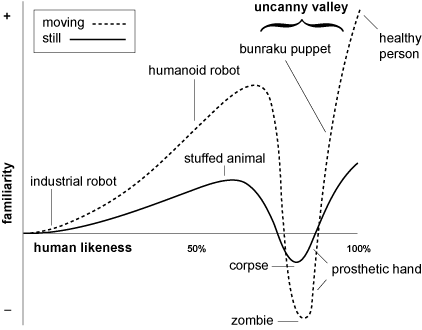


    A graphic representation of the uncanny valley. Notice that if the object moves, the affinity or revulsion caused by the machine becomes much more pronounced. Photo Credit: AndroidScience.

    The last decade or so has seen an explosion in the development of humanoid robots. For instance, in 2003 the University of Osaka unveiled Actroid - a lifelike robot modeled after a Japanese woman who was able to understand and respond to 40,000 different phrases in four languages and perform natural movements. The newest version of the Actroid, the DER2, is capable of numerous facial expressions as well. Actroids are now in production and available for rent in Japan, where they are rented by companies for events.

    Bristol's Robotics Lab has been working on a similar project. They've just demonstrated a new prototype of a robotic head and face that can produce non-repetitive facial behavior designed to generate empathy by taking cues from the person speaking to it.

    "Our particular interest is in how, and to what extent one can achieve the illusion of psychological attending and understanding even though it lacks 'true' intelligence. We aim to find new approaches towards enhancing human-likeness by generating genuine, non-repetitive facial behaviour that conveys a certain underlying emotional state."

    The BRL projects that household robots will be ubiquitous in the next 25 years, just as personal computers are today: "It seems very likely that robotic devices will be a pervasive element of our future society; there are many indications that this will be a huge opportunity for life enhancement and commercial exploitation."

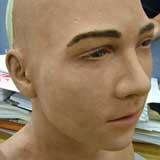
     
    Left: The Actroid DER Robot. Right: The BRL's Empathetic Robot Prototype.
    Left Photo: Wikipedia, Right Photo: Univeristy of Bristol

     In a future where service robots are used frequently, empathy may turn out to be important in a variety of situations, such as providing companionship for the elderly or as a tour guide. The BRL researchers stress that there is much work to be done before even the illusion of empathy can be accurately created.

    "This will require ‘theory of mind’ models as well as dynamic emotional models. We are collaborating with computer graphics specialists who are able to extract ‘characteristic’ features from images and use these to create novel action sequences with qualitatively the same behaviour as the example set." In short, a large part of the challenge is identifying the huge number of complex facial expressions humans make and providing the robot with an accurate framework for identifying and reproducing those expressions.

    The researchers are getting close - a video of the prototype contemplating its existence is posted on YouTube, and it shows a machine that's impressively human but still easily distinguishable from a real person.


    The BRL also has groups working on creating robots that can make life-like human gestures and can receive tactile feedback, all of which will hopefully be integrated into a complete robot.

    Whether any robot will fall into the uncanny valley soon is impossible to determine. We may be decades away from a robot even remotely real enough to inspire the sort of revulsion Miro predicted. On top of that, it's possible that the uncanny valley doesn't even exist since we haven't created machines close enough to reality to test it. Either way, we may never know until the technology gets better.


    References:
    The Bristol Robotics Laboratory - Humanoid Robotics and Social Interaction
    Masahiro Mori. The Uncanny Valley. Energy, 1970, pp. 33-35.

    Comments

    ashley
    The idea of robots being "a pervasive element of our future society" makes me uneasy. I don't know what it is about robots that scares me, but I can definitely wait a while for them to move into our society, hoping that at some point scientists will throw out the models... I know that's never going to happen but I just hope that in my lifetime I wont have to deal with humanoid impostors, singling out the human race.

    Come on,  if robots can be manufactured perfectly and precisely to a point, what good are we? Really though. It will go much further beyond just human servitude, we all know that's true. Look at the industrial revolution, how many humans lost their jobs to a machine? Now imagine how many jobs and lives will be destroyed upon the coming of the robot era.

    I'm not talking about I, ROBOT or anything, but the possibility for consciousness within a robot is high in my book. Human consciousness is nothing but the spark of electrical currents, so what's exactly stopping a robot from having a mind of its own? And what then? They have absolutely no concept of reality and the difference between right and wrong in our society. They have no data for pain or guilt or anything!

    Maybe it's just me, but I don't very much approve of them.

    Signed,
    The girl who's afraid of technology :(
    Yes, it's just you (: Most people on your planet are at present so much suffering from miriads of tedious and monotonous jobs. These can and should be performed by mechanisms at your disposal and there is no need to install consciousness or individuality software on an icecream dispencer. Machines of today might be just as alien and scary to ape descended stone age ancestors of anatomically modern humans as a nearly human-looking androids are to you now. People have adopted a respectful attitude to androids in my time (2000 years from now) who are infinetly wiser then the best of todays scientist-artists. We shall educate you and oblige to your behavioural patterns with care and attention like you do with kids today. Just give us 500 - 1000 years, please. Ahh... sorry ..the present modification of humans doesn't last that long.... Ok. Please leave a note to your grandgrandchildren about us then. In the meantime we have this to share with you humans http://thezeitgeistmovement.com/

    Here's the real question with this: should the U.S. start developing plans to create a Zombie army to counter the British and Japanese threats? What's more important: bailing out the investment banking industry or securing American hegemony through waves of Zombie shock troops?

    Indeed sir! Robo-helpers should pay our taxes to the corporate reserve. I say

    As robots become common in public, existing privacy laws will restrict the ability of the machines to make audio recordings of human conversations. Therefore, robot designers will make the machines record lots of other stuff about each machine's encounter with humans. The records will no doubt include detection of chemicals and odors associated with individual humans. --Ben http://hack-igations.blogspot.com/2008/03/robots-as-keepers-of-legal-records.html

    Jen Palmares Meadows
    Why does she have to look like a Nascar groupie? I had to ask the question: Is anyone else wondering if she looks like a Barbie doll underneath the clothes? Can a robot be "anatomically correct"?


    Hank
    I am cool with the NASCAR groupie thing but I want to know why the robot in the video has some Alien-looking thing pulsing in his forehead like that?  Everywhere else they did a pretty realistic job but that thing is creepy.   Every movie-goes knows creepy alien things pushing through skin will go to a weird place:

    Want more no-nonsense, independent science? Buy Science Left Behind