Fake Banner
Enrico Stomeo - A Lifelong Passion For Meteor Studies

I was reached this evening by the news of the passing of a dear friend, Enrico Stomeo. Enrico was...

Surviving Queues: 1 - At The Airport

Nobody likes to wait in line. Whether you are sitting in your car waiting to reach the toll booths...

Choosing Your Bets: The Selection Bias

As some of the long-time readers of this blog know, in this column I have occasionally discussed...

Have A Master In Science, Want A Post-Doc Position Directly?

Do you have a master in Science, and want to start a Post-Doc position directly? You can have it...

User picture.
picture for Hank Campbellpicture for Heidi Hendersonpicture for Patrick Lockerbypicture for Bente Lilja Byepicture for Sascha Vongehrpicture for Johannes Koelman
Tommaso DorigoRSS Feed of this column.

Tommaso Dorigo is an experimental particle physicist, who works for the INFN at the University of Padova, and collaborates with the CMS and the SWGO experiments. He is the president of the Read More »

Blogroll

Rugby is a beastly game played by gentlemen; soccer is a gentleman's game played by beasts; football is a beastly game played by beasts.

Henry Blaha

Let it be clear on this publically, to show I am not kidding: there is a scientology ad on the right column today. If that is not gone by tomorrow from here, I will.

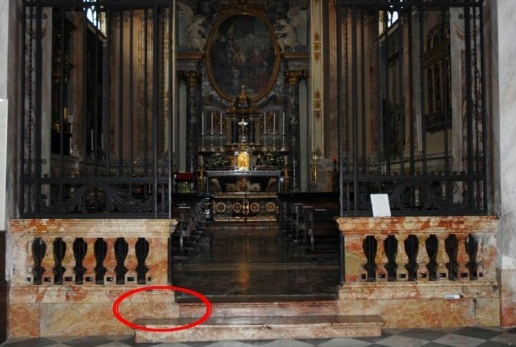
The priest of Vigevano's Duomo must have been startled to realize that by far the most faithful presence at mass, ever since the altar was built, is not nonna Pina but a real dinosaur -a glaring testimony of the falsity of catholic-diffused pseudoscience and of the true origin of life on Earth. The red circle in the picture on the right shows the location of the marble slab in the altar.


The CMS experiment has just released a new result which excludes the possibility that quarks have a substructure at energy scales below 4 TeV. The result comes from the analysis of just a handful of inverse picobarns of collision data -2.9 to be precise- and shows excellently just how well suited are the LHC collisions for this business. The limit is extended by over one TeV above the former result of the Tevatron experiments, and some 600 GeV above the results of the ATLAS collaboration, who also recently reported on their search for of quark compositeness in 7 TeV collisions, finding a limit at 3.4 TeV.
Week number one of my course on Subnuclear Gauge Physics is over. I think that in the first five hours of lesson I have given to my students a reasonable picture of the early experimental attempts and theoretical developments aimed at understanding the structure of atomic nuclei and individual nucleons with electron scattering. So I thought I might try and simplify the picture further, to reach a wider audience here. Of course, the topic is not terribly entertaining, unless one understands fully just how important these studies are for fundamental physics even nowadays -despite having started over 60 years back.
Swamped by my course of Subnuclear Gauge Physics, I have little time left to surf the web and keep an eye on what happens in the blogs I usually visit. Nevertheless, today is Saturday and I have allowed myself a short tour. Below is a list of the most interesting things I have read.


  • First of all, there's an interesting new blog out there, with experimental particle physics explained to laymen. The language is not English, but it is a language you should learn, too.