I was delighted today, as I checked the page of public ATLAS results, to find a very beautiful new result. The signal ATLAS found and
just published on the arxiv is not one anybody could doubt to be there: no surprise whatsoever. And yet, it is a difficult one to extract, and one on which I myself have spent several years of my research work on the CDF experiment.
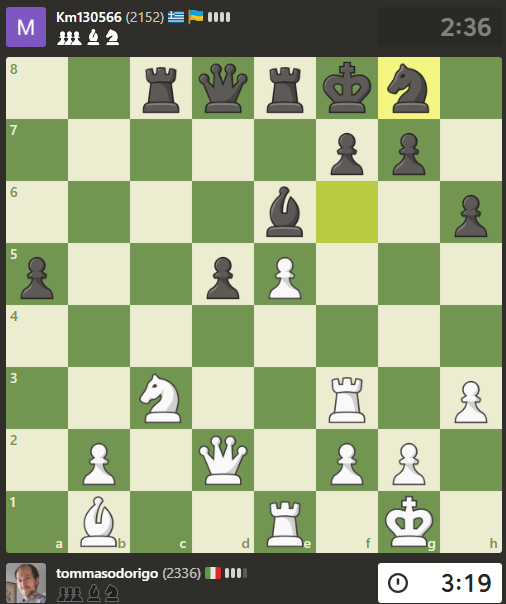
The 35th international chess tournament in Mogliano Veneto this year did not feature strong grandmasters or international masters, but a pack of 24 local players of average strength around 2150. Still, it was a very hard-fought competition, with almost no game ending as a draw before all winning attempts had been tried.
I scored a rather disappointing 2 points out of 5, losing two games -one of them undeservedly, for a performance rating is 2030, a bit less than what I believe is my current playing strength. Below I report my only win, against Enrico Danieli, an elo 2070 player.
Danieli-Dorigo, Mogliano 2014
1.d4 d5 2.Nc3 Bf5 3.e4?!
A
meteor caught on film during its non-luminous free fall at terminal velocity ? Or an elaborate hoax ? Or something else ? I must admit that when I saw the video posted in the internet a few weeks ago I was intrigued, and operated a willful suppression of disbelief. The footage showed a free-falling black stone that really looked like a meteoroid, passing by the owner of the camera hanging on a parachute, on the skies of Norway. I wanted to believe!
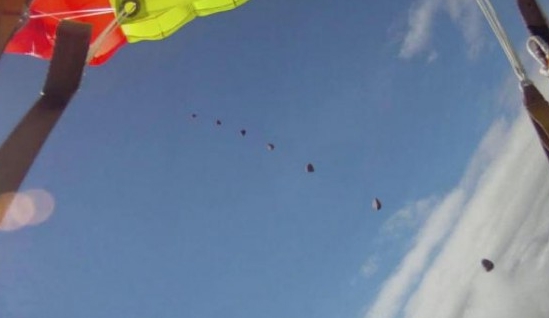 Above: sum of frames from the video shot by the parachuters
Long-time readers of this blog (are there any left ?) know me well since I often used to write posts about personal matters here and in my previous sites. However, I am aware that readers come and go, and I also realize that lately I have not disclosed much of my personal life here; things like where I work, what's my family like, what I do in my pastime, what are my dreams and my projects for the future. So it is a good idea to write some personal details here.
Below is a clip from a chapter of my book where I describe the story of the silicon microvertex detector of the CDF experiment. CDF collected proton-antiproton collisions from the Tevatron collider in 1985, 1987-88, 1992-96, and 2001-2011. Run 1A occurred in 1992, and it featured for the first time in a hadron collider a silicon strip detector, the SVX. The SVX would prove crucial for the discovery of the top quark.
Yesterday I was in Rome, at a workshop organized by the Italian National Institute for Nuclear Physics (INFN), titled "What Next". The event was meant to discuss the plan for basic research in fundamental physics and astrophysics beyond the next decade or so, given the input we have and the input we might collect in the next few years at accelerators and other facilities.


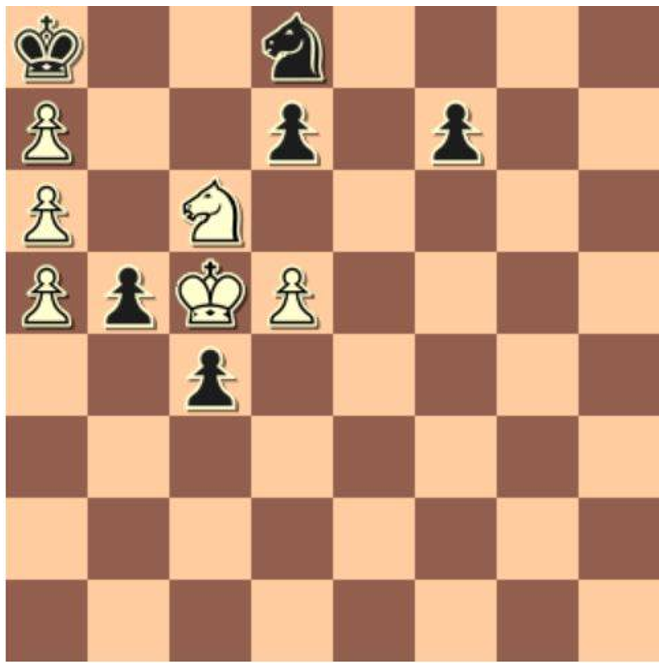 A Chess Study Requiring Backpropagation
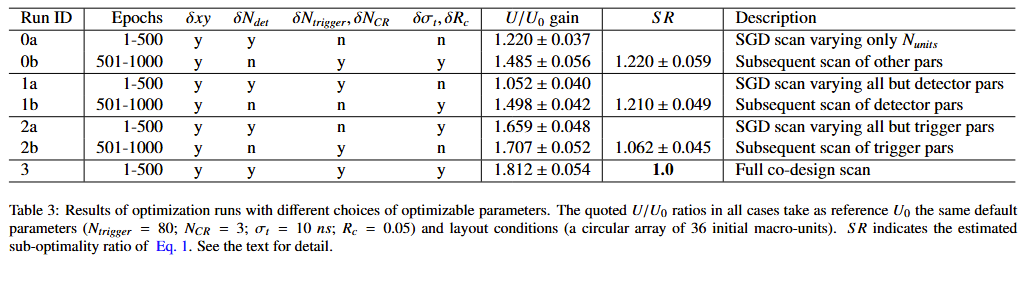 Co-Design Of Scientific Experiments
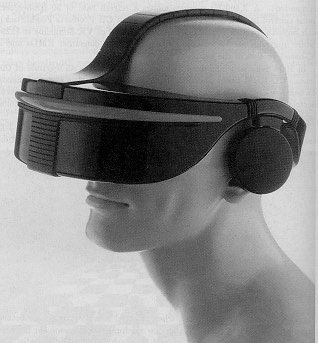 Travel With Two Infants
 A Nice Little Combination