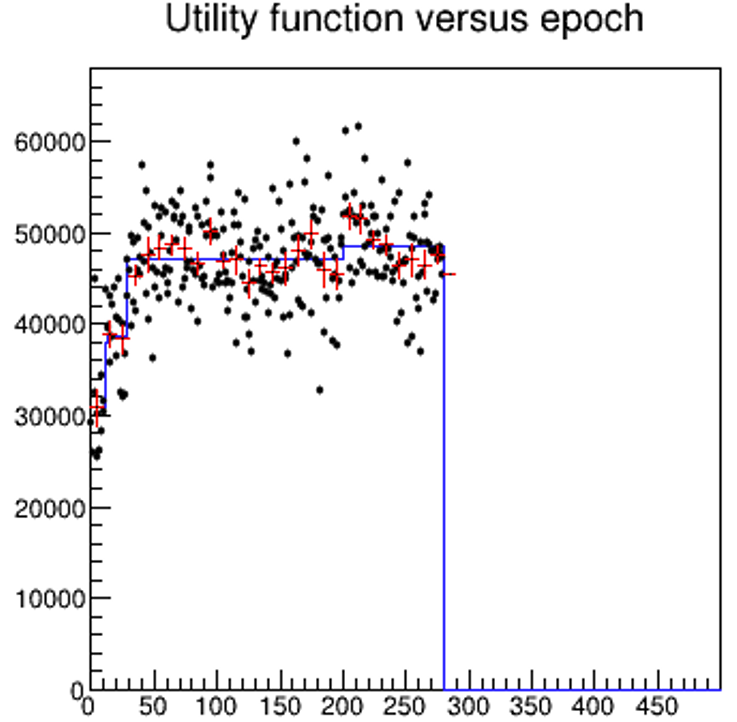
Below I offer a preview of the slides I will show tomorrow at an invited seminar on the rather technical topic of "The b-jet energy calibration with Z-->bb decays", which I have come to CERN to give at a meeting of the LHCb collaboration. As I mentioned already in the first part of this two-part article, the topic is rather technical, and I do not expect a large audience -but I will nonetheless make an attempt at explaining the meaning of the slides pasted below. Then, of course, I am available to provide some additional light on any specific issue among those dealt below which you may want to understand more about.
Tomorrow I am traveling to CERN, where I have been invited to give a seminar at a meeting of the LHCb experiment. My talk will discuss the issue of the energy calibration of b-quark jets, a topic to which I have devoted a good part of my research time for the last thirteen years. The talk will of course be centred on the explanation of the analysis Julien Donini and I, together with a few colleagues, performed in CDF a few years ago, the search for Z boson decays to b-quark jet pairs.
Today I visited the 53rd international art exposition at the Biennale di Venezia, which this year is titled "Fare Mondi" (making worlds). I am posting below a few pictures I took of the installations I saw there, for those of you who are not insensitive to contemporary arts. But before I do, let me add a personal note.
"It is incredible how technology changes our lives. I, for example, was not used to swear."
(Teo Guadalupi)
From 1958 to 1970 Wladimiro Dorigo, my father, directed a political and cultural magazine called "Questitalia" ("This italy"), where emerging political issues were discussed, and the ongoing transformations of Italian society were dissected by a distinguished group of intellectuals. I own a copy of all the 150 issues of that publication, and every once in a while I pick one of them out of the lot at random, and learn what Italy was 40 or 50 years ago.
From the front page of an operational circular of the CERN laboratories:
In the interest of readability, this circular has been drafted using the masculine gender only. However, use of the masculine gender should be understood to refer to both sexes. The provisions of the circular therefore apply to both men and women except where it is clear from the context that they concern one sex or the other exclusively.