
Fake Banner
A Chess Study Requiring Backpropagation

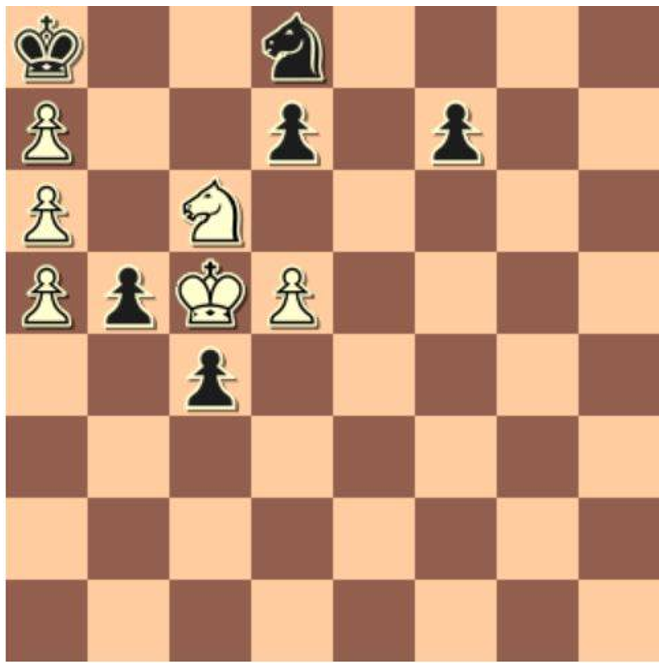
The following position is a win for white. But how?It seems like white is able to grab a knight...
Co-Design Of Scientific Experiments

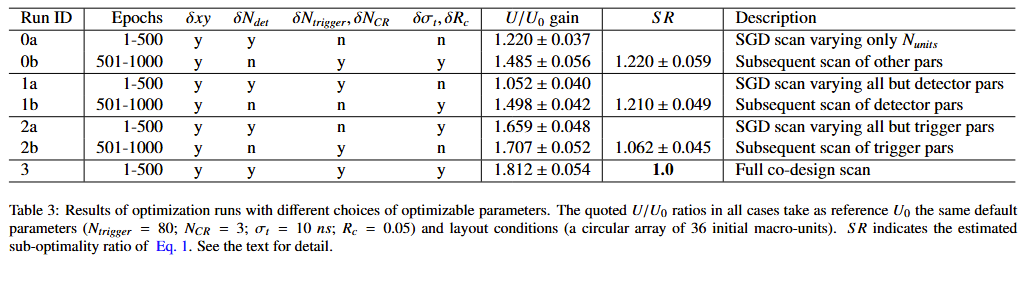
Next Monday, or Tuesday at the latest, you will find a new bulky paper in the arXiv. Titled "On...

Travel With Two Infants

The other day I traveled with Kalliopi and our two newborns to Padova from Lulea. After six full...
A Nice Little Combination

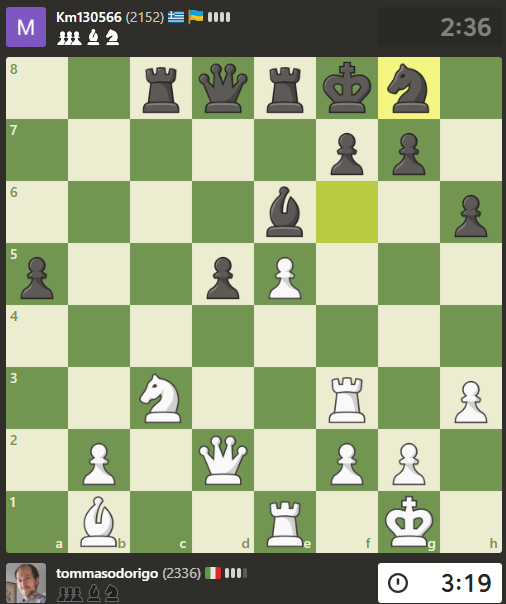
Although I have long retired from serious chess tournaments (they take too much time, a luxury...

User picture.
picture for Hank Campbellpicture for Patrick Lockerbypicture for Heidi Hendersonpicture for Bente Lilja Byepicture for Sascha Vongehrpicture for Johannes Koelman
Tommaso DorigoRSS Feed of this column.

Tommaso Dorigo is an experimental particle physicist, who works for the INFN at the University of Padova, and collaborates with the CMS and the SWGO experiments. He is the president of the Read More »

Blogroll
The European Union has released some data on the latest call for applications for ITN grants. These are "training networks" where academic and non-academic institutions pool up to provide innovative training to doctoral students, in the meanting producing excellent research outputs.

I spent the last weekend in Berlin, attending a conference for editors organized by Elsevier. And I learnt quite a bit during two very busy days. As a newbie - I am handling editor for the journal "Reviews in Physics" since January this year - I did expect to learn a lot from the event; but I will admit that I decided to accept the invitation to attend the event more out of curiosity for a world that is at least in part new to me, rather than out of professional sense of duty.
Burton Richter, 1975 Nobel prize in Physics for the discovery of the J/ψ meson, speaks about the need of a new linear collider for the measurement of Higgs boson branching fractions in a video on Facebook (as soon as I understand how to paste here I will!)

Richter has been a fervent advocate of electron-positron machines over hadronic accelerators throughout his life. So you really could not expect anything different from him - but he still does it with all his might. At one point he says, talking of the hadron collider scientists who discovered the Higgs boson:

I am very happy today because I have been notified by the European Community that a project I submitted for funding as coordinator last January has been evaluated very positively by the EU reviewers. The project is a training network of universities and research centres in Europe, with participation of two additional academic partners and four industrial partners from the US, Russia, Italy and Belgium. The network name is "AMVA4NewPhysics", and it aims at developing and applying cutting-edge statistical learning tools to new physics and Englert-Higgs boson studies to the LHC data collected by ATLAS and CMS.

There are 10^11 stars in the galaxy. That used to be a huge number. But it's only a hundred billion. It's less than the national deficit! We used to call them astronomical numbers. Now we should call them economical numbers.

Richard Feynman, who would turn 97 years old today. Happy birthday, mr. Feynman!







