

Banner
By Patrick Lockerby | March 19th 2010 04:35 PM | 7 comments | Print | E-mail | Track Comments
About Patrick

Retired engineer, 60+ years young.
Computer builder and programmer.
Linguist specialising in language acquisition and computational linguistics...

View Patrick's Profile
Rock Scissors Paper Custard


Ok, forget the scissors and paper - this article is about rocks

and custard.


The Sliding Rocks Of Racetrack Playa


Racetrack Playa is a dry lake bed in Death Valley National Park.  It is famous for its sliding rocks.  Theories that the rocks have been moved by people or animals have been ruled out.  These rocks move according to some as yet unknown natural mechanism.
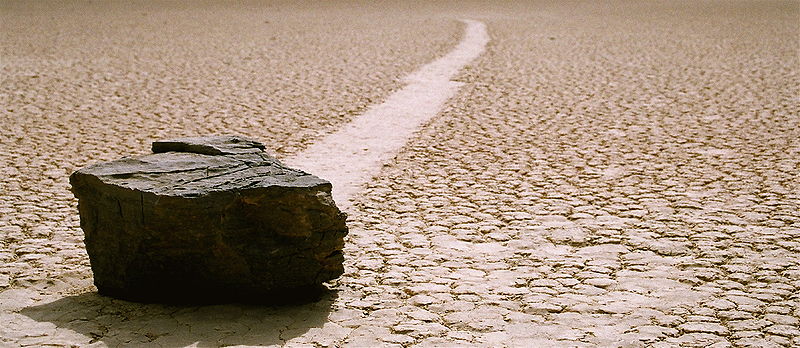


Image source: Wikimedia, Tahoenathan, GNU.


The sliding rocks are few in number and are found mainly in the southeast.
Examination of trail patterns shows an inferred general trend in rock movement toward the north-northeast (Figure 3).This is consistent with the direction of prevailing winds. However, there is a high degree of variation in trail character. Surprisingly, trail lengths and headings are not well correlated with rock shape, volume or area of surface contact.
...

...
...
Terrain analysis of the surrounding basin quantifies the influence of topography on inferred airflow, which ultimately governs the nature and magnitude of sliding rock episodes.
http://www.nature.nps.gov/geology/usgsnps/deva/ftracPM.html
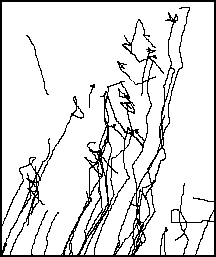

It is highly likely that the rocks are moved by winds.  However, the exact mechanism remains unknown.


A tentative theoretical mechanism for rock movement.

The dried out surface of the playa has a fairly rough texture.  It is improbable that any wind normal for the area could cause a rock to slide over such a surface.  On the assumption that wind is the cause of sliding one must seek a natural means by which the surface may be so modified as to permit sliding.

Mud is notoriously slippery.  A specific type of mud is used as a lubricant in the drilling of boreholes.  However, I suggest that the stones do not simply slide on mud during or after rainfall.

I suggest that a small quantity of rain over the region could amount to enough rain in a shallow flash flood to produce anything from about a half to two inches of very liquid mud.  If the mud behaves as a non-newtonian liquid then that is sufficient to explain the observed tracks.

As mud flows over the surface, or as the mud liquifies from the top down, it can act as a lubricant.  A strong enough wind can cause some stones to move.  Even as the depth of liquid mud is increasing a moving stone may continue moving along the surface.  If a lull allows a stone to stop moving it will sink into the mud and the depth to which it sinks will determine whether or not the next gust of wind will cause movement.

The trail left by a rock in a non-newtonian fluid will be heavily damped.  It will not form an angular bow wave, nor will it form a spreading stern wave.  The wave will be parallel to the path of motion.  The waves on either side of the depression made by the rock will dissipate very slowly. 

In a short-duration flash flood followed by intense sunshine the displaced fluid will not have time to settle much, but will be dried in situ.  The resulting debris trails either side of the rock's path will show the slump angle of dried material and will appear to have formed in a dry condition.

Conclusions:

If the Racetrack Playa rocks slide on a non-newtonian fuid surface during brief intervals of rain  then evidence of this should be observable in the trails. 

The trails will show angular discontinuities of direction.

Over any small enough area the distances that rocks move between contemporaneous discontinuities will be highly correlated.

At any past point of rest, whether or not at an obvious geometric discontinuity, there should be some evidence of spoil transverse to the track.

---------------------
Further reading:

http://geology.com/articles/racetrack-playa-sliding-rocks.shtml

http://www.nature.nps.gov/geology/usgsnps/deva/ftracPM.html

-------------------
Related - but only just :)

Custard: a non-newtonian fluid.



Comments

jtwitten
Brian Dunning of Skeptoid has all but solved this one already.


logicman
Josh: I've seen that video, but thanks anyway.  It shows just how sparse and shallow the water is during the few occasions when it rains.

The proposed ice mechanism is not new and has been rejected by geologists who have looked into this. 

a follow-up mapping project conducted in May, 1998, showed that the abnormally stormy El Niño winter conditions of 1997-98, while favorable to the development of ice sheets, contributed little to the displacement of rocks from their original mapped locations.

http://www.nature.nps.gov/geology/usgsnps/deva/ftracPM.html


The problem with ice as a rock-moving mechanism is that a flat sheet of ice pushing a rock at ground level would obliterate the trail left by the rock and would leave its own trail instead.


The two main theories that keep cropping up relate to either ice or slippery mud.
Unit movement over so great a span scarcely allows any reasonable conclusion as to cause other than wind-blown ice floes dragging protruding stones. Ice ramparts and other evidence indicate longshore shearing motion, feasible for ice floes but impossible for ice shove by thermal expansion.
ORIGIN OF PLAYA STONE TRACKS, RACETRACK PLAYA, INYO COUNTY, CALIFORNIA
GEORGE M STANLEY September 1953

The author is of the opinion that the furrows or trails are made in the wet and slippery clay surface of the playa by rocks propelled by the wind.

Wind-Blown Rocks and Trails on Little Bonnie Claire Playa, Nye County, Nevada
Thomas Clements Journal of Sedimentary Research Volume 22 (1952)


To the best of my knowledge, nobody has considered the motion of wind-blown rocks on the surface of a non-newtonian liquid.

Professor Paula Messina at San José State University and PI (Principal Investigator) of this phenomenon probably has the best hypothesis for these rocks, which by the way are traveling, in general, uphill on a gentle slope.

1) This is Death Valley, and that is not ordinary dry mud you see there. This is partially lithified mud because of the extreme temperatures and arid conditions--the record temp being 134° F.

2) On average, Death Valley gets about 2" of rain per year. Sometimes it can all fall in one day causing a flash flood, with fine grains being transported in the flood water. It's these flood waters combined with very fine mud sediment that carved out Marble Canyon and created its extremely smooth surface. But that's not what moved these rocks. Flash floods like that only occur infrequently. But there is a connection and that is the fine sediment that this mud produces when it gets wet. Because of point #1, namely that the mud is partially lithified, the mud does not become saturated with water. In fact, most of the water runs off the surface carrying the fine mud sediments laying on top of the partially lithified mud.

3) You've heard of hydroplaning? Well, when the surface of this mud gets wet it becomes extremely slippery, to the point where you could push one of these rocks (and some of them weigh as much as 600 - 700 lbs.) with your finger and it would send it flying, as though it were on a flat and smooth surface of ice covered with a thin film of water. It really doesn't take that much rain and certainly not a short-duration flash flood. And you're forgetting about the three natural springs there that may also be contributing to lower friction coefficients in the area over time. And remember that the Racetrack is 5 cm lower in elevation than the main playa, so water tends to pool in that area (remember I said in the beginning that these rocks are traveling uphill?). But, it is mostly due to the properties of, once again, the partially lithified mud itself that allows these rocks to move so easily.

4) These rocks do not move small distances when they do move but rather large distances.

5) After a storm you can have hurricane force winds moving along the surface of the Racetrack Playa coming from the south. The valley itself acts as a kind of wind tunnel, funneling the wind directly onto the plain.

6) The leading hypothesis currently is that after a rain when the surface of the mud becomes very slick and the winds reach hurricane force it's the combination of the slick surface of the mud and the powerful winds that moves these rocks very dramatically. It's the shifts in wind direction that causes the rocks to move in different directions, sometimes causing a rock to make a right angle turn from its previous course.

Now, it's true that no one knows for sure what makes these rocks move. But this is the best hypothesis thus far.

On many points you are correct. But you missed some very important points in your analysis.

And Patrick! Before you say a word, remember this is my field of expertise that you're treading on, and I didn't take years of geology to not know what I am talking about! ;-)

logicman
Eric: I'm very much on the outside of geology looking in, so I appreciate your comments all the more.

I wrote this piece after seeing one too many 'gosh is it ufos?' type comments across the web. 

Wow!  Nobody ever saw the rocks gouging furrows!  It must take a lot of force to scrape those trails with rocks.  Wierd mystery!   Spooky! 

Now, who wants to volunteer to go into a cold desert in a howling gale to video a rock just in case it might move?  Nobody?  I thought not.


Eric: I appreciate what you say about the topography, the fine sediments, etc.  However, I have yet to see an account of rock movement that doesn't require an initial movement of a rock from off its dry bed onto a newly wet area, especially considering the minimal amount of water involved.  Water of about an inch rolling down a long enough slope would have no trouble moving very small rocks, but reports of the playa indicate that water is slow and low, as shown in the video that Josh linked. btw - Thanks Josh.

Aquaplaning can only arise when a body traveling over a surface and displacing a film of fluid reaches a velocity at which the fluid is not displaced fast enough for the body to maintain surface contact.  The body then rides up on a wedge of fluid.  This is the mechanism by which a rotating shaft in a bearing builds up and rides on a fluid film.  In order to build up the film, energy must be used to overcome the static friction, or 'stiction'.

My reference to a 'flash flood' should not imply any specific minimum depth of water.  A single millimeter of water streaming over a bone-dry surface area constitutes a flash flood.

The tracks show that some of these rocks have moved over half a kilometer apparently in a single surge.  For that to happen, I suggest, a rock must remain stationary until it has half a kilometer of water-soaked sediment ahead of it.  If a rock moves as soon as its local area is wet enough, then it will skate only a small distance before overtaking the water front and encountering a dry area.  No track segment will be longer than a few meters.  No proposed mechanism that I have seen allows for that holding back before commencing a continuous motion.

If a rock doesn't move until sufficent water has seeped into the sediment under it and converted it to some form of mud then that would give time for the water to extend well ahead of the rock.  Once put in motion by a strong wind it could continue to sail for a long distance even before a reduced wind strength.

I suggest that the exact composition of the surface sediments and the sediments washed down onto the racetrack will reveal much about the specific mechanical properties of the wet sediment as a lubricant: gel, colloid or other fluid type.


A final point: where do all the rocks go? 

There should be a pile of rocks at the upslope ponding boundary.  Perhaps there is sufficient water on rare occasions such that some rocks sink in the mud enough to be immovable.  Further sediment deposits would cover any protruding parts over geological time.

A final solution to this puzzle must explain:

How does a rock begin to move: how is static friction overcome?

Why do all of the rocks available downslope not move, but just a few?

Why is there no terminal line of rocks which have already been moved to the limit line of the system over geological time?

Thanks again for your input, Eric.  I look forward to your resolutely tearing my suggestions to shreds.  But at least my suggestions beat the idea that the rocks are being moved by furry animals, pranksters or aliens -

I hope.  :-)

If a rock doesn't move until sufficient water has seeped into the sediment under it and converted it to some form of mud then that would give time for the water to extend well ahead of the rock. Once put in motion by a strong wind it could continue to sail for a long distance even before a reduced wind strength.

I suggest that the exact composition of the surface sediments and the sediments washed down onto the racetrack will reveal much about the specific mechanical properties of the wet sediment as a lubricant: gel, colloid or other fluid type.

I agree with all of your points, Patrick.

In answer to your questions, which are all good ones, I honestly don't know. This is still very much a mystery, and that's what makes it so fascinating. ;-)

Professor Messina once confessed that she hopes that this mystery isn't solved in her lifetime. She went on to say, that for her, what makes these rocks so fascinating is because it is a puzzle that we humans with all of our so-called ingenuity don't seem to be able to figure out, at least not completely. The fun is in the mysterious nature of these rocks.

I tend to agree with her sentiment. ;-)

logicman
Eric:  I was surprised that you agree with my points.  Surprised and delighted.  Thanks.

As to spoiling the mystery, I wouldn't want to do that.  Perhaps I should withdraw my suggestions and reintroduce the paper and scissors.  Not forgetting the custard.

:-)

Definitely don't forget the custard, Patrick! lol ;-)

Add a comment

The content of this field is kept private and will not be shown publicly.
  • Allowed HTML tags: <sup> <sub> <a> <em> <strong> <center> <cite><TH><ul> <ol> <li> <dl> <dt> <dd> <img> <br> <p> <blockquote> <strike> <object> <param> <embed> <del> <pre> <b> <i> <table> <tbody> <div> <tr> <td> <h1> <h2> <h3> <h4> <h5> <h6> <hr> <iframe>
  • Lines and paragraphs break automatically.
  • Web page addresses and e-mail addresses turn into links automatically.
CAPTCHA
If you register, you will never be bothered to prove you are human again. And you get a real editor toolbar to use instead of this HTML thing that wards off spam bots.

