




An open letter
to H. Lawrence Culp, Jr.,
Chairman and Chief Executive Officer (CEO)
GE Aerospace
Dear Sir,
the pilots of Air India Flight 171 could be entirely exonerated if industry experts were motivated to investigate the AI 171 accident within their particular areas of expertise.
The AAIB preliminary report and various investigators in social media* agree that maximum airspeed was achieved before the fuel switches were moved.
As you will know, the GEnx engines of VT-ANB are high bypass turbofans. They spin on after fuel is shut off and continue to produce useful thrust from the high-bypass fan due to the high momentum aka flywheel effect of all the rotating parts.
Maximum airspeed arises after fuel is shut off when the residual thrust of the spooling down engines exactly matches the drag of the aircraft at that speed and in that configuration.
General Electric, with its highly skilled personnel, tools and computers can easily determine accurate figures for airspeed, air temperature, airframe drag, engine angular momentum and other relevant data.
General Electric can determine with a high degree of accuracy the thrust being produced by the engines of VT-ANB at the moment of maximum achieved airspeed, the thrust at that point being exactly equal to the drag.
General Electric can, by applying its knowledge of the spooldown characteristics of the engines it manufactures, determine to perhaps plus or minus 0.1 or even 0.01 seconds the time at which the fuel was shut off.
In Air India Flight 171 - The Vital Seconds and in Air India Flight 171 Accident - The Most Probable Cause it was claimed that the fuel was shut off on the runway.
If that claim is in error then General Electric can easily point out the error.
I respectfully request that you address this request, in the expectation that the pilots will be shown to be blameless through the due diligence, honor and integrity that are still alive and well in America.
Regards,
Patrick lockerby
* Unofficial investigations, apart from my own -
Not the Pilot’s Fault: Inside the First 61 Seconds of AI171
Air India Crash | The Pilots Tried to SAVE the Airplane - With Proof
What Really Happened to Air India 171?
------------------------------------------------------------
Explanatory notes
The following notes are intended for any reader who is not familiar with the notion of residual thrust in a turbofan after the fuel is shut off.
When a turbofan's fuel is cut off, the N1 (low-pressure spool) rollback rate is a variable deceleration determined by many factors such as engine rpm and airspeed at the moment of shutdown, together with factors such as rotational inertia (flywheel effect), air temperature and density, oil viscosity, electrical load.
The higher the initial N1 speed at the time of fuel cut-off, the more residual momentum aka stored kinetic energy the engine has.
The forces of the airflow which resist the fan's rotation are a major factor in the deceleration rate. The higher the airspeed, the more slowly the N1 will decelerate. Conversely, with zero airspeed on the gound the engines will spool down much more rapidly than in flight.
Spooldown generally takes many seconds to reach the condition where the engine is just windmilling.
General Electric has the tools to determine with great accuracy the spooldown rates of its engines after fuel is shut off. It is a simple matter of recording the spooldown and thrust using a brake dynamometer, or perhaps using a safe in-flight single engine shutdown test to replicate AI 171 airspeeds.
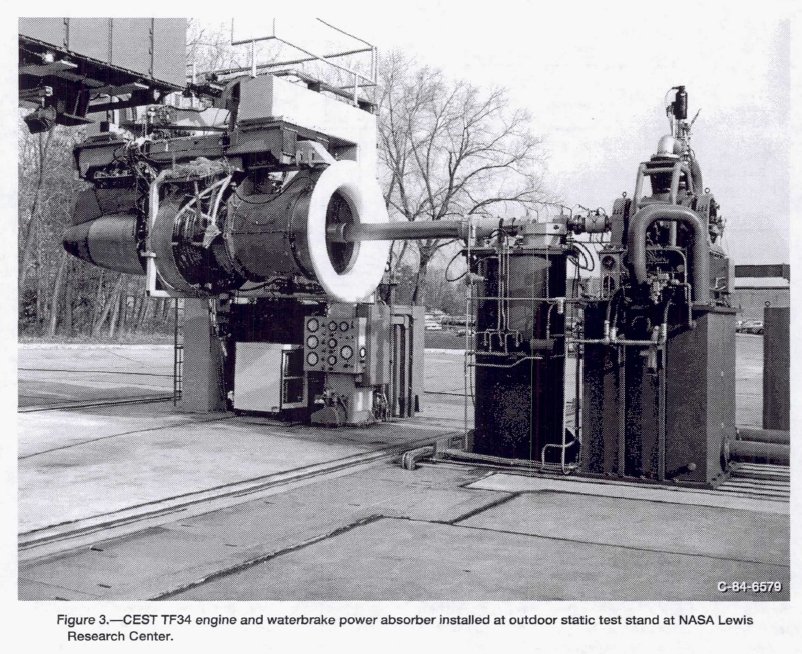
A water brake dynamometer as used by GE in testing a modified TF34
image source
https://ntrs.nasa.gov/api/citations/19960022775/downloads/19960022775.pdf
.



Comments