




The Timeline - Vital Seconds.
This timeline is constructed from what little information was given in the AAIB Preliminary Report, together with what is publicly available about the 787-8's systems and engines. The timeline is explained in more detail below and in my previous articles on Science 2.0
08:07:37 - Aircraft commenced takeoff roll.
No problems indicated.
08:08:33 - Aircraft achieved 153 kts IAS - V1
At about this time the fuel was shut off by FADEC/TCMA error.
08:08:35 - Aircraft achieved 155 kts IAS - VR
Residual thrust at this point is still enough for takeoff.
08:08:39 - Air/ground sensors transitioned to air mode.
The RAT, inhibited until wheels off ground now deploys.
08:08:42 - Aircraft achieved maximum recorded airspeed of 180 Knots.
The pilots, previously focused on takeoff now realise the peril.
Switches rapidly moved to cutoff and run.
Fuel switches to off data is recorded.
Pilot A asks pilot B why he cut fuel off.
Pilot B responds that he did not cut off the fuel.
Electrical failure occurs.
Fuel on data is not recorded because there is no DC power to the switches.
EAFR continues to record switches as being off.
08:08:47 - RAT began supplying hydraulic power. (approximate time)
This event is approximately 7 seconds after RAT deployment is triggered.
08:08:51 - interpolated
RAT now begins to provide electrical power, approximately 10 seconds after deployment.
08:08:52 - Engine 1 fuel cutoff switch transitioned from CUTOFF to RUN.
This event could not be recorded or acted on without electrical power.
The time stamp 08:08:52 is the likely time of electrical power being restored.
The forward EAFR has battery backup but cannot record any change of switch state
if there is no system power.
08:08:54 - APU Inlet Door began opening. (approximate time)
APU air inlet was found open to the in-flight position.
There was insufficient time for spin-up of the APU.
08:08:56 - Engine 2 fuel cutoff switch transitioned from CUTOFF to RUN. (approximate time)
The delay may be explained as correct pilot action.
One switch is moved to run and then instruments are monitored to check result.
There could be no relight signal to the FADEC until DC power was restored at about 08:08:51.
08:09:05 - MAYDAY call was made by AI171.
“No thrust, losing power, unable to lift.” Verbatim quote from The Independent.
08:09:11 - FWD EAFR recording stops.
Likely as the tail strikes building A.
There is no evidence of engine or battery malfunction - what some see as smoke at liftoff is dust. Evidence of dust was shown previously in Air India Crash: Update #5 - It's Dust, Not Smoke. Many images and videos may be found on the internet showing dust being lofted by wake turbulance.
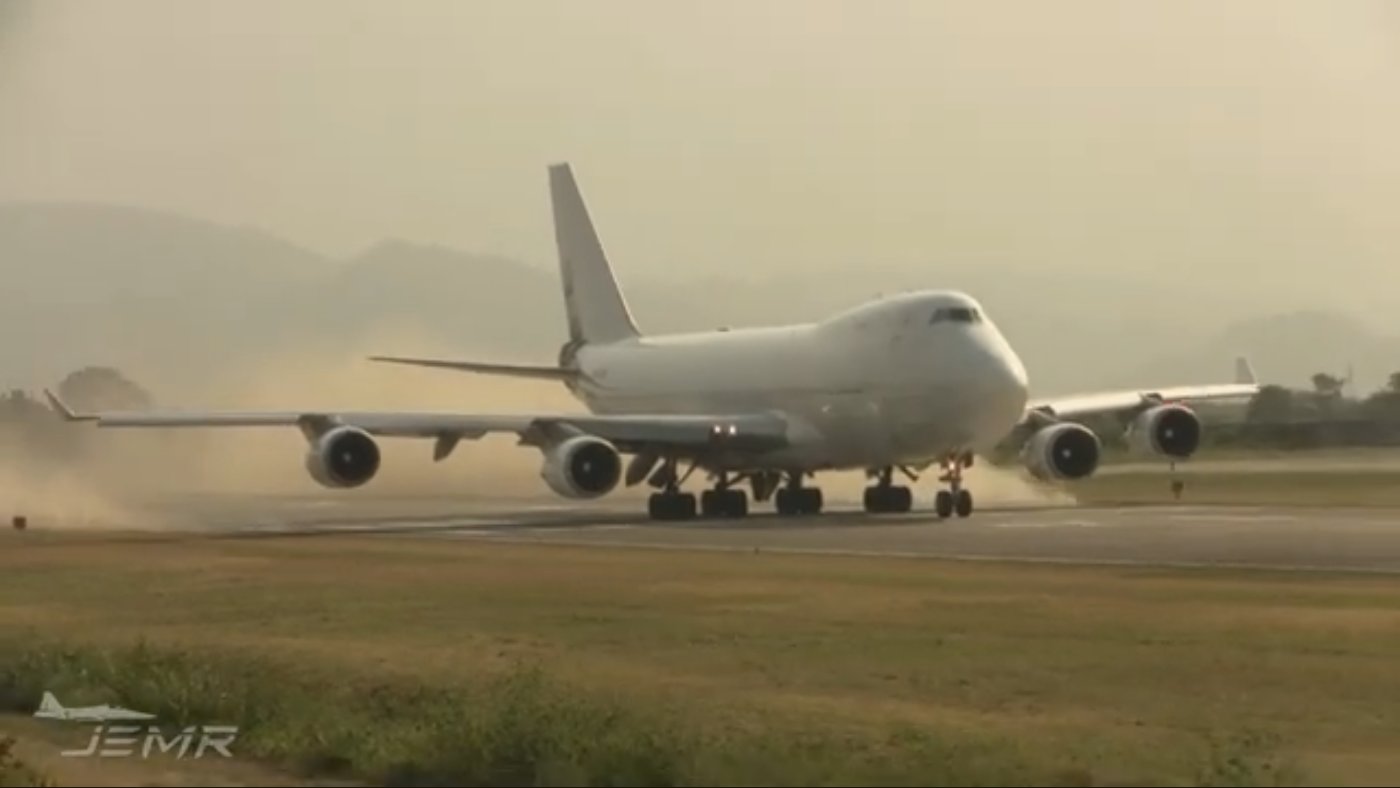
747 Dusty takeoff, MHLM San Pedro Sula, Honduras
The First 3 Vital Seconds
a combination of known facts and Newtonian mechanics is used to show that the most probable cause of the tragedy was a software fault. Evidence is submitted which shows that the fuel was cut off by the aircraft's automated control systems and the switches were afterwards moved by a pilot as a perfectly proper corrective action.The Air India 171 accident was caused by a total loss of useful thrust for a few vital seconds. The cause of that loss of thrust was almost certainly the automated shutting off of fuel to both engines before the wheels lifted off the runway.
Air India Flight 171 Accident - The Most Probable Cause
Although software package 130 is executed while the aircraft is in flight and on the ground, Software package will only cut fuel to the engine if the aircraft is on the ground. Software package 130 monitors the flight status of the aircraft using system information received by EEC 18.
TCMA patent
Ram Air Turbines are inhibited from being deployed on the ground. If the fuel was shut off before liftoff the RAT would not deploy until the wheels left the ground. It appears likely that the fuel was cut off as many as 3 seconds before VR. During those vital seconds the residual thrust from the bypass fans would have been declining.
The RAT was deployed even as airspeed was declining. It could not have supplied its designed output for long. That may be a factor in the failure to relight engine number 2 if the power to the igniters was insufficient.
As the aircraft slows down, the RAT’s output diminishes. Most RATs have a minimum airspeed below which they can no longer sustain the required power. For airliners, this is often around 120–150 knots.The DGCA Investigates The Most Probable Causes
Ram Air Turbine Systems: What Pilots Need to Know
A good investigation will begin with knowledge of, or research into the histories of the specific aircraft, the specific model, the type. It may be useful to research any similar accidents to similar aircraft. Even if an air-industry company has a history of problems it would be premature to assume blame and then seek evidence to fit a theory.
Even before the investigation begins it is usually possible, for a type that has been flying for many years, to know the most likely problem areas and to check other aircraft of that type.
The crash happened on June 12th. On June 13th DGCA ordered enhanced inspection of Air India’s Boeing 787 Dreamliner fleet.
The Directorate General of Civil Aviation (DGCA) has directed Air India to carry out additional maintenance actions on its Boeing 787-8 and 787-9 planes equipped with Genx engines with immediate effect.Clearly, the DGCA suspected that some problem in the aircraft had shut off the fuel. Pilot error or malice wasn't even on their radar. But from the very first news of the crash there was speculation in news media and social media about pilot error. The science, the known facts and the interpolated facts show that the pilots were beyond blameless: they fought valiantly to save the aircraft.
These actions will be carried out in coordination with the DGCA regional offices concerned.
Air India’s Boeing 787-8 Dreamliner aircraft, operating a flight from Ahmedabad to London Gatwick, crashed soon after the take-off on Thursday afternoon. Out of the 242 people on board the plane, only one person survived.
With effect from January 15, the regulator has ordered various one-time checks of the Boeing 787 planes, including inspection of fuel parameter monitoring and associated system checks.
Inspection of cabin air compressor and associated systems, electronic engine control [EEC] system test, [engine fuel driven-actuator operational test], and oil system checks have also been ordered.
[not original text]
State Times Jun 13, 2025
The Pilots Were Not At Fault
"We are deeply disturbed by speculative narratives emerging in sections of the media and public discourse - particularly the reckless and unfounded insinuation of pilot suicide," the Indian Commercial Pilots' Association (ICPA) said in a statement released late on Saturday night.The Switches Did Not Cause Fuel Shutoff
"Let us be unequivocally clear: there is absolutely no basis for such a claim at this stage, and invoking such a serious allegation based on incomplete or preliminary information is not only irresponsible - it is deeply insensitive to the individuals and families involved."
The Indian Commercial Pilots' Association (ICPA) as reported by BBC
The ALPA India also said it was "surprised at the secrecy surrounding these investigations" and alleged that "suitably qualified personnel were not taken on board for the probe".
ALPA India = Airline Pilots' Association of India as reported by BBC.
Don't vilify Air India crash crew: Indian pilots' association
... the Engine 1 and Engine 2 fuel cutoff switches transitioned from RUN to CUTOFF position one after another with a time gap of 01 sec. The Engine N1 and N2 began to decrease from their take-off values as the fuel supply to the engines was cut off.By taking these two sentences as indicating that the movement of the switches was the cause of fuel cutoff it appears that there was pilot error/malice. But perhaps this passage invites the reader into the post hoc fallacy trap.
AAIB Preliminary Report
post hoc ergo propter hoc
A casual reading of the AAIB report seems to show that the fuel was cut off after the switches were moved. But perhaps "The Engine N1 and N2 began to decrease from their take-off values as the fuel supply to the engines was cut off." and the pilots then reacted with an attempt at engine relight only after they became aware of the cause of the loss of thrust.
Post hoc is a particularly tempting error because correlation sometimes appears to suggest causality. The fallacy lies in a conclusion based solely on the order of events, rather than taking into account other factors potentially responsible for the result that might rule out the connectionThe engines have mechanical backup pumps and will carry on running during an electrical failure unless the main fuel valves aka spar valves are commanded shut before the electrical failure. The spar valves are not spring loaded.
Wikipedia Post hoc ergo propter hoc
What Can Happen Will Happen, Absent Preventive Steps
This AD is prompted by a report of two occurrences of engine thrust rollback (reduction) during takeoff. We are issuing this AD to prevent dual-engine thrust rollback, which could result in the airplane failing to lift off before reaching the end of the runway or failing to clear obstacles below the takeoff flight path.
FAA AD effective October 16, 2006
Limited Options After Engine Failure At Takeoff
Note that, by regulation, turns immediately after takeoff cannot be initiated below the greater of 50'AGL or one half of the aircraft wingspan and, that during the initial climb, turns are limited to 15° of bank. Turning will result in a reduction in aircraft climb capability.Footnote
In the event of an engine failure after V1:
Establish and maintain directional control with appropriate rudder input
Rotate at Vr and establish a climb speed of V2
If the failure occurs after the aircraft is airborne, a climb speed of between V2 and V2 + 10 is acceptable
Utilise appropriate aileron input to maintain wings level. At, or near, VMinimum Control Air (Vmca), as much as a 5° bank away from the dead engine may be required
When safely airborne and established in a positive climb, retract the landing gear.
Engine Failure During Takeoff - Multi-Engine Transport Category Jet Aircraft
I accept fault for any errors in this article and stand ready to be corrected. I am not paid by anyone to write here and I have no connection to any of the entities mentioned.
----------------------------------------------------------------------------------------------
Useful information / web sites
https://flightsafety.org/
https://skybrary.aero/
India airline growth
WHAT’S Really Going ON In INDIA?! Can This Continue?
https://youtu.be/vPfRbHYnCVM?si=DsdXpZAk9DxFNsUB
.



Comments