




How is that even possible? It won't matter, if history is any indication, career bureaucrats at the US Centers for Disease Control and Prevention are already scheduling a briefing before Congress to ask for more money to prevent this new pandemic.
Like they did with Pre-Diabetes, where the United States stood alone in declaring that a blood a1c level so low only 5% of people with it would develop Type 2 diabetes in their lives was a pandemic they needed funding to stop. A blood level so low that half of China would be Pre-Diabetic if the CDC were in charge. Pharmaceutical companies would love to have 700,000,000 people designated as customers but every other country continues to shake their head at our belief system, the same way tourists are baffled by 80,000 Prop 65 'may cause cancer' stickers all over California stores.
You don't need science, science may even be the enemy; you only need epidemiology. And perhaps belief in homeopathic effects. Yet because the CDC claimed it, anyone with that a1c can get Wegovy or one of the others, actual diabetes drugs, covered by insurance we all pay for.
The new paper does what all correlations do; tell us how worrisome the effects are. In this case that if you have high blood pressure, you are 1.5X as likely to also develop cognitive disorders. There are real head-scratchers in such claims. Since the 1970s, well-funded medical organizations like the American Medical Association and American Heart Association have hijacked an alarming amount of American government medical policy. What used to be high blood pressure 50 years ago is now 40 points lower when it comes to systolic pressure (force during heart beat) and the diastolic standard for 'high' has also been reduced a lot. As with air quality and chemicals, we keep panic high by defining risk down, even if there is no improvement in outcomes.
Those changes to 'high' blood pressure mean a whole lot more people, tens of millions more, are on medication. That led to a corresponding drop in cognitive disorders...oh wait, no it didn't.
That is where magic - call it Homeopathic or Integrated Medicine beliefs if you like - comes in. There has been no lowering of cognitive disorders, losartan and the rest have no effect on brain function. So the authors invoke that blood pressure is causing blood vessel damage before there is high blood pressure. It might as well be called Pre-Hypertension.
What gives? It's due to the bane of public trust in science and cousin of epidemiology, mouse studies. This is only EXPLORATORY because it is only in mice. Rodents are not little people, despite what activists who want to ban chemicals 'at the drop of a rat' insist needs to happen.
The authors instead created a mouse version of hypertension with the angiotensin hormone and suggest that is a proxy for humans, even though everyone knows it isn't. After they gave they increased blood pressure in mice they looked at brain cells and found that the lining of blood cells seemed 'older', neurons seemed damaged, and the blood-brain barrier seemed less effective. They stated that oligodendrocytes did not express genes as well as they had.
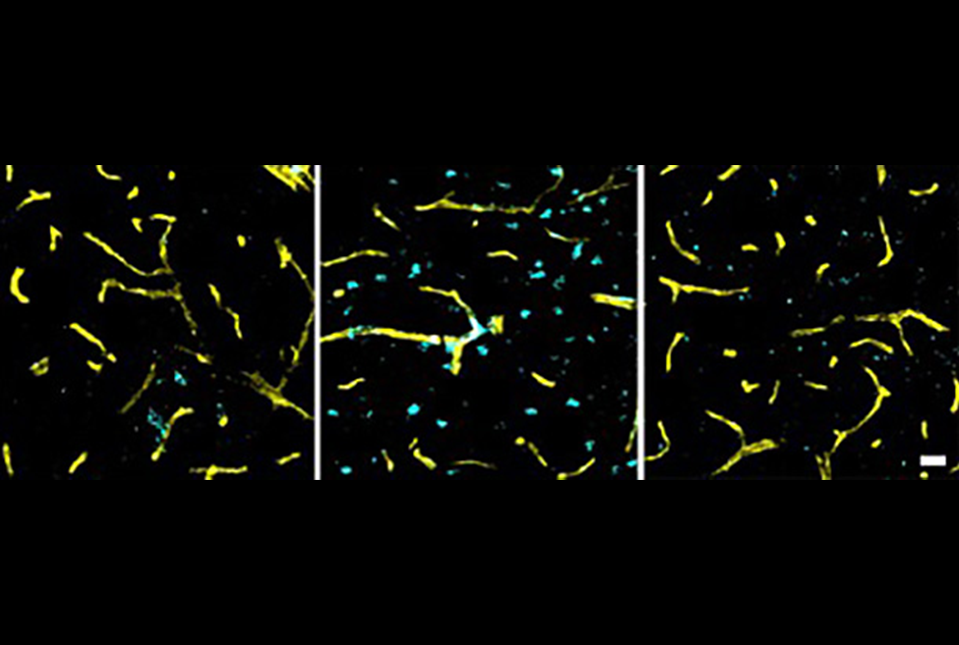
Left: brain cortex of mice without hypertension. Yellow are normal endothelial cells, blue are senescence - they have stopped functioning properly. Midddle: After angiotensin is administered to cause hypertension, there are more blue 'dying' cells. Right: Blocking angiotensin receptors improved endothelial cells. Credit: Dr. Anthony Pacholko
They note that losartan inhibits the angiotensin receptor but that is the problem with correlation that lacks a plausible biological mechanism. If an angiotensin II receptor type 1 (AT1) antagonist was more than breezy correlation to cognitive decline there would be a noticeable difference after 30 years and 100,000,000 people. Yet there isn't.
Citation: Schaeffer, Samantha M., Pacholko, Anthony G., Santisteban, Monica M., Ahn, Sung Ji, Racchumi, Gianfranco, Wang, Gang, Park, Laibaik, Faraco, Giuseppe, Anrather, Josef,
Iadecola, Costantino, Hypertension-induced neurovascular and cognitive dysfunction at single-cell resolution, Neuron 0896-6273 doi:10.1016/j.neuron.2025.10.018



Comments