Banner
Pilot Study: Fibromyalgia Fatigue Improved By TENS Therapy

Fibromyalgia is the term for a poorly-understood condition where people experience pain and fatigue...

High Meat Consumption Linked To Lower Dementia Risk

Older people who eat large amounts of meat have a lower risk of dementia and cognitive decline...

Long Before The Inca Colonized Peru, Natives Had A Thriving Trade Network

A new DNA analysis reveals that long before the Incan Empire took over Peru, animals were...

Mesolithic People Had Meals With More Tradition Than You Thought

The common imagery of prehistoric people is either rooting through dirt for grubs and picking berries...

User picture.
News StaffRSS Feed of this column.

News Releases From All Over The World, Right To You... Read More »

Blogroll

The genomics revolution has been going on for decades, but half of known eukaryote lineages remain unstudied at the genomic level.

A new survey, with results published in
of Trends in Ecology and Evolution, concludes that this is simply a popularity contest and the field is displaying research bias against 'less popular', but potentially genetically rich, single-cell organisms. The lack of microbial representation leaves a world of untapped genetic potential undiscovered.

UPTON, NY—Scientists at the U.S. Department of Energy's Brookhaven National Laboratory are seeking ways to synchronize the magnetic spins in nanoscale devices to build tiny yet more powerful signal-generating or receiving antennas and other electronics. Their latest work, published in Nature Communications, shows that stacked nanoscale magnetic vortices separated by an extremely thin layer of copper can be driven to operate in unison, potentially producing a powerful signal that could be put to work in a new generation of cell phones, computers, and other applications.

The aim of this "spintronic" technology revolution is to harness the power of an electron's "spin," the property responsible for magnetism, rather than its negative charge.

It's community pool season and while urban moms think that a chlorinated municipal pool is cleaner than a rural pond, microbiologists know that isn't really true.

Bacteria and parasites can lurk in all kinds of water and put a real damper on summertime fun.

At biggest risk are the youngest kids, for a variety of reasons.
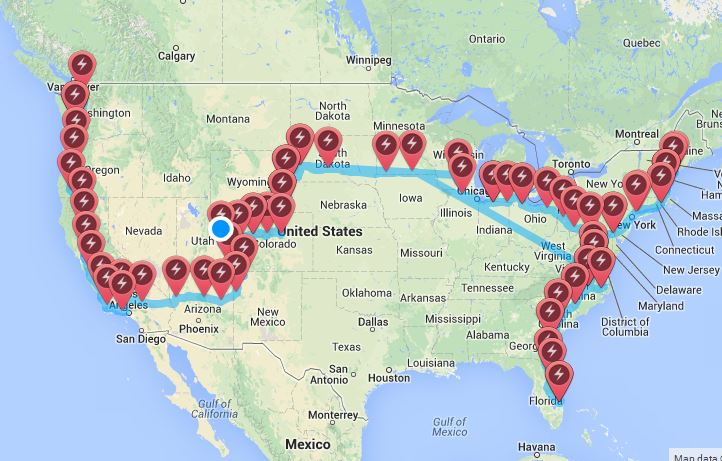
Earlier this month, the Epic Electric American Road Trip, a 24-day, 12,183-mile battery-powered journey sponsored by electric vehicle (EV) software and information services company Recargo Inc., was completed.

They expect to be awarded Guinness World Record verification for the longest vehicle journey ever taken using 100% electric power. The goal was to emphasize the possibilities of the nation's current electric vehicle charging infrastructure.
North Carolina farmers and landowners are participating in program to grow giant miscanthus grass for renewable products using underutilized and marginal land.

Giant miscanthus grass is a rapidly renewable biomass crop that provides a viable economic alternative for many farmers and landowners with underutilized and marginal land that might otherwise lay dormant or fail to provide annual profits.

Perennial giant miscanthus grows well under a range of soil and environmental conditions. It requires little to grow and maintain. It's a simple, convenient and profitable crop to raise.

Planting biomass at commercial scale includes solving the significant challenge of establishing rhizome-propagated crops. 

Astronomers have taken unprecedented images of the intergalactic medium (IGM) — the diffuse gas that connects galaxies throughout the universe — with the Cosmic Web Imager, which was designed and built at the California Institute of Technology.

Until now, the structure of the IGM has mostly been a matterof speculation, but with observations from the Cosmic Web Imager, deployed on the Hale 200-inch telescope at Palomar Observatory, astronomers are obtaining our first three-dimensional pictures of the IGM.

The Cosmic Web Imager will make possible a new understanding of galactic and intergalactic dynamics, and it has already detected one possible spiral-galaxy-in-the-making that is three times the size of our Milky Way.