Banner
Pilot Study: Fibromyalgia Fatigue Improved By TENS Therapy

Fibromyalgia is the term for a poorly-understood condition where people experience pain and fatigue...

High Meat Consumption Linked To Lower Dementia Risk

Older people who eat large amounts of meat have a lower risk of dementia and cognitive decline...

Long Before The Inca Colonized Peru, Natives Had A Thriving Trade Network

A new DNA analysis reveals that long before the Incan Empire took over Peru, animals were...

Mesolithic People Had Meals With More Tradition Than You Thought

The common imagery of prehistoric people is either rooting through dirt for grubs and picking berries...

User picture.
News StaffRSS Feed of this column.

News Releases From All Over The World, Right To You... Read More »

Blogroll

According to a new study in single-celled organisms, cheating could be genetic. And it could be the same in humans, giving new meaning to the term 'slime mold.'

An international team found that some amoebae have the ability to use cheating tactics to give them a better chance of survival. The research suggests that cheating may be widespread among social creatures - but so are survival instincts. Around other cheaters, or when cheating would place all in peril, the cheating did not occur.

Scientists at the National Institute of Environmental Health Sciences (NIEHS) recently conducted a study showing that long-term exposure to a component of artificial butter flavoring called diacetyl can be harmful to the nose and airways of mice. The study was conducted because diacetyl has been implicated in causing obliterative bronchiolitis (OB), a rare but debilitating lung disease, in humans.

OB has been detected in workers who inhaled significant concentrations of the flavoring in microwave popcorn packaging plants. When laboratory mice inhaled diacetyl vapors for three months, they developed lymphocytic bronchiolitis - a potential precursor of OB. None of the mice, however, were diagnosed with OB.

5 million trillion trillion.

That's a lot of zeroes but it's how many single-celled microbes there are on Earth. And they affect almost every ecological process.

Though microbes are everywhere and essentially rule the planet, scientists have never been able to conduct comprehensive studies of microbes and their interactions with one another in their natural habitats. A new study provides the first inventories of microbial capabilities in nine very different types of ecosystems, ranging from coral reefs to deep mines.


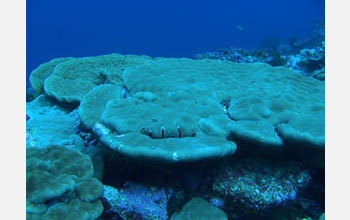
Coral from Kingman atol (Northern Line Islands).

In a find that sheds light on how Earth-like planets may form, astronomers this week reported finding the first evidence of small, sandy particles orbiting a newborn solar system at about the same distance as the Earth orbits the sun.

"Precisely how and when planets form is an open question," said study co-author Christopher Johns-Krull, assistant professor of physics and astronomy at Rice University. "We believe the disk-shaped clouds of dust around newly formed stars condense, forming microscopic grains of sand that eventually go on to become pebbles, boulders and whole planets."

In previous studies, astronomers have used infrared heat signals to identify microscopic dust particles around distant stars, but the method isn't precise enough to tell astronomers just how big they become, and whether the particles orbit near the star, like the Earth does the sun, or much further away at a distance more akin to Jupiter or Saturn.

Individual genes do not cause depression, but they are thought to increase the probability of an individual having a depression in the face of other accumulating risk factors, such as other genes and environmental stressors.

One gene that has been shown to increase the risk for depression in the context of multiple stressful life events is the gene for the serotonin transporter protein. This gene is responsible for making the protein that is targeted by all current drug treatments for depression.

Researchers have identified 25 genes regulating lifespan in two organisms separated by about 1.5 billion years in evolutionary change. At least 15 of those genes have very similar versions in humans, suggesting that scientists may be able to target those genes to help slow down the aging process and treat age-related conditions.

The two organisms used in this study, the single-celled budding yeast and the roundworm C. elegans, are commonly used models for aging research. Finding genes that are conserved between the two organisms is significant, researchers say, because the two species are so far apart on the evolutionary scale -- even farther apart than the tiny worms and humans. That, combined with the presence of similar human genes, is an indication that these genes could regulate human longevity as well.