Banner
Pilot Study: Fibromyalgia Fatigue Improved By TENS Therapy

Fibromyalgia is the term for a poorly-understood condition where people experience pain and fatigue...

High Meat Consumption Linked To Lower Dementia Risk

Older people who eat large amounts of meat have a lower risk of dementia and cognitive decline...

Long Before The Inca Colonized Peru, Natives Had A Thriving Trade Network

A new DNA analysis reveals that long before the Incan Empire took over Peru, animals were...

Mesolithic People Had Meals With More Tradition Than You Thought

The common imagery of prehistoric people is either rooting through dirt for grubs and picking berries...

User picture.
News StaffRSS Feed of this column.

News Releases From All Over The World, Right To You... Read More »

Blogroll

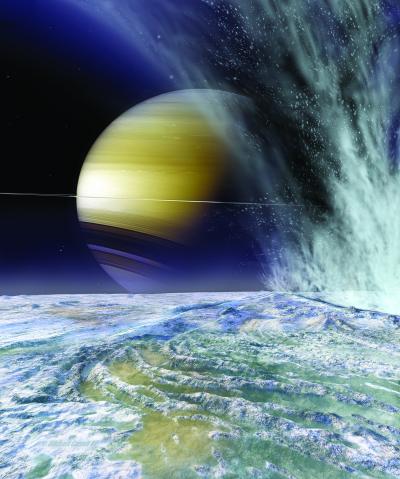
The raging eruption of dust and water from the south pole of Enceladus, Saturn's sixth-largest moon, has intrigued scientists ever since the Cassini spacecraft provided dramatic images of the phenomenon.

Physicist Nikolai Brilliantov from the University of Leicester and colleagues in Germany, have revealed why the dust particles in the plume emerge more slowly than the water vapour escaping from the moon's icy crust.

Enceladus orbits in Saturn's outermost "E" ring. It is one of only three outer solar system bodies that produce active eruptions of dust and water vapour.

Kava has been used in ceremonies and for recreational and social purposes in the South Pacific since ancient times, much like alcohol, tea or coffee is in other societies today.

In the 1980s other medicinal uses for kava began to emerge and it was marketed in herbal form as a natural way to treat conditions such as anxiety, insomnia, tension and restlessness, particularly in Europe and North America.

More recently, evidence began to emerge about the adverse affect kava could have on the liver and serious concerns about the dangers of kava and the effects on the liver have resulted in regulatory agencies, such as the US Food and Drug Administration and Australia's Therapeutic Goods Administration, banning or restricting the sale of kava and kava products.

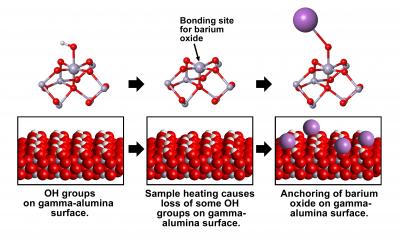
A discovery in molecular chemistry may help remove a barrier to widespread use of diesel and other fuel-efficient "lean burn" vehicle engines. Researchers at the Department of Energy's Pacific Northwest National Laboratory have recorded the first observations of how certain catalyst materials used in emission control devices are constructed.

The PNNL team observed how barium oxide attaches itself to the surface of gamma-alumina. Barium oxide is a compound that absorbs toxic nitrogen oxide, commonly referred to as NOx, from tail-pipe emissions. Gamma alumina is a form of aluminum oxide that is used as a support for catalyst materials, such as barium oxide, that are the active ingredients in exhaust systems.

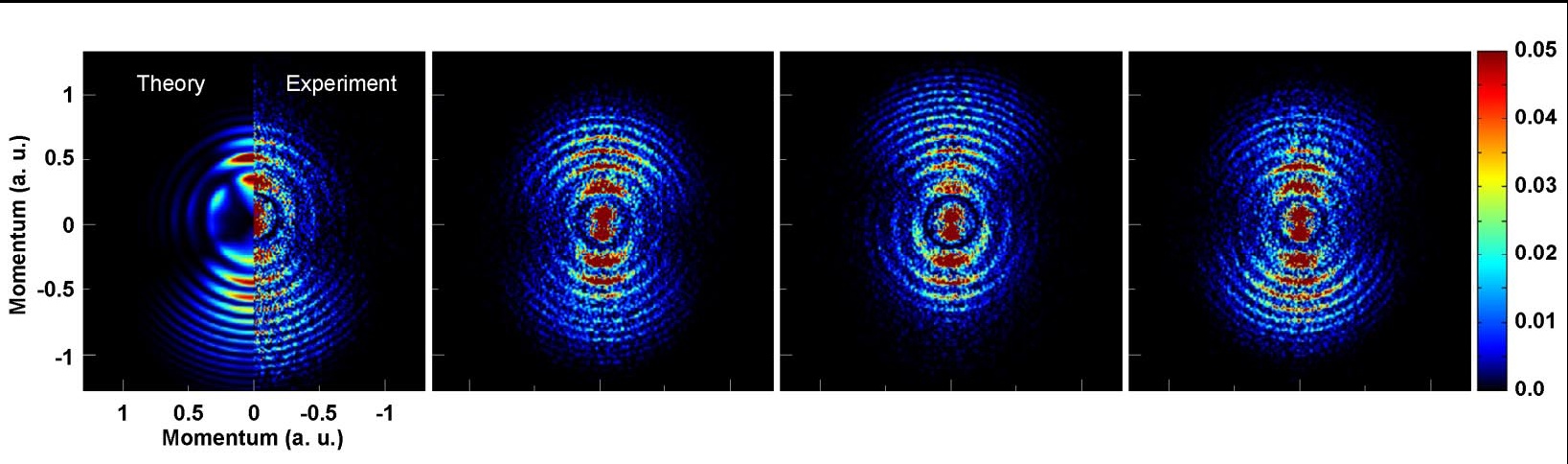
It has always been impossible to clearly photograph electrons since their extremely high velocities have produced blurry pictures. In order to capture these rapid events, extremely short flashes of light are necessary, but such flashes were not previously available.

With the use of a newly developed technology for generating short pulses from intense laser light, so-called attosecond pulses, scientists at the Lund University Faculty of Engineering in Sweden have managed to capture the electron motion for the first time.

The movie shows how an electron rides on a light wave after just having been pulled away from an atom.

“Antarctica is the ultimate destination for anyone interested in natural history but it also challenges those people who visit to think broadly about our responsibilities to all life on Earth.”

That’s the view of Dr Robert Lambert, a lecturer on Tourism and the Environment at The University of Nottingham, who has just returned from the Antarctic in his role as an Observer for the International Association of Antarctica Tour Operators (IAATO).

Dr Lambert, who is a member of the Business School’s Christel DeHaan Tourism and Travel Research Institute, says the relationship between nature and people is complex and constantly changing and great positives can come from tourism in Antarctica. He believes those lucky enough to experience it could become ambassadors for the region to help develop a ‘constituency’ of support for Antarctica.

American adults have a higher prevalence of stroke than their European counterparts, due in part to a higher rate of stroke risk factors among Americans and barriers to care in the United States, according to a study presented at the American Stroke Association’s International Stroke Conference 2008.

Compared to European men, U.S. men had 61 percent higher odds of having a stroke and U.S. women had almost twice the odds of stroke as European women.

“Most of this gap is among relatively poor Americans who were, in our data, much more likely to have a stroke than poor Europeans, whereas the gap in stroke prevalence is less marked between rich Americans and rich Europeans,” said Mauricio Avendano, Ph.D., author of the study. “Risk factors alone do not account for the differences we found, which points to the role of broader healthcare and structural policies.”