Banner
Pilot Study: Fibromyalgia Fatigue Improved By TENS Therapy

Fibromyalgia is the term for a poorly-understood condition where people experience pain and fatigue...

High Meat Consumption Linked To Lower Dementia Risk

Older people who eat large amounts of meat have a lower risk of dementia and cognitive decline...

Long Before The Inca Colonized Peru, Natives Had A Thriving Trade Network

A new DNA analysis reveals that long before the Incan Empire took over Peru, animals were...

Mesolithic People Had Meals With More Tradition Than You Thought

The common imagery of prehistoric people is either rooting through dirt for grubs and picking berries...

User picture.
News StaffRSS Feed of this column.

News Releases From All Over The World, Right To You... Read More »

Blogroll

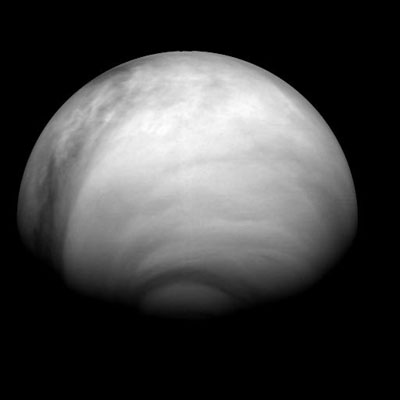
Venus, it turns out, is a planet of extraordinarily changeable and extremely large-scale weather. Bright hazes appear in a matter of days, reaching from the south pole to the low southern latitudes and disappearing just as quickly. This kind of ‘global weather’, unlike anything on Earth, has given scientists a new mystery to solve.

The cloud-covered world of Venus is all but a featureless, unchangeable globe at visible wavelengths of light. Switch to the ultraviolet and it reveals a truly dynamic nature. Transient dark and bright markings stripe the planet, indicating regions where solar ultraviolet radiation is absorbed or reflected, respectively.

In July 2007, the Venus Monitoring Camera (VMC) captured a series of images showing the development of a bright southern haze.

The first direct evidence of how and when tectonic plates move, that collision with one sliding below the other into the rocky mantle, could potentially improve their ability to assess earthquake risks.

A team of researchers writing in Nature found that, contrary to common scientific predictions, dense plates tend to be held in the upper mantle, while younger and lighter plates sink more readily into the lower mantle.

The mantle is a zone underneath the Earth's crust encompassing its super hot molten core. It is divided into an upper and lower area, and is made up of a 2,900 km circumference of churning, viscous rock. It is constantly fed with new material from parts of tectonic plates which slide down from the surface into it.

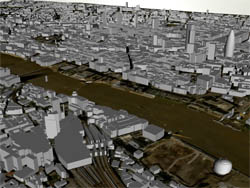
A new way of looking at cities has emerged during the last 20 years that could revolutionise planning and ultimately benefit city dwellers.

‘The Size, Scale and Shape of Cities’ in Science advocates an integrated approach to the theory of how cities evolve by linking urban economics and transportation behaviour with developments in network science, allometric growth and fractal geometry.

Professor Batty argues that planning’s reliance on the imposition of idealised geometric plans upon cities is rooted in the nineteenth century attitude which viewed cities as chaotic, sprawling and dirty.

Researchers at Dana-Farber Cancer Institute have found a previously unknown molecular pathway in mice that spurs the growth of new blood vessels when body parts are jeopardized by poor circulation.

At present, their observation adds to the understanding of blood vessel formation. In the future, though, the researchers suggest it is possible that the pathway could be manipulated as a means of treating heart and blood vessel diseases and cancer.

Bruce Spiegelman, PhD, and his colleagues at Dana-Farber discovered that PGC-1alpha – a key metabolic regulatory molecule – senses a dangerously low level of oxygen and nutrients when circulation is cut off and then triggers the formation of new blood vessels to re-supply the oxygen-starved area – a process known as angiogenesis.

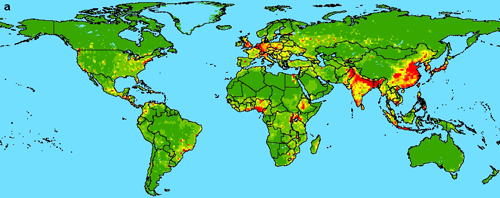
Deadly emerging diseases have risen steeply across the world and an international research team has provided the first scientific evidence mapping the outbreaks’ main sources.

They say:

New diseases originating from wild animals in poor nations are the greatest threat to humans and;

Expansion of humans into shrinking pockets of biodiversity and resulting contacts with wildlife are the reason.

Meanwhile, richer nations are nursing other outbreaks, including multidrug-resistant pathogen strains, through overuse of antibiotics, centralized food processing and other technologies.


Zoonotic pathogens passed from wildlife to people, from lowest occurrence (green) to highest (red).

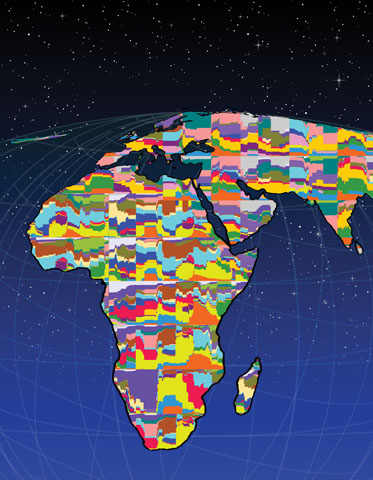
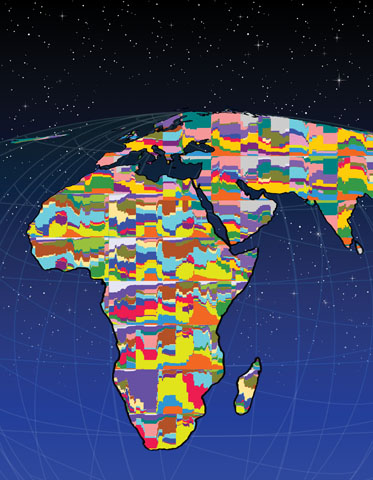
University of Michigan scientists and their colleagues at the National Institute on Aging have produced the largest and most detailed worldwide study of human genetic variation, a treasure trove offering new insights into early migrations out of Africa and across the globe.

Like astronomers who build ever-larger telescopes to peer deeper into space, population geneticists like Noah Rosenberg are using the latest genetic tools to probe DNA molecules in unprecedented detail, uncovering new clues to humanity's origins.

The latest study characterizes more than 500,000 DNA markers in the human genome and examines variations across 29 populations on five continents.


A schematic of worldwide human genetic vari