Banner
Pilot Study: Fibromyalgia Fatigue Improved By TENS Therapy

Fibromyalgia is the term for a poorly-understood condition where people experience pain and fatigue...

High Meat Consumption Linked To Lower Dementia Risk

Older people who eat large amounts of meat have a lower risk of dementia and cognitive decline...

Long Before The Inca Colonized Peru, Natives Had A Thriving Trade Network

A new DNA analysis reveals that long before the Incan Empire took over Peru, animals were...

Mesolithic People Had Meals With More Tradition Than You Thought

The common imagery of prehistoric people is either rooting through dirt for grubs and picking berries...

User picture.
News StaffRSS Feed of this column.

News Releases From All Over The World, Right To You... Read More »

Blogroll

Tiny particles of pure silica coated with an active material could be used to remove toxic chemicals, bacteria, viruses, and other hazardous materials from water much more effectively and at lower cost than conventional water purification methods, according to researchers writing in the International Journal of Nanotechnology.

Peter Majewski and Chiu Ping Chan of the Ian Wark Research Institute, at the University of South Australia, explain that the availability of drinking quality water is fast becoming a major socio-economic issue across the globe, especially in the developing world. However, water purification technology is often complicated, requires sophisticated equipment and is expensive to run and maintain. Moreover, it usually requires a final costly disinfection stage. The Australian team suggests that nanotechnology could provide a simple answer to the problem.

ESA’s Integral has made the first unambiguous discovery of high-energy X-rays coming from a rare massive star at our cosmic doorstep, Eta Carinae. It is one of the most violent places in the galaxy, producing vast winds of electrically-charged particles colliding at speeds of thousands of kilometres per second.

The only astronomical object that emits gamma-rays and is observable by the naked eye, Eta Carinae is monstrously large, so large that astronomers call it a hypergiant. It contains between 100–150 times the mass of the Sun and glows more brightly than four million Suns put together. Astronomers know that it is not a single star, but a binary, with a second massive star orbiting the first.

When the public considers competing arguments about a new technology’s potential risks and benefits, people will tend to agree with the expert whose values are closest to their own, no matter what position the expert takes. The same will hold true for nanotechnology, a key study has found.

The study results appear in a report issued today by the Project on Emerging Nanotechnologies (PEN). The study was based on experiments involving some 1,600 American adults and was carried out by the Cultural Cognition Project at Yale Law School — an interdisciplinary team of researchers from Yale University, the University of Washington, The George Washington University, Cornell University, and Decision Research in Eugene, Oregon.

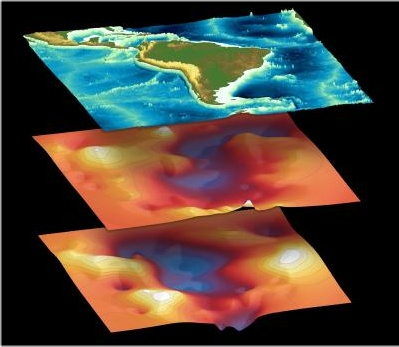
Volcanoes are notoriously hard to study. All the action takes place deep inside, at enormous temperatures. So geophysicists make models, using what they know to develop theories about what they don’t know.

Research led by Gregory P. Waite, an assistant professor of geophysics at Michigan Technological University, has produced a new seismic model for figuring out what’s going on inside Mount St. Helens, North America’s most active volcano. Waite hopes his research into the causes of the earthquakes that accompany the eruption of a volcano will help scientists better assess the hazard of a violent explosion at Mount St. Helens and similar volcanoes.

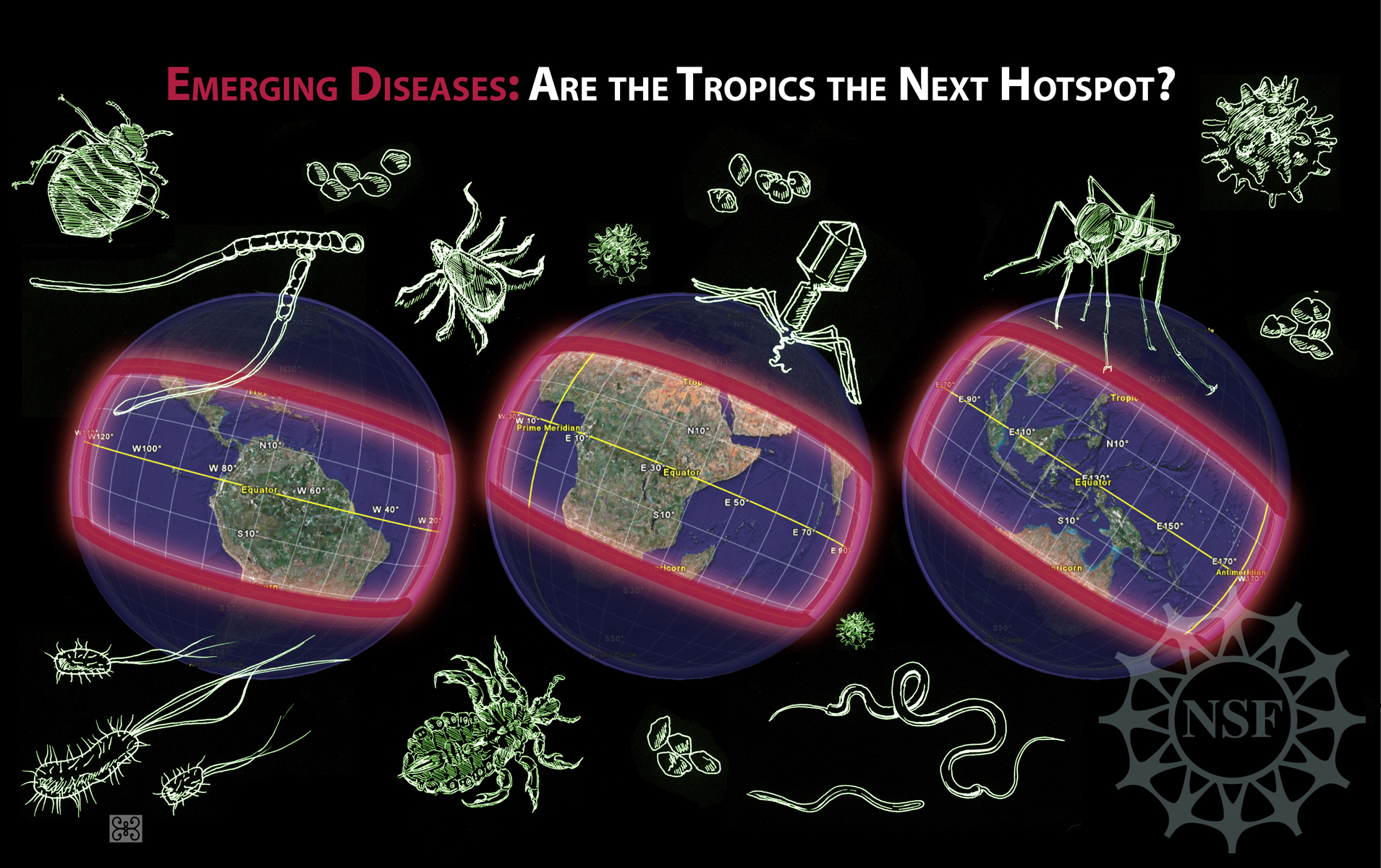
Scientists from four well-known institutions say the next major disease like HIV/AIDS or SARS could occur in any of a number of developing countries concentrated along the equator. They encourage increased surveillance to prevent the spread of a potential outbreak.

Using global databases and sophisticated computer models to analyze patterns of emerging diseases, the researchers -- from the Consortium for Conservation Medicine (CCM) at Wildlife Trust, N.Y., the Institute of Zoology, London, U.K., Columbia University, N.Y., and the University of Georgia, Athens, Ga.

While studying towards his doctorate of philosophy, Anders Jørgensen discovered a previously undescribed species of parasite that infects farmed fish and produces serious disease.

Single-celled parasites of the genus Spironucleus are known to produce serious illness in farmed and aquarium fish. In farmed salmon, these parasites create foul-smelling, puss-filled abscesses in muscles and internal organs. After the first outbreaks of this disease were described in farmed salmon in the late 1980’s, it was assumed that the cause was Spironucleus barkhanus, which is a fairly common parasite in the intestine of wild grayling and Arctic char. In these fish species, however, the parasite is benign.