Banner
Pilot Study: Fibromyalgia Fatigue Improved By TENS Therapy

Fibromyalgia is the term for a poorly-understood condition where people experience pain and fatigue...

High Meat Consumption Linked To Lower Dementia Risk

Older people who eat large amounts of meat have a lower risk of dementia and cognitive decline...

Long Before The Inca Colonized Peru, Natives Had A Thriving Trade Network

A new DNA analysis reveals that long before the Incan Empire took over Peru, animals were...

Mesolithic People Had Meals With More Tradition Than You Thought

The common imagery of prehistoric people is either rooting through dirt for grubs and picking berries...

User picture.
News StaffRSS Feed of this column.

News Releases From All Over The World, Right To You... Read More »

Blogroll

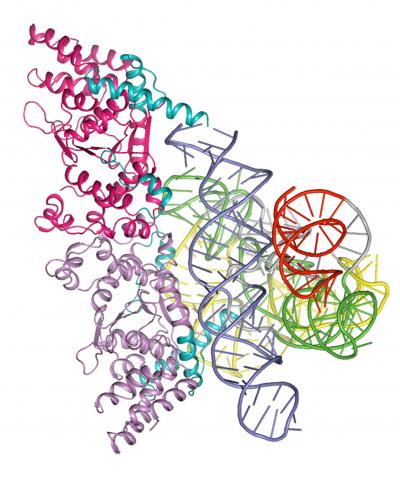
The crystal structure of a molecule from a primitive fungus has served as a time machine to show researchers more about the evolution of life from the simple to the complex.

By studying the three-dimensional version of the fungus protein bound to an RNA molecule, scientists from Purdue University and the University of Texas at Austin have been able to visualize how life progressed from an early self-replicating molecule that also performed chemical reactions to one in which proteins assumed some of the work.

"Now we can see how RNA progressed to share functions with proteins," said Alan Lambowitz, director of the University of Texas Institute for Cellular and Molecular Biology.

New observations from Suzaku, a joint Japanese Aerospace Exploration Agency (JAXA) and NASA X-ray observatory, have challenged scientists’ conventional understanding of white dwarfs. Observers had believed white dwarfs were inert stellar corpses that slowly cool and fade away, but the new data tell a completely different story.

At least one white dwarf, known as AE Aquarii, emits pulses of high-energy (hard) X-rays as it whirls around on its axis. "We’re seeing behavior like the pulsar in the Crab Nebula, but we’re seeing it in a white dwarf," says Koji Mukai of NASA Goddard Space Flight Center in Greenbelt, Md. The Crab Nebula is the shattered remnant of a massive star that ended its life in a supernova explosion.

Neurosurgeons from the University of California, San Francisco are reporting significant results of a new brain mapping technique that allows for the safe removal of tumors near language pathways in the brain. The technique minimizes brain exposure and reduces the amount of time a patient must be awake during surgery.

Perhaps even more profound, the study provides new data that refines scientists’ understanding of how language is organized within the human cortex. It identifies new regions involved in speech production, reading and naming. The team used this data to generate a three-dimensional cortical language map that is more detailed and integrates more data than any language map of the brain ever generated.

Are we running out of helium? Lee Sobotka, professor of chemistry and physics at Washington University in St. Louis, says it is being depleted so rapidly in the world’s largest reserve, outside of Amarillo, Tex., that supplies are expected to be gone there within the next eight years.

The helium we have on earth is not readily renewable, it has been built up over billions of years from the decay of natural uranium and thorium. The decay of these elements proceeds at a super-snail’s pace.

It will impact more than balloons and kids' voices, Sobotka says. “Helium’s use in science is extremely broad but its most important use is as a coolant. Helium is non-renewable and irreplaceable.

A class of chemicals in red wine grapes may significantly reduce the ability of bacteria to cause cavities, according to a study published recently in the Journal of Agricultural and Food Chemistry.

The findings suggest that specific polyphenols, present in large amounts in fermented seeds and skins cast away after grapes are pressed, interfere with the ability of bacteria to contribute to tooth decay. Beyond cavities, the action of the wine grape-based chemicals may also hold clues for new ways to lessen the ability of bacteria to cause life-threatening, systemic infections.

Bacteria that eat sugar and release cavity-causing acid onto teeth may soon be made dramatically more vulnerable to their own acid. Researchers have identified key genes and proteins that, if interfered with, can take away the ability of a key bacterial species to thrive as its acidic waste builds up in the mouth.

The ability of Streptococcus mutans (S. mutans) to survive in acid is one reason that the species is the main driver of tooth decay worldwide. Past research has shown that this ability has several components including a bacterial enzyme called fatty acid biosynthase M (FabM), which when shut down, makes S. mutans almost precisely 10,000 times more vulnerable to acid damage.