




A few media content creators and commenters keep returning to the topic of the swirls of what they refer to as smoke which they claim can be seen in the airport surveillance footage of the Air India 171 tragedy.
To a very high degree of probability there was no smoke and no engine fire, nor any indication of engine damage. Like so many airports around the world, Ahmedabad airport is very dusty. Also, like many cities, Ahmedabad suffers from significant air polution1.
All planes disturb the air in which they fly. Apart from the propwash or jet exhaust there are vortices generated at the wingtips as, in simple terms, the air flowing over the wing meets the air flowing from under it. When a plane takes off those vortices meet the ground and are deflected. The bigger the plane, the bigger the vortices. This disturbed air, wake turbulence, can upset or even bring down any plane that flies into it.
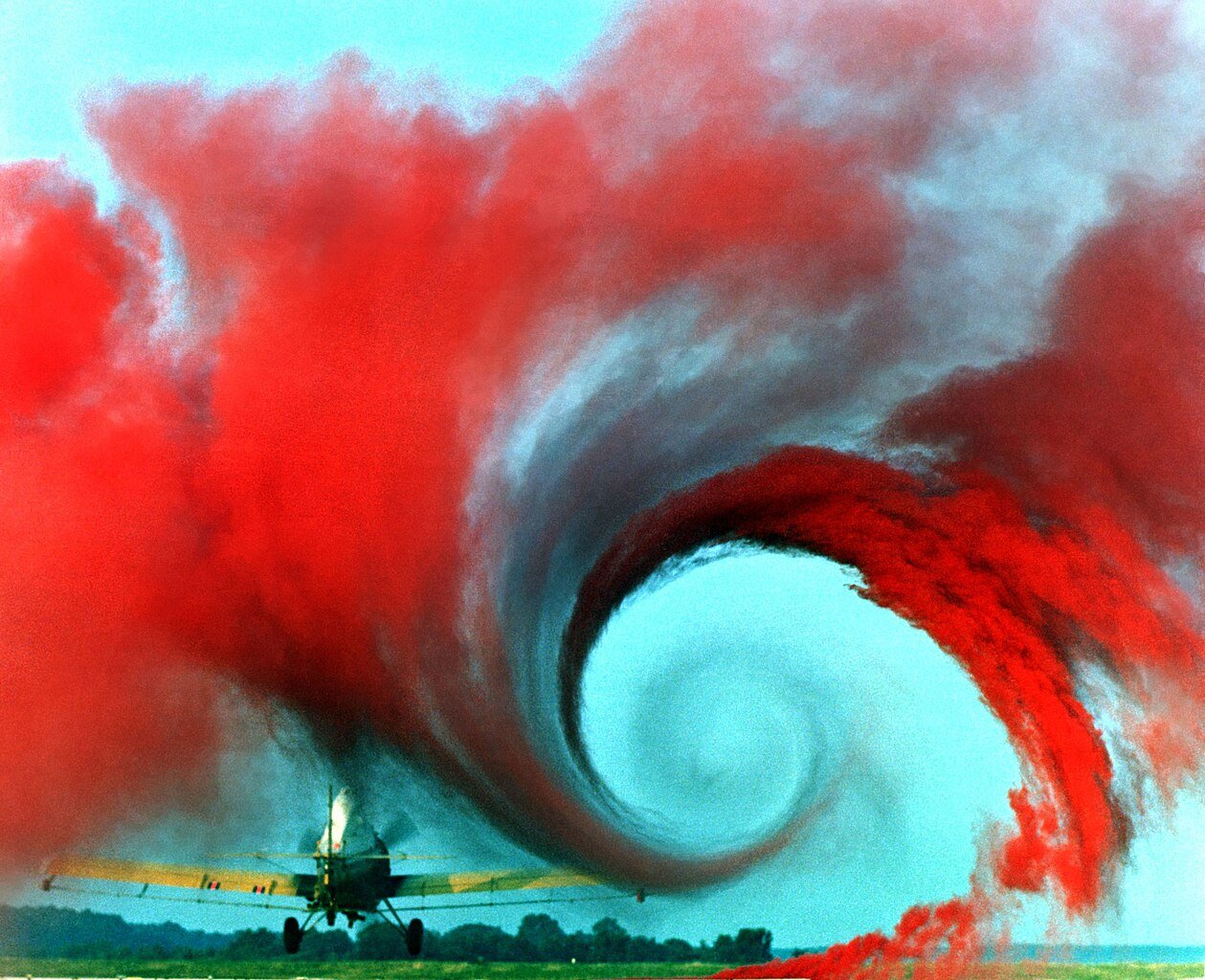
Wake Turbulence. Image courtesy Wikipedia2.
Given the power of wake turbulence to endanger following aircraft it should not be surprising to note that it can lift dust. More, and heavier dust than is disturbed by an average breeze or wind. The amount of dust lofted by wind or wake turbulence depends on air speed, particle size, particle mass and particle cohesion. In simple terms: light and dry dust is lofted by a given air speed in greater volumes than heavier moist dust.
The amount of dust available to be lofted at any given airport varies with soil type and with ground cover. Ground cover may include concrete, tarmac, grass or anything that tends to prevent lofting of soil particles.
Dust emission is a main source of aerosol in the atmosphere and is highly sensitive to wind velocity.
...
As wind is the only driving force for dust emission to occur, the study of dust emission requires the knowledge of 10 m wind speed, the threshold velocity under which the dust emission takes place (Kim et al., 2013)
Dust emission from different soil types in the northwest and the Indo-Gangetic Plains of India3
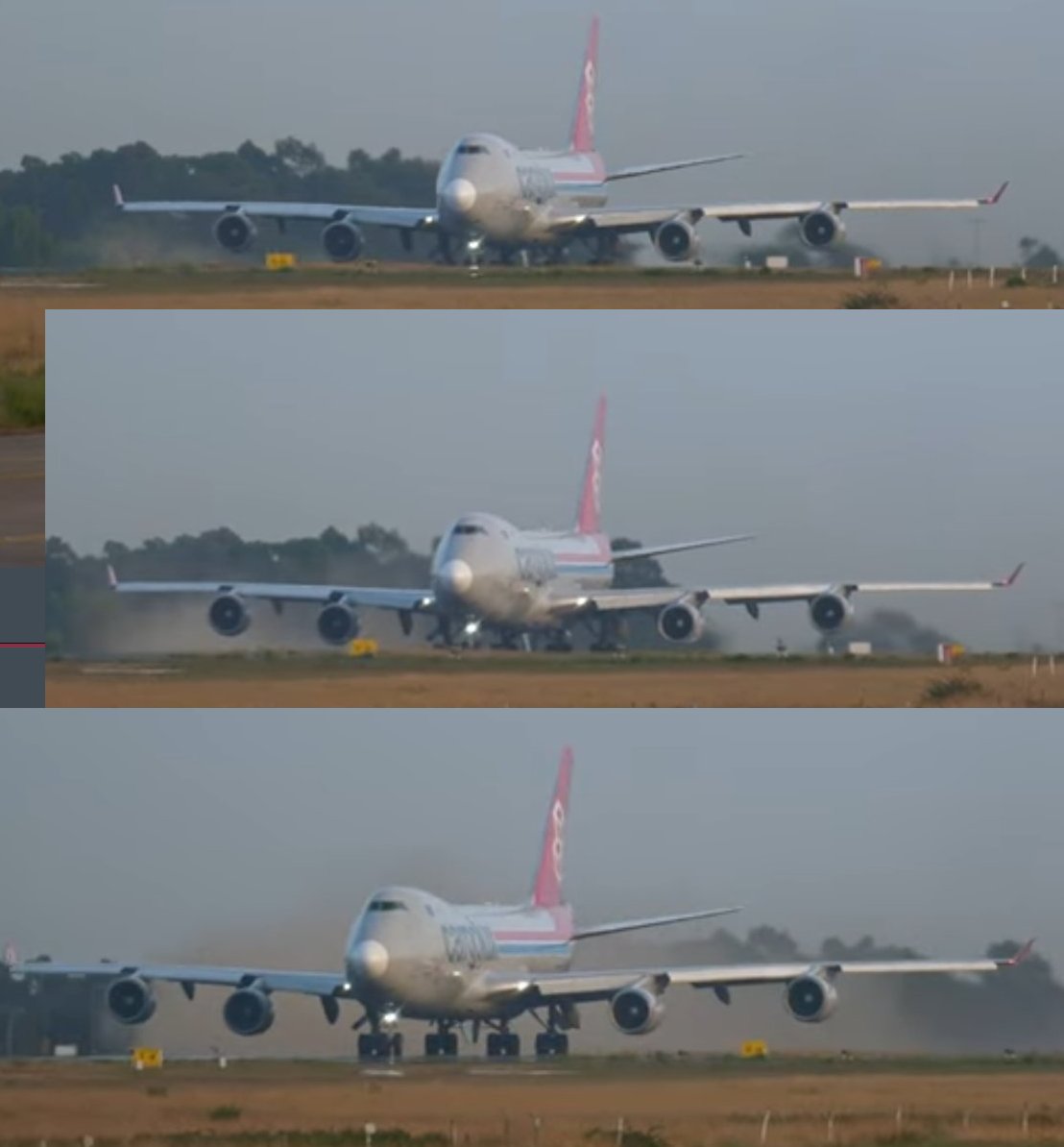
Cargolux Dusty Takeoff at Porto, Portugal. Screenshots from a Youtube video4
The images above show that it is normal to see dust swirls when a plane takes off. The images and linked video also support the common sense and common knowledge idea that more dust is lofted from bare earth than from grass-covered earth.
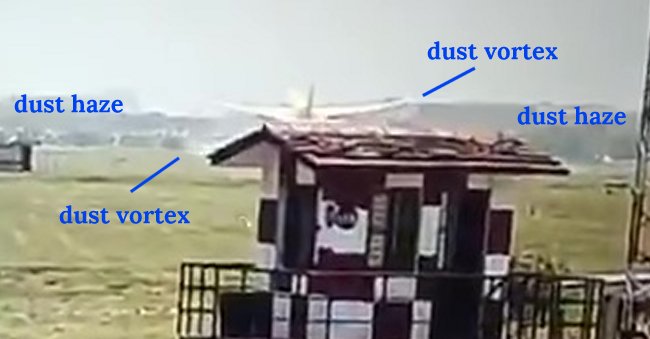
Air India Dust In Wake Turbulence
This screenshot from the airport surveillance video shows wake turbulence lofting dust. More dust is lofted by the left wingtip than the right because of the greater area of the earth to the left of the plane, whereas the earth to the right is of less area because it is interupted by taxiways. Depending on the time of year and the degree of maintenance, the soil can be dry or damp, grass covered or almost bare.
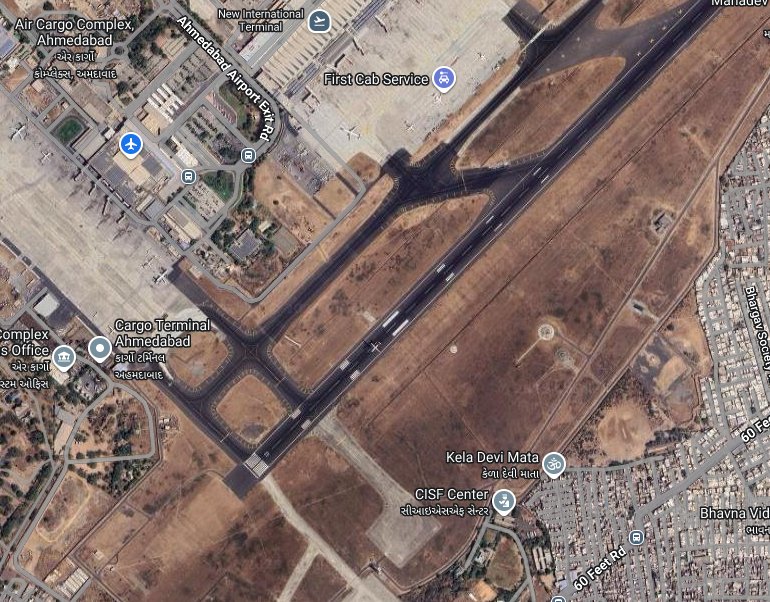
Ahmedabad Airport, showing bare soil beside the runway.
Atmospheric Dust: A Global Health Hazard
Fine particle pollution, PM is already a major public health concern, because it can penetrate deep into the respiratory tract (disrupting heart and lung function) and already exceeds safe levels in Indian cities. Due to its microscopic size, PM can lodge deep in the lungs and cause irreparable respiratory harm, especially in children.
The highest contributor of PM2.5 in the cities naturally comes from industrial emissions (including power generation), followed by emissions from road re-suspension and construction activities, further followed by transport emissions from road, rail, aviation and shipping.
What Ahmedabad Can Do To Reduce AQI5
Dust: A Hazard To Machines
It is widely known that dust can damage machinery. That is why reciprocating engines have air filters. It is why hydraulic mechanisms and vehicle suspension systems are sealed to attempt to prevent dust ingress. Less well known is that dust can have an adverse effect on electronics.
Every material has three electrical properties: resistance, inductance and capacitance. Resistance is the tendency to oppose a flow of current. Inductance is a tendency to oppose a change in the rate of flow of current. Capacitance is the ability to store an electrostatic charge. Dust on small wires, circuit tracks or electronic components can change their capacitance. At the high frequencies encountered in modern computers, electronics and communication systems a relatively minor change in capacitance can cause data corruption per se, or data unreliability through errors of critical timing.
Airport Dust Mitigation.
There would seem to be an obvious cost benefit in mitigating dust problems at airports. Dust can damage planes and the health of all humans who use the airport. Ahmedabad Airport is moving in that direction.
In sync with the global vision of increasing green cover, SVPIA in its current initiatives has planted over 2,000 trees of nearly 20 different species at the airport. Just before privatisation a year back, the airport had about 6,000 trees and has increased that to 8,000 with the recent addition of 2,000 trees in just one year. Adding to green cover and reducing carbon footprint, the SVPI airport has been taking up several initiatives, one of them being increasing greenery inside and outside terminal buildings. The airport has also added about 2,000 square metres of shrubs and 1,200 square metres of green cover using lawn turf.There is no ideal solution to airport dust. London's Docklands Airport aka London City Airport has grass and water each side of the runway. This is ideal as far as dust is concerned but is probably not ideal for landing a plane with lateral stability issues.
asianaviation.com 16 Jan 2022 Ahmedabad Airport works to improve green credentials6
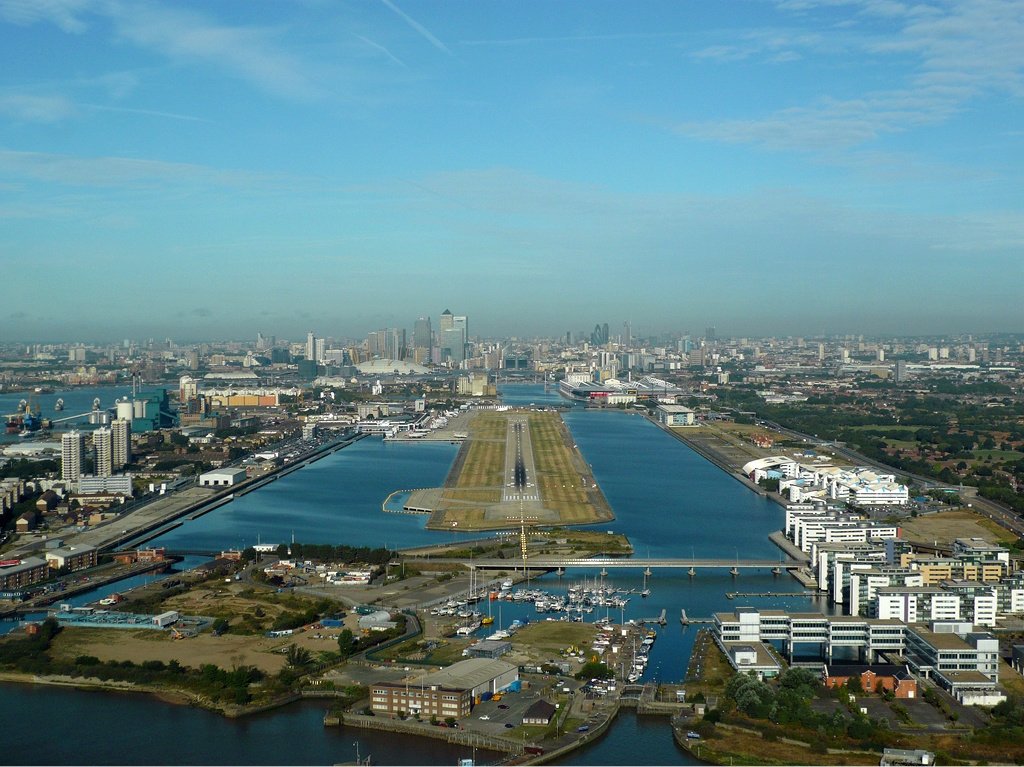
That Airport also has a an EMAS7 zone, an Engineered materials arrestor system. The primary purpose of such zones is to rapidly decelerate a plane which goes off the runway with minimal damage to the plane. It has a secondary value in that it covers bare soil and so reduces dust uplift.
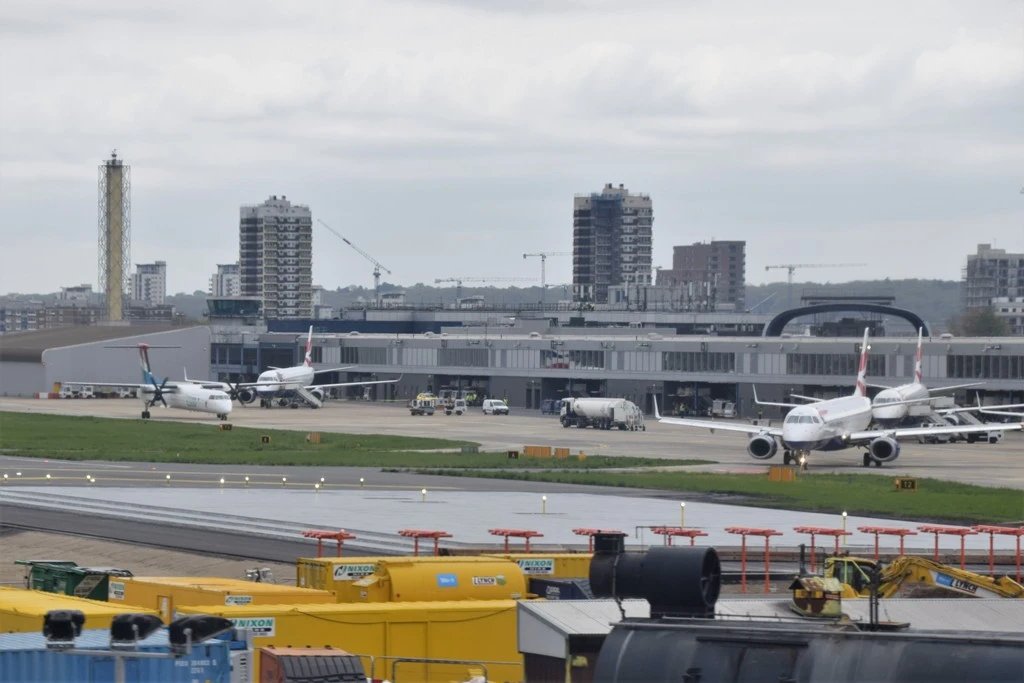
Engineered materials arrestor system
Conclusion
Given the facts about dust in general and Ahmedabad in particular it is far more likely that dust is seen in the AI 171 video, rather than smoke.
In an ideal world those responsible for airports would do everything possible to safeguard the health of people and planes by taking steps to reduce dust uplift by planes. EMAS zones adjacent to runways would have a high initial cost but low maintenance costs. Also, EMAS zones can save lives.
Sources
1 - Ahmedabad Air Pollution
https://timesofindia.indiatimes.com/city/ahmedabad/industrial-hubs-recor...
2 - Wikipedia - Wake Turbulence
https://en.wikipedia.org/wiki/Wake_turbulence
3 - Dust emission from different soil types in the northwest and the Indo-Gangetic Plains of India
Atmósfera 28(4), 251-260 (2015)
doi: 10.20937/ATM.2015.28.04.04
4 - Cargolux Dusty Takeoff at Porto, Portugal
https://youtu.be/CWSwz9wMgxA?si=LzBCtZSHNSbT3Gud
5 - What Ahmedabad Can Do To Reduce AQI
https://thesecretariat.in/article/what-ahmedabad-can-do-to-reduce-aqi
6 - Ahmedabad Airport works to improve green credentials
https://asianaviation.com/ahmedabad-airport-works-to-improve-green-crede...
7 - Engineered materials arrestor system
https://en.wikipedia.org/wiki/Engineered_materials_arrestor_system
Further Information
A Dust Storm In Ahmedabad
https://www.researchgate.net/publication/374628499_EXAMINATION_OF_A_DUST...
What is Wake Turbulence? | Causes | Factors | Avoidance
https://youtu.be/MpFro6HohsI?si=40FBJ0kh9ZZY22ye
.



Comments