




I am indeed as proud as a first-timer, despite the fact that spires lists 416 papers with my name on the front page, a couple dozens of which as only author. The reason is that this morning, after ten days of work which I had expected to be three and which felt like a month, I was finally able to give the final touches and submit to the arxiv a paper which is has a special personal meaning: it is the first scientific article which is based on material I wrote on this blog. Well, what do I know. For sure the first one with my name on the front page!
I can imagine two different reactions from the reading of the above statements.
1) "He has gone nuts, and this is the final proof".I think the truth is roughly in the middle. For sure it is a rather unconventional thing to work hard on a problem for the (at least initial) only goal of writing a blog post; and this I certainly did, although to be precise the blog posts were at least three. And for sure, being in the condition of reusing one's writing efforts for additional projects -scientific papers, newspaper articles, books, you name them- is a considerably effective way of using one's time.
2) "He has reached the blogging nirvana, where whatever gets written in a blog bears fruit."
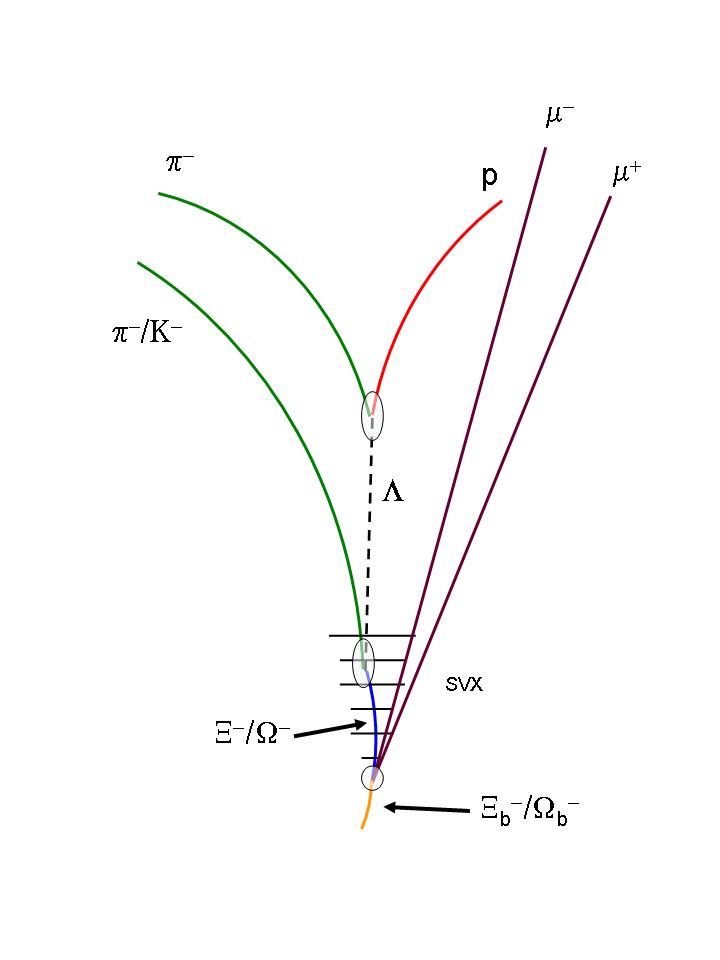 Now, the paper. It is based on investigations I made in May this year (part I, part II, part III), when the CDF observation of the Omega_b baryon, a very fancy hadron made up by a bottom and two strange quarks, caused some confusion in the world of experimental particle physics (see the decay products of a
 The very solid evidence of the particle flew in the face of a previous observation of the same particle by the antagonist experiment, D0, which had obtained a similarly solid signal one year before, but with quite different measured characteristics. In particular, the mass.
The two results are incompatible by 6.2 standard deviations, something that happens by chance only once in a billion times or so. Were CDF and D0 observing two different particles ? And if not, which of the two measurements was wrong ?
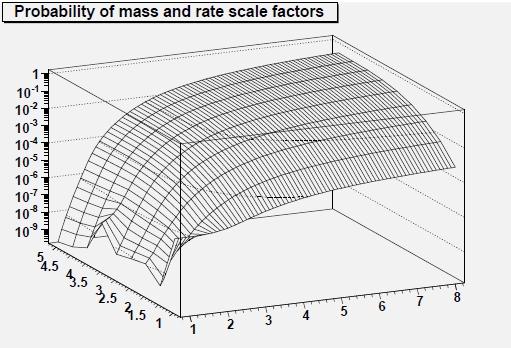 You can read my posts on the matter by following the links above; the more curious among you might however fancy downloading the original paper I submitted (ps file, pdf file): you will thus read it before anybody else, given that the Cornell preprint archive takes a couple of days to publish submitted material (maybe to have time to censor unwanted submissions, as was argued here). You might even just browse through the 14-page document and just concentrate on the figure pasted on the left, which summarizes my findings.
So, if you want to know why the D0 estimate of the probability that their signal is due to a statistical fluctuation was underestimated by a factor seventy, read my paper. I assure you it is quite readable and there is no hard physics in it. Below are title and abstract. Enjoy!
Type-I Error or Mass Bias ? An Investigation on the  Discovery
T.Dorigo
Abstract
T.Dorigo
Abstract
The D0 and CDF collaborations recently published two independent analyses that both claim to represent the observation of the Omega_b particle, a baryon made up by a (bss) quark combination. Both signals are estimated to exceed the statistical significance of five standard deviations; however, the mass measurements derived from the candidates differ by over six standard deviations, accounting for estimated systematics. Measured rates also appear to differ, although they remain compatible within the large uncertainties.
In this paper the author recomputes the significance of the D0 result, showing that it was considerably overestimated in the original publication; he then investigates with a pseudoexperiment-based approach which, among different hypotheses, appears the most likely cause of the observed discrepancy between the D0 and CDF signals.
In this paper the author recomputes the significance of the D0 result, showing that it was considerably overestimated in the original publication; he then investigates with a pseudoexperiment-based approach which, among different hypotheses, appears the most likely cause of the observed discrepancy between the D0 and CDF signals.



Comments