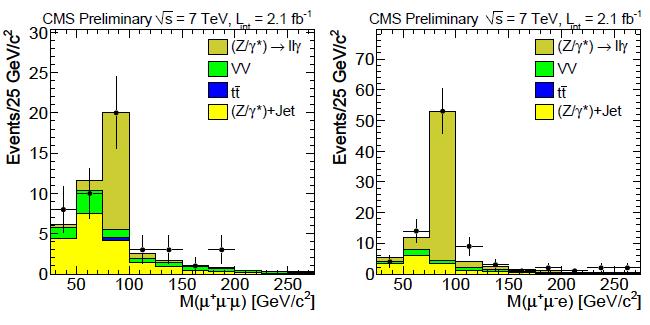
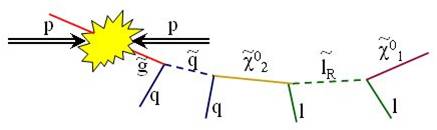
A process which caught some of the LHC Higgs analysts by surprise in the recent run of analyses for summer 2011 conferences is the production of multiple-lepton events by a process called "internal photon conversion in Z events". What is it, and how can we size it up ?
The conversion of a real, energetic photon into a fermion-antifermion
pair readily occurs when the particle traverses a medium: the process is also known as "pair production", and is the leading form of energy loss of energetic photons in matter. It is thanks to it (and to the related process called "bremsstrahlung" of energetic electrons) that our electromagnetic calorimeters can measure electrons and photons!
A routine check of the hep-ex preprints in the Cornell Arxiv revealed today some interesting papers worth giving a look. At least, they are interesting to me: don't expect me to publicize stuff I do not understand or care about! Also, I should mention that many more interesting papers are daily produced, but one cannot really follow everything...
So here is a short list with minimal commentary, for those of you willing to expand your knowledge with a half hour of paper browsing.
This morning I read with interest
a paper on Physics Today, titled "
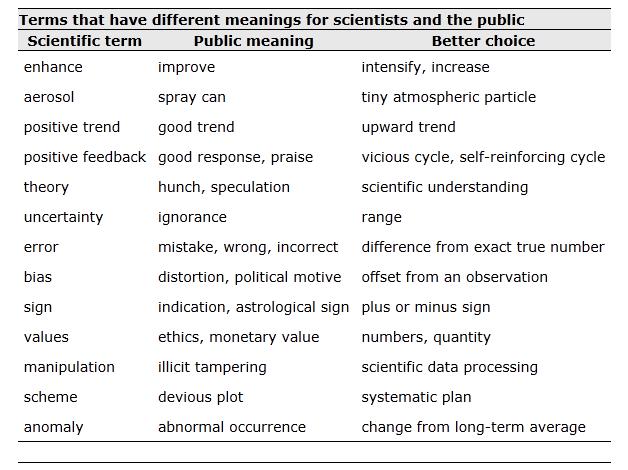
Communicating the Science of Climate Change", by R. Somerville and S. Hassol. In it, there is a table worth pondering about. Here it is:
October is passing and the neutrino saga continues to make headlines here and there, but I know that the excitement is bound to slowly dampen, as the preprint claiming superluminal speeds ages in the Arxiv without being sent to a scientific magazine.
I was happy to see today a very nice piece discussing the Opera result on allegedly superluminal motion of muon neutrinos, written by Paolo Ciafaloni, a colleague from Lecce University. The piece is in Italian, so you either know the language or need to revert to google translate or some other web resource in order to make sense of it. But the nice thing is that Paolo is caressing the idea of writing a blog of his own, and maybe in English - maybe for Science 2.0 .
The saga of the superluminal neutrinos took a dramatic turn today, with the publication of a
very simple yet definitive study by ICARUS, another neutrino experiment at the Gran Sasso Laboratories, who has looked at the neutrinos shot from CERN since 2010.


 Choosing Your Bets: The Selection Bias
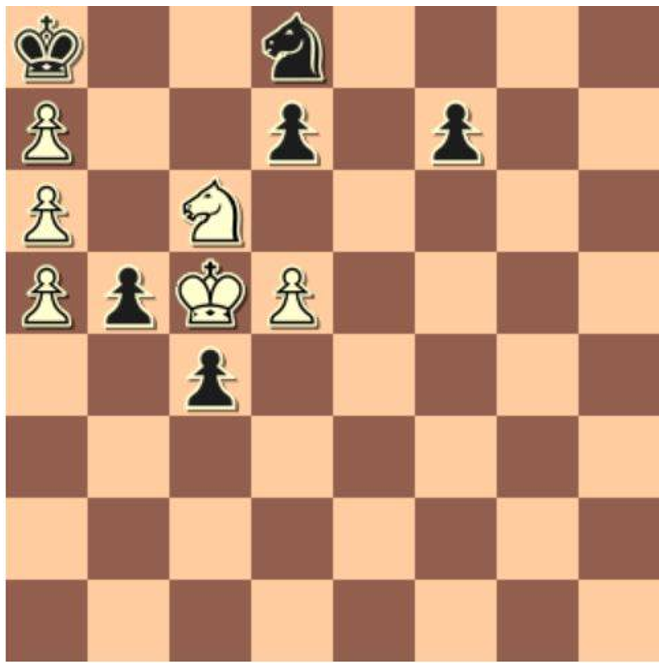 A Chess Study Requiring Backpropagation
 Co-Design Of Scientific Experiments