Fake Banner
Choosing Your Bets: The Selection Bias

As some of the long-time readers of this blog know, in this column I have occasionally discussed...

Have A Master In Science, Want A Post-Doc Position Directly?

Do you have a master in Science, and want to start a Post-Doc position directly? You can have it...
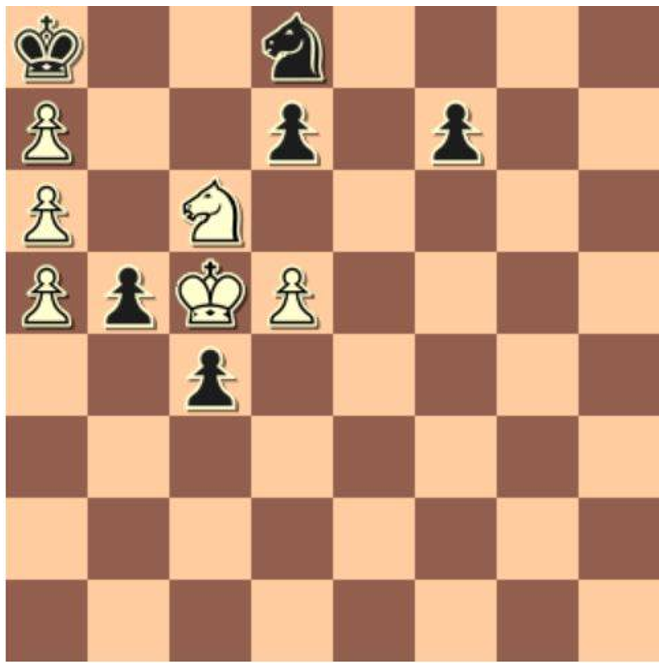
A Chess Study Requiring Backpropagation

The following position is a win for white. But how?It seems like white is able to grab a knight...
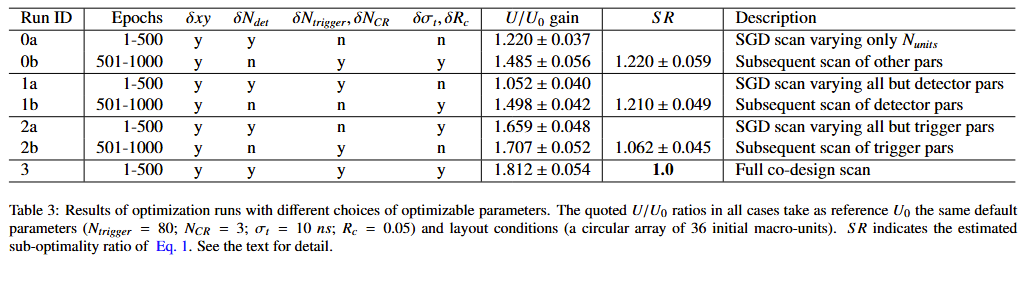
Co-Design Of Scientific Experiments

Next Monday, or Tuesday at the latest, you will find a new bulky paper in the arXiv. Titled "On...

User picture.
picture for Hank Campbellpicture for Heidi Hendersonpicture for Patrick Lockerbypicture for Bente Lilja Byepicture for Sascha Vongehrpicture for Johannes Koelman
Tommaso DorigoRSS Feed of this column.

Tommaso Dorigo is an experimental particle physicist, who works for the INFN at the University of Padova, and collaborates with the CMS and the SWGO experiments. He is the president of the Read More »

Blogroll

A few days ago I received from my esteemed colleague Massimo Passera, a theorist and an INFN director of research in the Padova section where I also work, a draft of a new article he produced with his colleagues Antonio Masiero and Paride Paradisi, which is relevant to my present interests. The paper discusses what new physics effects could be accessible by the precision measurement of elastic scattering of energetic muons off electrons, in a setup which is being considered at the CERN north area for the determination of the hadronic contribution to the effective electromagnetic coupling (the article has meanwhile being published in the arXiv).

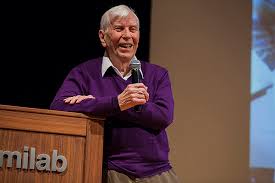
The Tevatron collider, the giant marvel accelerator built at the Fermi National Accelerator Laboratory in the eighties and operated there for over thirty years, until its demise in 2012, lost one of its fathers the other day, as Alvin Tollestrup passed away.

Tollestrup was maybe the key contributor to the project of putting together a 1-TeV particle accelerator, solving many issues for the construction of its superconducting magnets. But he also was for a long time the spokesperson of the CDF experiment, and the driving force behind the collective effort that led CDF to see a first evidence of the top quark in 1994, and then claim discovery for the long sought sixth quark in 1995.

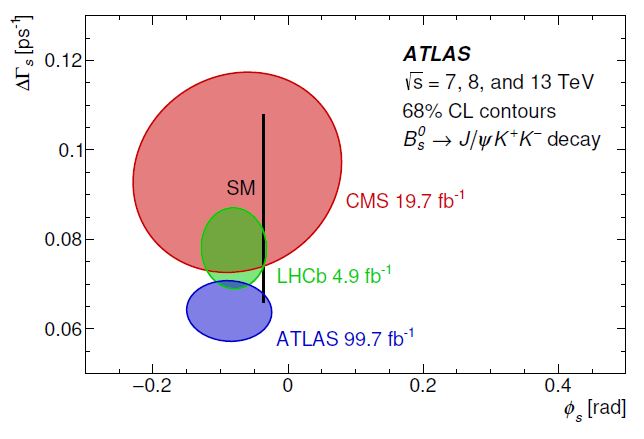
The ATLAS Collaboration has released last week the results of a careful analysis of a large dataset of proton-proton collisions acquired during Run 2 of the Large Hadron Collider. This is a measurement of CP violation effects in the system of B hadrons.

Although LHC and ATLAS are things that readers of Science20 may be acquainted with, I realize that the previous 14-word sentence contains already a mention of at least four unknown entities to 99.99% of non specialists, so I suspect I have to open a parenthesis already now.

One of the most suprising results of the "Machine Learning for Jets" (but really, for particle physics in general) workshop I attended in New York City two weeks ago was the outcome of a challenge that the organizers had proposed to the participants: find a hidden signal of some new physics process in a dataset otherwise made up of some physics background, when no information on the new physics was given, nor on the model of the background.<\p>

The third "Machine Learning for Jets" workshop is ongoing these days at the Kimmel centre of New York University, a nice venue overlooking Washington Square park in downtown Manhattan. I came to attend it and remain up-to-date with the most advanced new algorithms that are been used for research in collider physics, as I have done last year. The workshop is really well organized and all talks are quite interesting, so this is definitely a good time investment for me.

What hurts you is not what you don't know, but those mistaken assumptions which "everyone knows to be true".
[The following text is courtesy Andras Kovacs - T.D.]