Fake Banner
Choosing Your Bets: The Selection Bias

As some of the long-time readers of this blog know, in this column I have occasionally discussed...

Have A Master In Science, Want A Post-Doc Position Directly?

Do you have a master in Science, and want to start a Post-Doc position directly? You can have it...
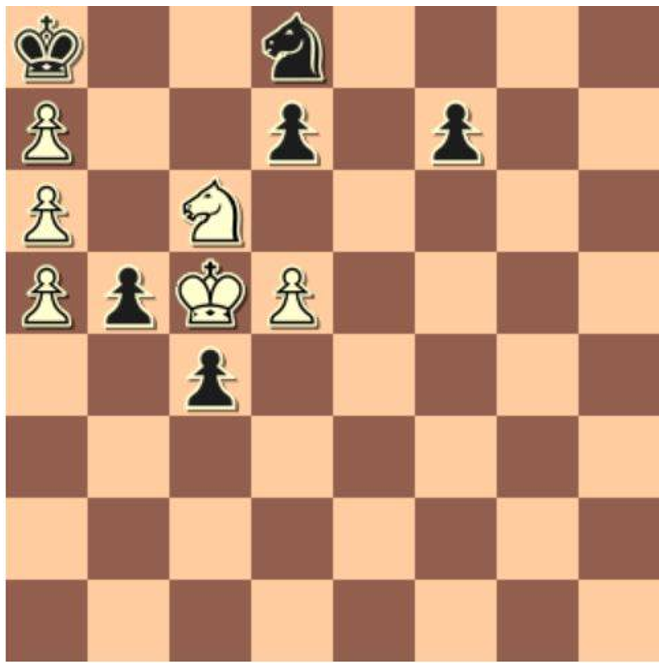
A Chess Study Requiring Backpropagation

The following position is a win for white. But how?It seems like white is able to grab a knight...
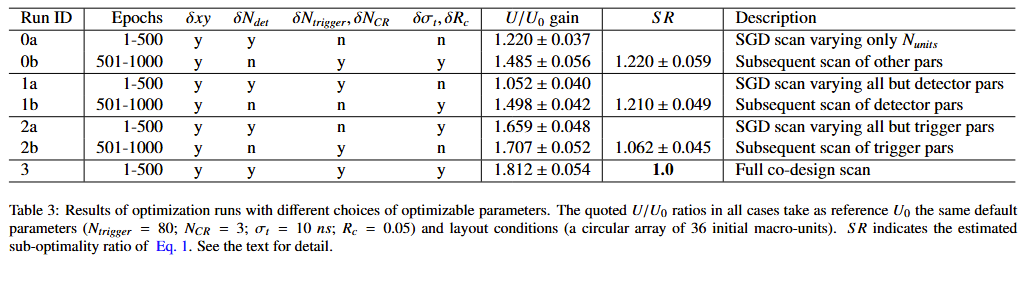
Co-Design Of Scientific Experiments

Next Monday, or Tuesday at the latest, you will find a new bulky paper in the arXiv. Titled "On...

User picture.
picture for Hank Campbellpicture for Heidi Hendersonpicture for Patrick Lockerbypicture for Bente Lilja Byepicture for Sascha Vongehrpicture for Johannes Koelman
Tommaso DorigoRSS Feed of this column.

Tommaso Dorigo is an experimental particle physicist, who works for the INFN at the University of Padova, and collaborates with the CMS and the SWGO experiments. He is the president of the Read More »

Blogroll
The ATLAS and CMS collaborations released yesterday a joint document where they discuss the combination of their measurements of the rate of production of single top quarks in proton-proton collisions delivered by the LHC collider. The exercise is not an idle one, as the physics behind the production processes is interesting, and its study as well as the precise comparison of experimental results and theory predictions improves our ability to predict other reactions, wherein we might find deviations from the currently accepted theory, the Standard Model.
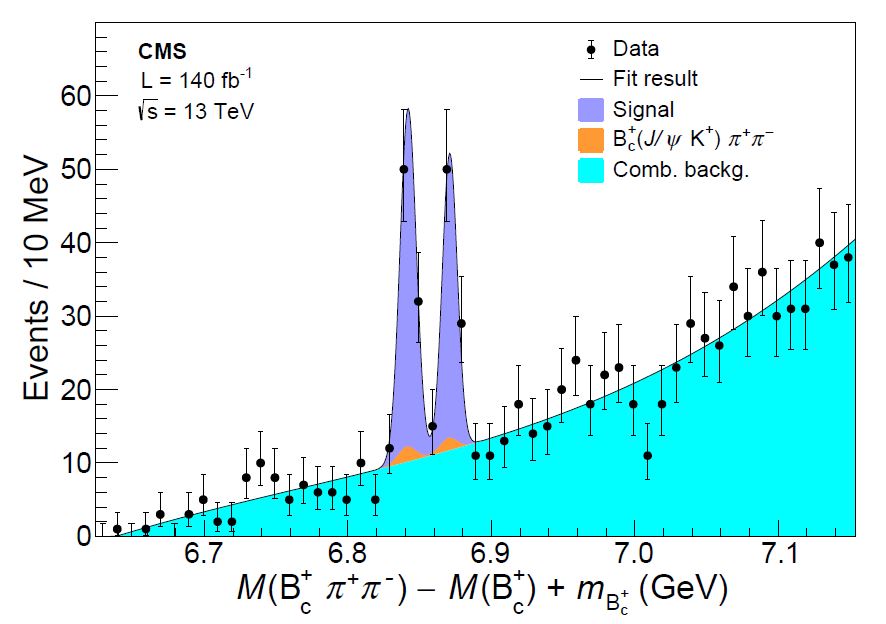
I am very happy to report today that the CMS experiment just confirmed to be an excellent spectrometer - as good as they get, I would say - by discovering two new excited B hadrons. The field of heavy meson spectroscopy proves once again to be rich with new gems ready to be unearthed, as we collect more data and dig deeper. For such discoveries to be made, collecting as many proton-proton collisions as possible is in fact the decisive factor, along with following up good ideas and preserving our will to not leave any stone unturned.

A school and symposium in Data Science in (Astro)-Particle Physics and Cosmology will be held on March 25 to 27 in Braga (Portugal). I am going to lecture on Machine Learning there, while prof. Glen Cowan will provide lectures in Statistics. I have provided a summary of the contents of my lectures in the previous post in this blog. The registrations to attend the school are now open, and I am distributing an announcement here.

On March 25 to 27 will be held the school titled "Data Science in (astro)particle physics and cosmology", in Braga (Portugal). The lecturers are prof. Glen Cowan (RHUL), who will cover Statistics, and myself, who will cover topics in Machine Learning. I thought I would mention this here, as for me it is a novelty - in the past years I have often given lectures in advanced statistics topics at various Ph.D. schools around the world, but I never focused explicitly and solely on ML.


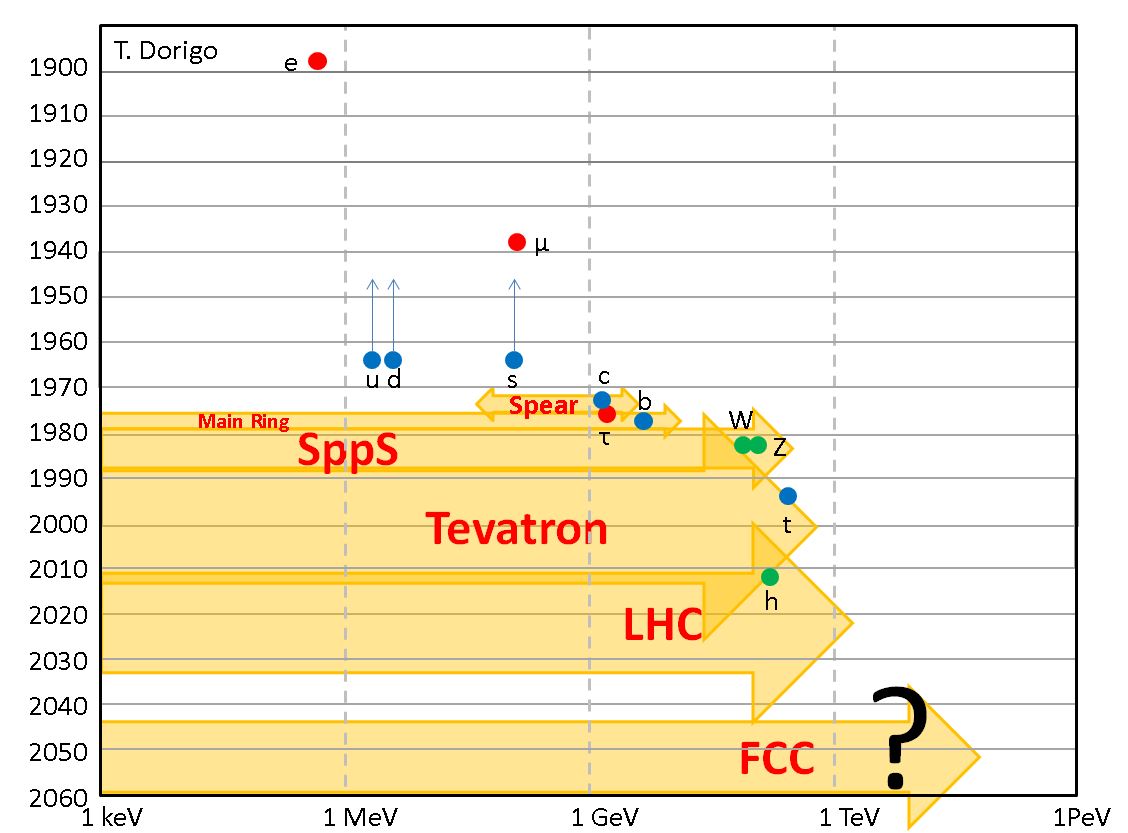
In the previous post I discussed, among other things, a purely empirical observation on the mass spectrum of elementary particles, which I summarized in a graph where on the vertical scale I put the year of discovery, and where I only cared to plot particles with a mass above a keV - in fact, we know that neutrinos have non-zero masses, but we have not measured them and they are of the order of an eV or below. Okay, for simplicity I will re-publish the graph below.

I have long been of the opinion that writing about science for the public requires the writer to simplify things down to a level which is sometimes dangerously close to mislead the uninformed readers. I think is a small price to pay if you want to keep open the channel of communication with the general public, but it is indeed a narrow path the one you sometimes find yourself walking on, and fallacy is always a possible outcome.