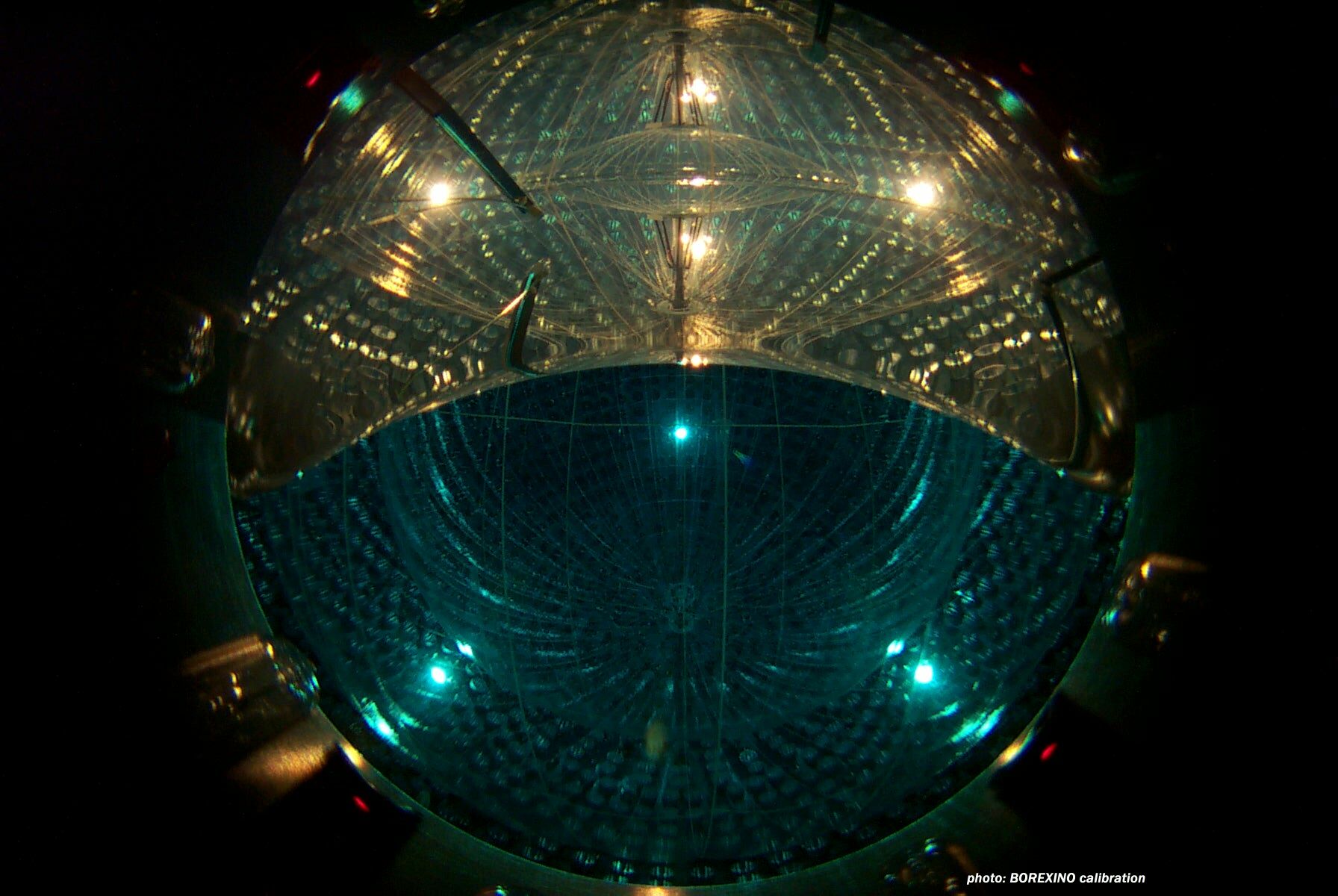
An experiment designed to study neutrinos at the Gran Sasso Laboratories in Italy is under attack by populistic media. Why should you care? Because it's a glaring example of the challenges we face in the XXI century in our attempt to foster the progress of the human race.
What is a neutrino? Nothing - it's a particle as close to nothing as you can imagine. Almost massless, almost perfectly non-interacting, and yet incredibly mysterious and the key to the solution of many riddles in fundamental physics and cosmology. But it's really nothing you should worry about, or care about, if you want to lead your life oblivious of the intricacies of subnuclear physics. Which is fine of course - unless you try to use your ignorance to stop progress.
Following the appearance of
Kent Staley's review of my book
"Anomaly!" in the November 2017 issue of Physics Today, the online site of the magazine offers, starting today,
an interview with yours truly. I think the piece is quite readable and I encourage you to give it a look. Here I only quote a couple of passages for the laziest readers.
Another quite positive review of my book
"Anomaly! Collider Physics and the Quest for New Phenomena at Fermilab" (which these days is 40% off at the World Scientific site I am linking) has appeared on
Physics Today this month.
Writing a serious review of research in particle physics is a refreshing job - all the things that you already knew on that specific topic once sat on a fuzzy cloud somewhere in your brain, and now find their place in a tidily organized space, with clear interdependence among them. That's what I am experiencing as I progress with a 60-pageish thing on hadron collider searches for diboson resonances, which will appear sometime next year in a very high impact factor journal.
Today at CERN a workshop started on the physics of the High-Luminosity and High-Energy phases of Large Hadron Collider operations. This is a three-days event meant at preparing the ground for the decision on which, among several possible scenarios that have been pictured for the future of particle physics in Europe, will be the one on which the European Community will invest in the next few decades. The so-called "European Strategy for particle physics" will be decided in a couple of years, but getting the hard data on which to base that crucial decision is today's job.
Some context