Following the appearance of
Kent Staley's review of my book
"Anomaly!" in the November 2017 issue of Physics Today, the online site of the magazine offers, starting today,
an interview with yours truly. I think the piece is quite readable and I encourage you to give it a look. Here I only quote a couple of passages for the laziest readers.
Another quite positive review of my book
"Anomaly! Collider Physics and the Quest for New Phenomena at Fermilab" (which these days is 40% off at the World Scientific site I am linking) has appeared on
Physics Today this month.
Writing a serious review of research in particle physics is a refreshing job - all the things that you already knew on that specific topic once sat on a fuzzy cloud somewhere in your brain, and now find their place in a tidily organized space, with clear interdependence among them. That's what I am experiencing as I progress with a 60-pageish thing on hadron collider searches for diboson resonances, which will appear sometime next year in a very high impact factor journal.
Today at CERN a workshop started on the physics of the High-Luminosity and High-Energy phases of Large Hadron Collider operations. This is a three-days event meant at preparing the ground for the decision on which, among several possible scenarios that have been pictured for the future of particle physics in Europe, will be the one on which the European Community will invest in the next few decades. The so-called "European Strategy for particle physics" will be decided in a couple of years, but getting the hard data on which to base that crucial decision is today's job.
Some context
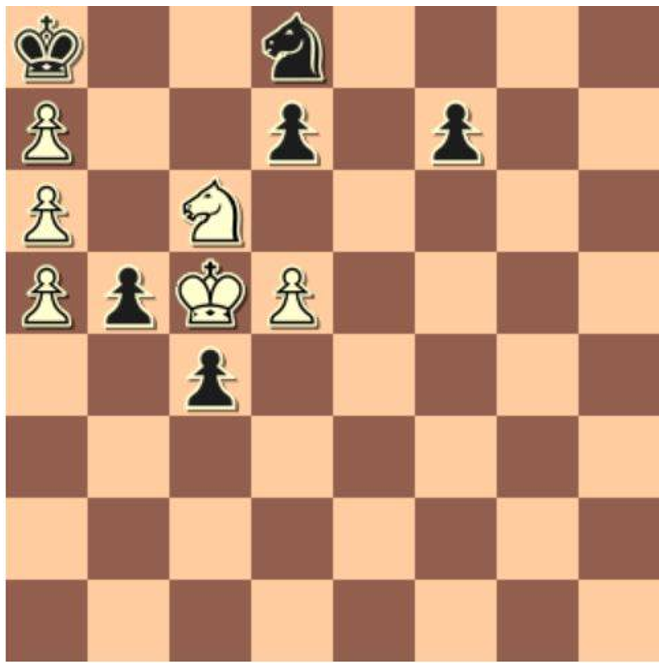
My activity as a chessplayer has seen a steady decline in the past three years, due to overwhelming work obligations. To play in chess tournaments at a decent level, you not only need to be physically fit and well trained for the occasion, but also have your mind free from other thoughts. Alas, I have been failing miserably in the second and third of the above requirements. So I have essentially retired from competitive chess, and my only connection to the chess world is through the occasional 5-minute blitz game over the internet.
Yesterday, October 20, was the
international day of Statistics. I took inspiration from it to select a clip from chapter 7 of my book
"Anomaly! Collider physics and the quest for new phenomena at Fermilab" which attempts to explain how physicists use the concept of statistical significance to give a quantitative meaning to their measurements of new effects. I hope you will enjoy it....
----


 Choosing Your Bets: The Selection Bias
 A Chess Study Requiring Backpropagation
 Co-Design Of Scientific Experiments









