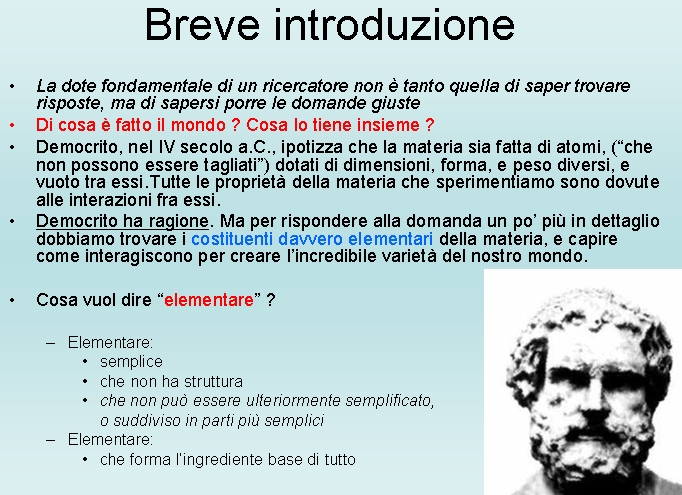
Last week in Tesero, in front of an audience of 150 interested laypersons, I spoke about the marvels of particle physics (the poster of the conference I gave is below, click to enlarge). My first slide made clear what I believe is the most important gift of a researcher -theorist or experimentalist- in fundamental science:
I am not a believer of any faith, and the most common prayer you can hear from my voice is "pass the salt". However, I claim I have the right to have my own opinion on what is worth praying for.
Praying for oneself or one's beloved relatives or friends is too selfish an occupation to deserve my attention. Praying for the world in general, for world peace, or for the human race, on the other hand, sounds a bit too ambitious for any single voice. There must be a middle ground.
On Friday evening I was in Tesero, where a crowd of 150 interested laypersons attended my talk on particle physics, organized by the very active
Gruppo Astrofili Fiemme. There, among other things, I discussed the challenge that is on between the Fermilab experiments in the United States and the CERN experiments in Europe. I will discuss elsewhere the successful evening; here I just want to show the status of data collection by the two challengers.
The physics news in August have so far disappointed me, with the only remarkable one being the sad departure of Nicola Cabibbo. After ICHEP 2010, with the frenzy of paper production that has characterized the month of July in all major particle physics experiments, it was easy to predict a slower pace. So I did not lose too much, apparently, by spending four weeks in Greece and one week in the Italian Alps.
But effective today, I am back in business. This means no more four-day hiatuses in updates of my blog (due to the trouble with accessing the web from the remote locations I have confined myself in), and a more effective coverage of news from the world of High-Energy Physics.
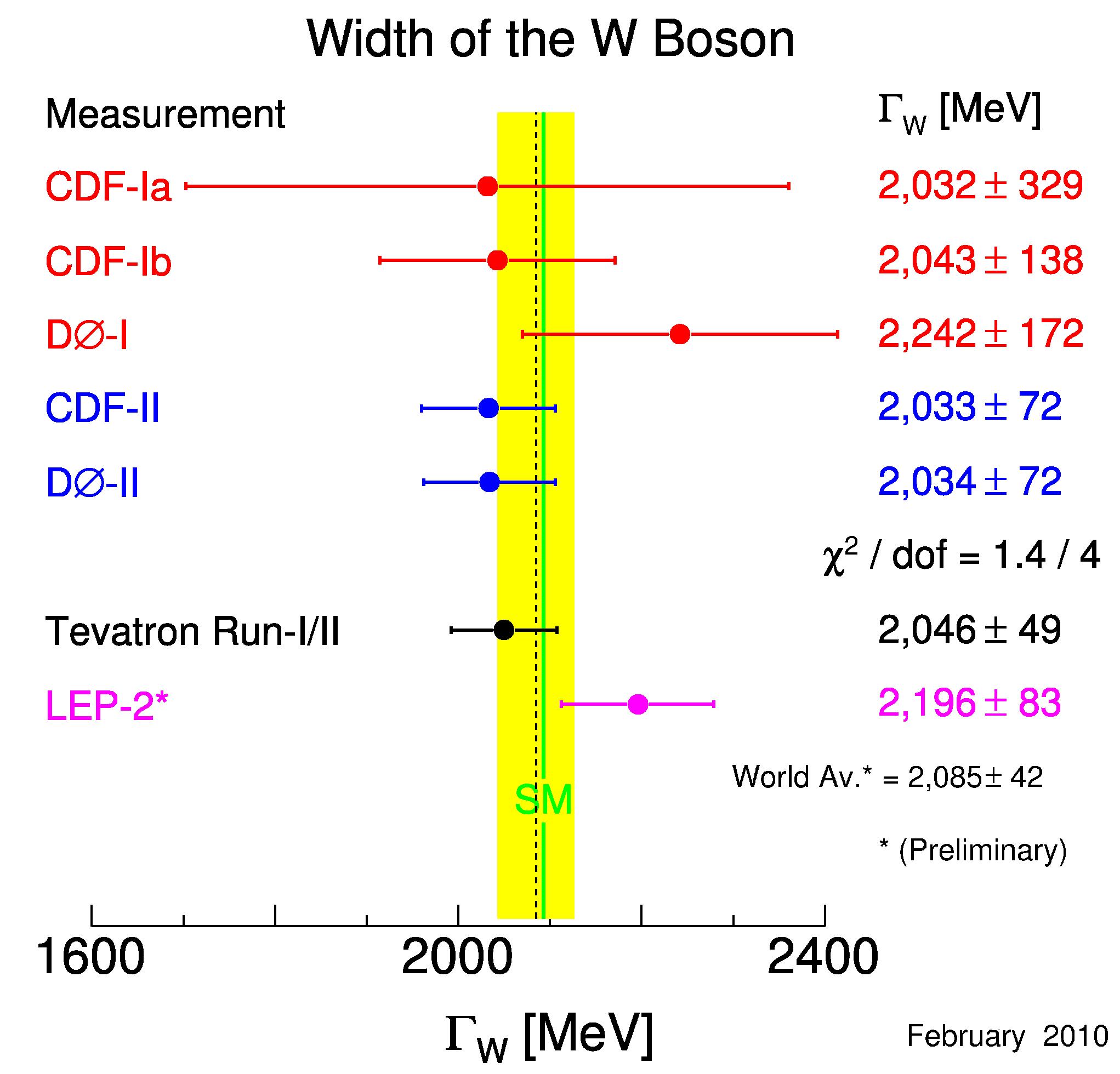
Being still in the middle of a rather long vacation (now in the Italian eastern alps), my blogging power is limited. So today I will just offer you some thoughts on the recent measurements of a fundamental parameter of the Standard Model called "W boson width".
The W boson, like any unstable subatomic particle, has a very short lifetime, which depends on the strength of its couplings to lighter particles, on its own mass (generally the heavier a particle is, the faster is its disintegration), and on the availability of lighter bodies into which to decay without breaking any fundamental rule.


 A Research Position In Neuromorphic Computing And Nanophotonics Open In Padova, Italy