The formulation of a fun physics problem with practical -and pleasant- applications occurred to me yesterday. I am currently spending a week in Madrid with my family, and we have chosen a very nice hotel in the suburbs, sacrificing travel time to the center for comfort. Among other things, the hotel offers a nice pool with several water jets along the sides. These are meant to allow you to swim against the water stream, so that you keep the same position as you push yourself against the stream.
We are on. This afternoon just after 1PM the LHC beams have started to produce proton-proton collisions in the heart of the experiments, at the never-before achieved energy of 7 TeV.
It was a long journey to get here -the project is twenty years old- but this is just the start of a new, more exciting one: In the course of the next two years, the Large Hadron Collider will gradually increase its power, allowing the CMS and ATLAS detectors to collect enough data to significantly extend into discovery territory.
"Berlusconi at times has some remorses, but then he thinks at how rich he is and he feels fine again".
Daniele Luttazzi
I received news on a brand new discovery by the MAGIC collaboration today, and I wish to inform you about it. Here follows the communication from Mose' Mariotti on behalf of the MAGIC team:
The MAGIC Collaboration reports the discovery of VHE (E >100 GeV)
emission from the new source MAGIC J0317+413. The source was in the
field of view of the MAGIC telescopes between October 2009 and February
2010. The emission position is consistent with the head-tail radio
galaxy IC310 (z=0.0189, RA: 03 16 43.0 Dec: +41 19 29, J2000) located
in the outer region of the Perseus cluster of galaxies (Abell 426). A
gamma-ray signal with a significance corresponding to >6 standard
deviations was obtained from 20 hours taken in stereoscopic observation
The number in the title, interpreted in units per square centimeters per second, is a flux rate, and it is a new world record set by the Tevatron collider last night on the number of protons and antiprotons forced to cross each other within a tiny interaction region in the core of the CDF and DZERO experiments.


 A Research Position In Neuromorphic Computing And Nanophotonics Open In Padova, Italy








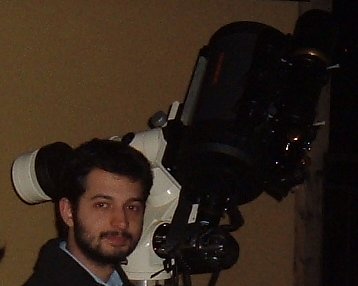 Marco Silva (right) is an amateur astronomer since the 1997 Hale-Bopp comet passage. He is also an amateur scientist. His studies can be found



