The field of particle physics is populated with believers and skeptics. The believers will try to convince you that new physics is about to be discovered, or that is anyway at close reach. The skeptics will on the other hand look at the mass of confirmations of the current theory -the Standard Model- and claim that any speculation about the existence of discoverable new phenomena has no basis.
A search just
posted on the Cornell arXiv by the ATLAS Collaboration caught my eye today, as it involves a signature which I have been interested on for quite a while. This is the final state of proton-proton collisions that includes an energetic photon and a recoiling dijet system, when the dijet system may be the result of the decay of a W or Z boson - or of a heavier partner of the Z, called Z'.
The setting
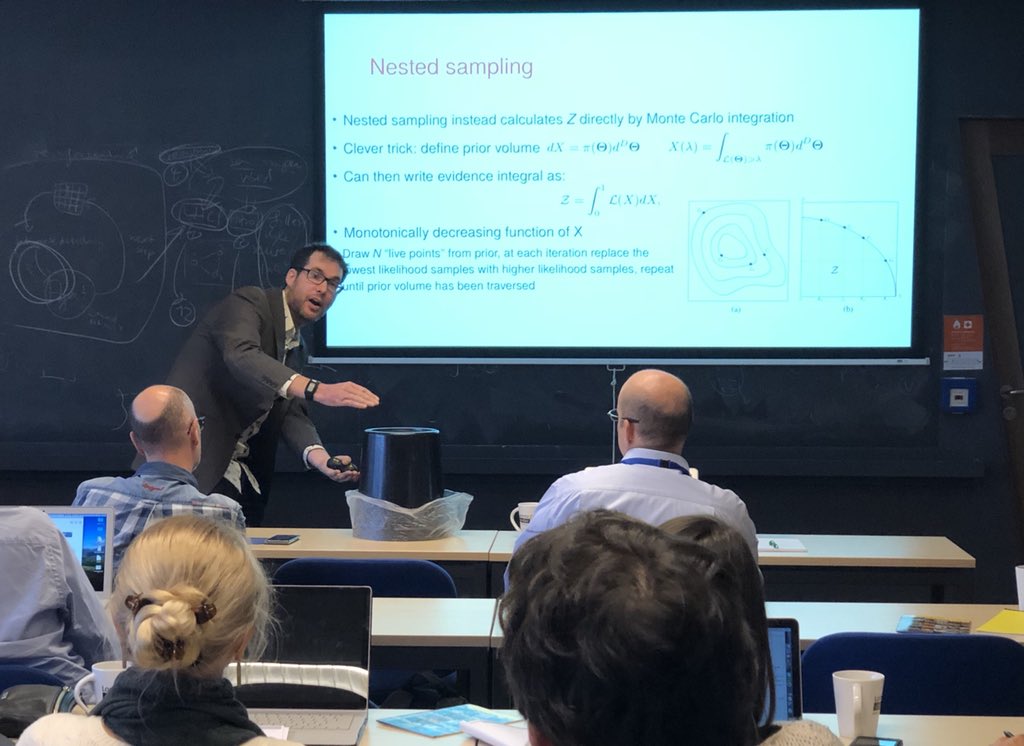
I am currently spending the week in Leiden (Netherlands), attending to a
very interesting workshop that brought together computer scientists, astronomers, astrophysicists, and particle physicists to discuss how to apply the most cutting-edge tools in machine learning to improve our chances of discovering dark matter, the unknown non-luminous substance that vastly overweights luminous matter in the Universe.
Peer review is the backbone of high quality scientific publications. Although the idea that only articles that are approved by a set of anonymous nitpickers can ever see the light of publication on "serious" journals is old and perfectible, there is currently no valid alternative to identify verified, rigorous scientific work, and to filter out unsubstantiated claims, and methodologically unsound results - the scientific analogue of "fake news".
The title of this post is the password code required to connect to my wireless network at home. The service, provided by the Italian internet provider Fastweb, has been discontinued as I moved to Padova from Venice, so you can't really do much with the code itself. On the other hand, it should give you hints on a couple of things.
I was born and have lived in Venice for over 51 years now (omitting to mention some 2 years of interruption when I worked for Harvard University, 18 years ago), but this has come to an end on December 31st, when I concluded a rather complex move to Padova, 35 kilometers west.
Venice is a wonderful city and quite a special place, if you ask me. A city with a millenary history, crammed with magnificent palaces and churches. A place where one could write a book about every stone. Walking through the maze of narrow streets or making one's way through a tight network of canals is an unforgettable experience, but living there for decades is something else - it makes you a part of it. I feel I own the place, in some way. So why did I leave it?


 A Research Position In Neuromorphic Computing And Nanophotonics Open In Padova, Italy