

Fake Banner
    Arduino Vs BasicX: Crunchy Boring Tech Series #3
    By Project Calliope | April 27th 2010 06:52 AM | 3 comments | Print | E-mail | Track Comments
    About Project

    'Project Calliope' is a pico-satellite funded by Science 2.0 and being launched in 2011 by a mad scientist who is a space & music enthusiast...

    View Project's Profile
    So yes, I'm launching a satellite.  And an $8K Personal Satellite needs a brain. But which brain? IOS' kits includes the BasicX processor; for Christmas I received the Arduino kit so beloved by DIY folks. Both are potentially flyable.  Let's compare.

    BasicX-24 (http://www.basicx.com/): 32K memory, requires 20mA plus up to 40mA I/O loads, operates at -40C to +85C. Programmed in BASIC (ugh) via serial cable.
     
     BasicX-24

    Arduino (http://arduino.cc): 16K memory, requires 50mA plus 40mA per I/O load, operates at -40C to +125C (estimate based on range its optional temperature sensor functions at). Programmed in a C subset via USB port.
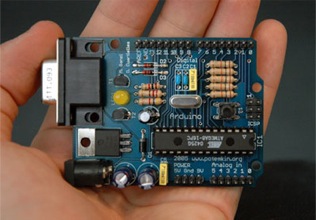
     
     Arduino

    So we end up with a classic rocket science trade-off. There's an easier to use, robust kit-- the Arduino. And a more bare-metal rig-- the BasicX-- that has better power usage but is a bit harder to hook up. Both are flyable. So do I go for ease of use, or performance?

    I'll clearly go for performance. The lower power requirements of the BasicX are an overwhelming plus. As a computer scientist, I'm not worried about the ground issues-- hooking it up, programming it, testing. This is a first launch, and I need to ensure everything is as 'tight' as can be.

    However, were I to launch a second (wooden?) satellite, I''d be tempted to try the Arduino, just as fan service to the DIY community.

    Alex

    Track The Satellite Diaries via RSS feed and Twitter @skyday  (or go slumming in my main column, the Daytime Astronomer)

    Comments

    Same voltage? Same clock rate? I'm in a similar situation, bicycle lighting control, not satellite (power and ease of programming matter to me). I got the impression that an Arduino is a standardized hardware layout, plus a thin software gloss, and that the Atmel (AVR) chips on which it is based are low power or capable of it (by putting the processor to sleep when not "thinking"). So even if you didn't go Arduino, you might go AVR. And if you don't put the processor to sleep, you can clock it down to the minimum necessary to run your stuff, and that also saves power.

    calliope
    Both have a wide voltage rate (5-12V).  The Arduino is 16MHz, and the BasicX-24 is nominally 7.37MHz but optimized to run its built-in BASIC faster.

    The reason I limited it to those two choices is that I'm not up to creating a custom rig, so I went with one of the 2 most common kits.  The BasicX-24 is a kit that comes with the IOS TubeSat, so it'll work with the PCB layouts they provide and is generally known to be 'flight ready'.  The Arduino is a known easy-to-use kit solution.

    To switch from "IOS-approved BasicX-24" to "DIY-friendly Arduino", either there would have to be a problem with the BasicX-24, or the Arduino would have to offer something much better than the BasicX-24.  Since they are roughly comparable, with the BasicX-24 having a better power profile and the Arduino having stronger programming support, the BasicX-24 wins this time.

    But if someone had an Arduino-based experiment they wanted to fly, it could be flown on a TubeSat.  And as you note, if someone had an AVR payload, they could fly that!  DIY satellites are fun.

    Alex
    I guess I was mostly surprised to see that you had only considered that one Arduino -- there's a mess of them out there, and you cut your power consumption by 4x if you cut your clock rate by 2x (I checked the docs, ATMega328P @ 8Mhz draws 9mA, provides 32k of memory). They do even better at 3.3V and even lower clock rates, but that might not work for you. The biggest win is it looks like it has a gung-ho and growing community.

    Ane yes, I know that you can't go switching horses mid-project.

    Add a comment

    The content of this field is kept private and will not be shown publicly.
    • Allowed HTML tags: <sup> <sub> <a> <em> <strong> <center> <cite><TH><ul> <ol> <li> <dl> <dt> <dd> <img> <br> <p> <blockquote> <strike> <object> <param> <embed> <del> <pre> <b> <i> <table> <tbody> <div> <tr> <td> <h1> <h2> <h3> <h4> <h5> <h6> <hr> <iframe><u><font>
    • Web page addresses and e-mail addresses turn into links automatically.
    CAPTCHA
    If you register, you will never be bothered to prove you are human again. And you get a real editor toolbar to use instead of this HTML thing that wards off spam bots.

