

Fake Banner
    Science & Social Media (AAS 215)
    By Project Calliope | January 21st 2010 02:25 PM | 2 comments | Print | E-mail | Track Comments
    About Project

    'Project Calliope' is a pico-satellite funded by Science 2.0 and being launched in 2011 by a mad scientist who is a space & music enthusiast...

    View Project's Profile
    I enjoyed presenting on Project Calliope two weeks ago, at the 215th AAS meeting.  I have a partial podcast of my talk in preparation, but in the meantime, here are the visual slides from my presentation (and also up as a PDF at ProjectCalliope.com.  The most important theme I covered was the shift from a tech mindset (build a crack engineering team) to a social mindset (gather a circle of interested people able to talk this up).   Though the value of the talk was in the dialog, not the slides, this does provide a useful basic primer on the how and why of launching a personal picosatellite.

    Project Calliope
    Science&Social Media

    Alex Antunes, Ph.D.

    Abstract: We present the 'Project Calliope' picosatellite to explore how to use social media to initiate, fund, and engage in scientific research. 'Project Calliope' is a sonified ionospheric detector being launched in 2010 on the "TubeSat" platform. It has no federal or academic contribution, and relies on 'citizen scientists' and such 'citizen journalist' channels as ScientificBlogging.com for its technical and infrastructure support. The fundamental question of whether good science can come from small packages has a mixed answer. We put forth the 'Science2.0' concept of science as play, provide a method for engaging individuals as contributors, discuss the pros and cons of operating a research project with full transparency, and present preliminary K12 outreach results.
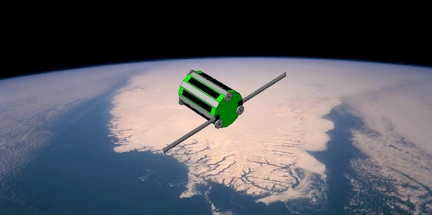
    Project Calliope is a science/music satellite

            Input: Earth's Ionosphere orbital environment
            Output: MIDI music signals


    Specs:


    • InterOrbital.com $8K 'TubeSat' in a 3-16 week polar orbit


    • 'ICube-X' Sensors from InfusionSystems.com


      • 2 ionospheric magnetic sensors


      • 1 particle counter


      • 4 light sensors to track spin


      • 1 temperature sensor


    • Downlink via shared HAM, estimate 90-180 minutes/day.


    • Redistribution via web and P2P


    Why?


    • Dawn of private space age


    • 'Small science' by individuals


    • Science&Music collaborating


    • Open notebook science


    • Sharing and remixing


    • It's what I do.


    Fueled by Social Media

    Original plan: assemble a crack engineering&ops team, then promote it myself.
    Reality: I can build it solo, using COTS! But promotion requires many hands.

    Communities Engaged

  • Public: via ScientificBlogging.com


  • Tech: Infusion Systems' tech team, InterOrbital Systems CEO


  • Music: P2PNet, Audio4Cast, Echolot


  • Edu: Project ASTRO, regional K12, J. Wallin


  • Academia: <crickets>


  • The Future is 2010/2011

    There is a love and need for space, not just among techies but among musicians, artists, students, anyone who looks up. @skyday #aas215


    This bear will fly to space!


    Alex

    Track The Satellite Diaries via RSS feed and Twitter @skyday  (or go slumming in my main column, the Daytime Astronomer)

    Comments

    I think that was one of the best Social Media Marketing webinars I've experienced yet. I definitely had a lot of notes and ideas for things to do. As the Web Community Coordinator (aka the Social Media Marketer) for my company I'm always looking for new way to view and experiment with. Thank you for these great tools from your presentation.

    Hatice Cullingford

    And the future is Bloggy!

    P.S. And no need for a spacesuit. A very lucky bear.

    Add a comment

    The content of this field is kept private and will not be shown publicly.
    • Allowed HTML tags: <sup> <sub> <a> <em> <strong> <center> <cite><TH><ul> <ol> <li> <dl> <dt> <dd> <img> <br> <p> <blockquote> <strike> <object> <param> <embed> <del> <pre> <b> <i> <table> <tbody> <div> <tr> <td> <h1> <h2> <h3> <h4> <h5> <h6> <hr> <iframe><u><font>
    • Web page addresses and e-mail addresses turn into links automatically.
    CAPTCHA
    If you register, you will never be bothered to prove you are human again. And you get a real editor toolbar to use instead of this HTML thing that wards off spam bots.

