

Banner
    Real-Life Robotech Mecha Have Finally Arrived
    By Hank Campbell | July 31st 2012 04:49 PM | 6 comments | Print | E-mail | Track Comments
    About Hank

    I'm the founder of Science 2.0® and co-author of "Science Left Behind".

    A wise man once said Darwin had the greatest idea anyone...

    View Hank's Profile
    Suidobashi Heavy Industry of Japan has finally found a way to make (a) work or (b) laser tag interesting to me; put me inside a giant robot. 

    But to get the "Kuratas mecha" you will have to spend $1.35 million. You will want to, because they have a polite, hot Japanese girl in shorts in their video. 

    Its diesel engine sends it at an elegant 10 KPH clip, basically a decent walking pace.  But these are too cool to run in.  No one looks cool running so until it can fly or turn into a motorcyle, a cool pace will do.

    This thing is huge.  Granted, the girl in the video is probably only 4 feet tall but look at the scale of it:


    Ironically, once inside, they are most concerned about you wearing a helmet as you smite invading Zentraedi. I mean, you are in a giant robot tank.  That is one big bullseye for alien gunships.


    Seriously, is this not the best wargame device ever?  Will they take a credit card for that $1.35 million?  Our navy is spending $6 billion for one new destroyer.  For that money we could have two brigades of soldiers running around in these.  And the HUD is cool:
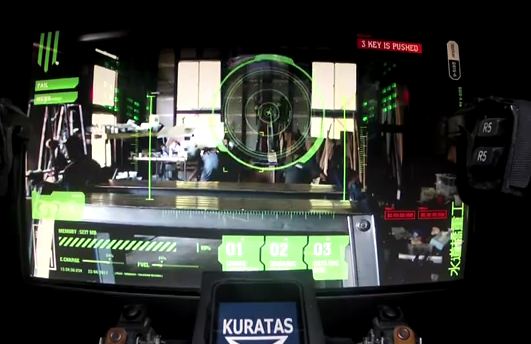


    I need to buy one before this gets banned because some sociopath who couldn't even get a membership in a gun club got NIH funding and used it to shoot up a movie theater.  Plus, it's GREEN:
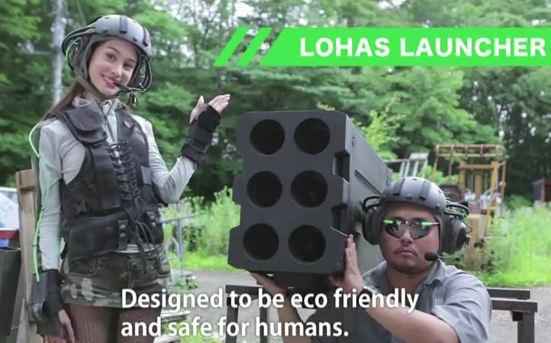


    Safe? Not when I am done retrofitting it.  The best part?  I can set it so all I have to do is smile and bad guys go down in a hail of BB gunfire:



    Please exit carefully after you have saved all of the protoculture from an alien civilization:
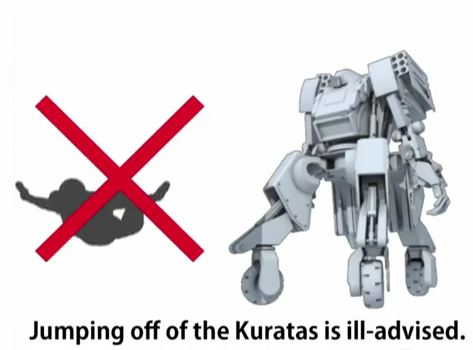

    No kidding?

    Comments

    Awesome!...

    Hank, there was no room to reply on the other post, but I am definitely of the belief that Science 2.0 is infinitely greater (and more useful to society) than Darwin's 'great idea'. Objectively, it invokes special selection (an intelligent goal-directed act) as a 'proof of concept', with the implication that over time, natural selection, (a non-intelligent process that describes the outcome of a complex relationship among living organisms) shall result in the 'emergence' creation, whatever, of new species, genus, order, class, phylum, and kingdom.

    Simply, appeals to 'time' as a magical agent that solves everything are unwarranted. If the mechanism is truly 'random', how does one justify any extrapolation given that the frequency, quality, and consequence of said 'mutation' cannot be known, or modeled in any way? No amount of time will allow nature to produce a sky-scraper, just as the 10+ millenia humans have bred canines have not resulted in any transformation to the fundamental anatomy, (i.e. a new limb, new ability, etc.) and has actually revealed explicit morphological boundaries that may not be breached without compromising the health and viability of the animal. -- in addition, domestic dogs can still breed successfully with wolves, i.e. they are the same species. I am not suggesting any 'super natural' intervention whatsoever, rather, pointing out the curious inversion of logic that seems to fascinate so many bright people. If it were possible, I would repeat the previous sentence a thousand times if it would mute the seemingly inevitable reactionary response.

    I am speaking solely in regards to the logical form of the argument (now pertaining to synthetic theory), which is evidently unsound and unfounded, and not remotely 'scientific' in any sense, given that the primary 'mechanism' i.e randomness, precludes any predictive power of the theory, cannot be tested, and has been falsified (see: dolphins/ bats echolocation re: molecular convergence). Independent and parallel molecular changes adopting the same sequence with the same outcome is not random. Yet the brilliant theory marches on.

    I hope that a detached and dedicated intellect can address (or enlighten me to) these inconsistencies as they are, while leaving me out of the discussion completely. I am not an 'ist' or 'ism' or any such thing. I merely have the basic rational faculties to know that extrapolation may only be done via specific and precise principles and not vague references to semantically void placeholders like 'nature' 'selection' 'emergence' 'random' etc.

    You have accomplished a great thing with this forum!

    Best regards, and many thanks!

    Brian G

    Gerhard Adam
    Fundamental transformations are unlikely.  Primarily because that isn't how the traits are "created" from the genetic information.  Often it is assumed that traits are micro-managed by the genes, but instead much of the development occurs in a much more general sense.

    That's why you'll find that whether it be a hand, wing or fin, it will likely be based on the basic form of five fingers.  In other words, there will NOT be a gross level change in the anatomy as you've described.  It would take a tremendous and quite radical mutation to cause a new limb to be formed, so everything will generally develop [or evolve] from a highly conserved set of genes which "constrain" the genetic "program" that can be invoked.
    No amount of time will allow nature to produce a sky-scraper...
    On the contrary.  Skyscrapers exist, as do the creatures that built them.  Nature certainly did "produce a sky-scraper" {.. and no, I'm not being a smart-ass}.

    You certainly couldn't expect a sky-scraper to evolve, since it can't grow, it can't be replicated [i.e. mutate and reproduce], so the next best thing would be to argue as to whether nature would evolve a creature that would construct such a thing.  Certainly we could lay similar claims to ant hills and termite mounds.
    Mr. Adam,

    You never cease to impress! (and enlighten)... So, I believe we're on the same page regarding the appropriate attribution of intelligence to all levels of the system? (not just reserving it for us 'special' humans :). You brought to my attention in a previous post the fantastic essay by Dennett, re: Intentional Systems. It seems to me, that the entire process of evolution makes perfect sense if we attribute intelligence appropriately, where it is manifest, and where it is due. Further, this does not require in any way that we make claims, assertions, or assumptions as to 'sufficient causes' for said intelligence.

    The most non-productive debates arise when we operate outside the boundaries of the evidence. Though, at the same time, it seems counter-productive (if not wholly irrational) to insist that these complex systems are not intelligent.

    Best regards, and many thanks for your insight,

    Brian G.

    Gerhard Adam
    One of the problems here is that of terminology.  "Intelligence" has a lot of baggage ranging from cognition to consciousness, etc.  So, even though I'm not thrilled with the terminology, I tend to ascribe an "intent" to such systems.

    While that certainly has enough trouble on it's own, it may be a bit less contentious than using "intelligence".  Of course, many people will presume that "intent" also carries with it the connotation of being conscious and exercise a "will" to action, but I'm not quite that rigid about it.

    For me it seems that "intent" could be the result of a system that operates by simple stimulus-response mechanisms.  In that way "intent" does not have to ascribe motivation.

    For example, we could argue that when we need food or water, our system signals our brain, as well as triggering other biochemical events so that we experience the need to pursue the acquisition of food or water.  That is the "intent" or "purpose" of those events.  They aren't conscious of the motivation, but they result in a system that aims at producing a particular effect to produce a particular outcome or result.  We aren't likely to confuse thirst with hunger or vice verse. 

    In the same way I try to distinguish between "intent" versus "purpose".  In other words, the "purpose" of the heart is to pump blood to all the cells and lungs.  These are essentially fixed processes.   However, when we experience fear or aggression, and the system is flooded with adrenaline, then the "intent" of that system is to ramp up the heart and lungs for the anticipated action.  Perhaps I'm the only one that sees the subtlety of the distinction, but that's how I'm inclined to view it.

    As you can see, that's hardly a completely thought out view, but its a beginning in terms of how I'm trying to understand such systems.

    Frank Parks
    Yeah, Hank.  Awesome HUD.  Check this out:
    http://what-if.xkcd.com/5/
    Hank
    That guy seems pretty confident but my Roomba has been eying me suspiciously so I will build a plasma cannon just in case.
    Want more no-nonsense, independent science? Buy Science Left Behind

