
Banner
Charlie Kirk An American On The Level of Louis Farrakahn. Rest In Peace. He often quoted 'science' in a misleading way though.

Charlie Kirk was shot while exercising his constitutional American right to free speech. ...

Eric Weinstein's Geometric Unity Has A Fundamental Flaw. No Lagrangian, No Theory

Eric Weinstein's theory of Geometric Unity is wrong. So is every other so-called theory of everything...

There Is No Such Thing as a "Nuclear Scientist". There Are Only Physicists

Let’s bury the dangerous, lazy, and politically convenient idea that there exists a distinct...

User picture.
picture for Hank Campbellpicture for Fred Phillipspicture for Patrick Lockerbypicture for Robert H Olleypicture for Chidambaram Rameshpicture for Jerry Decker
Hontas FarmerRSS Feed of this column.

My research focuses on astrophysics from massive star formation to astroparticle physics. Born and raised in Chicagoland I have lived in Bellwood, IL since 1984 and attended public schools here... Read More »

Blogroll

Astronomy, it seems, finds itself at the mercy of political caprice and economic machinations yet again. The Thirty Meter Telescope (TMT), once poised to revolutionize observational astronomy from the unparalleled vantage point of Mauna Kea, faces cancellation. Not due to heartfelt protest by everyday Hawaiians, but under the blunt axe wielded by the DOGE-driven economic philosophy championed by Donald Trump and the MAGA movement, with Elon Musk's tacit endorsement (at least until his next ketamine-infused revelation).

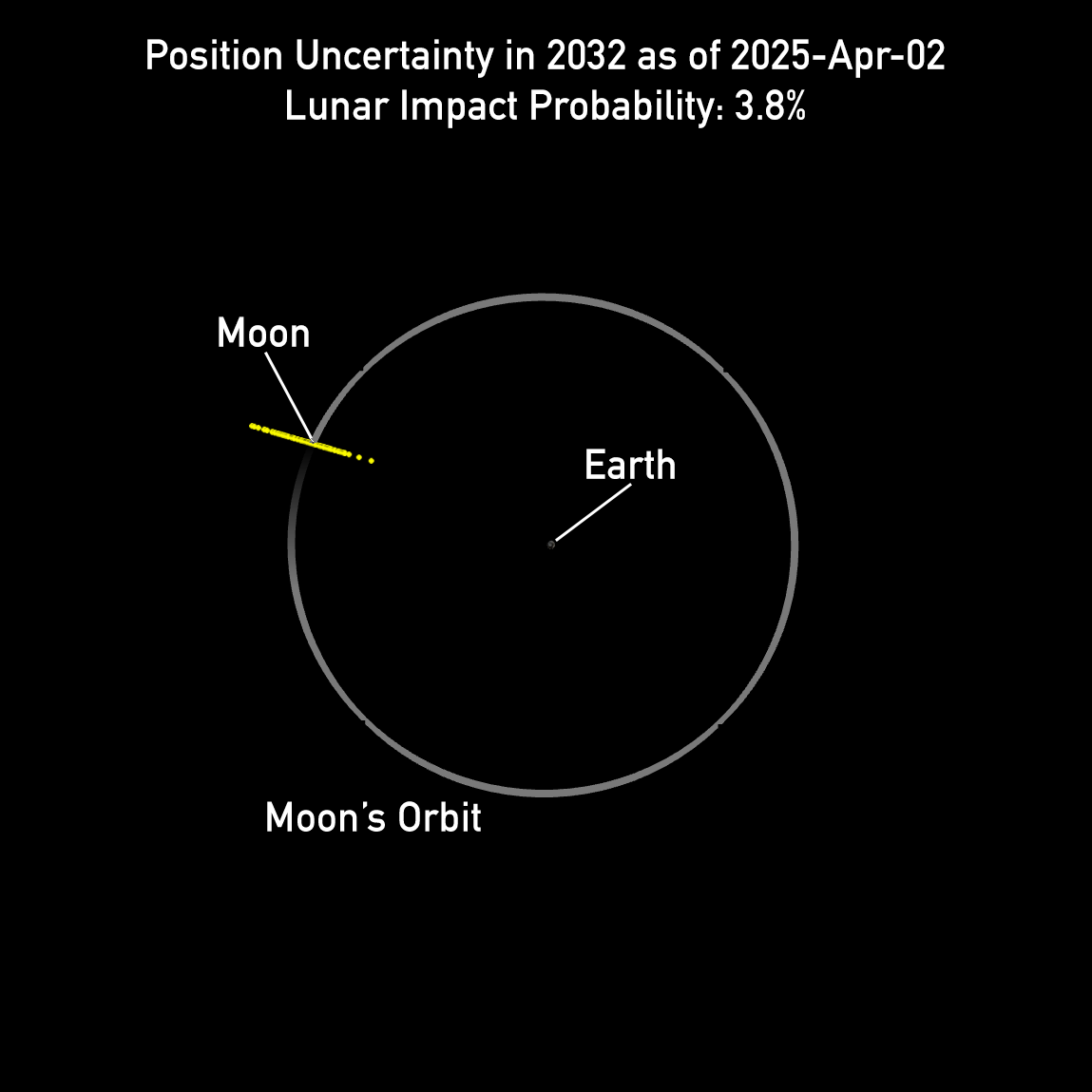
According to observations made by NASA using the James Webb Space Telescope, there is a three point eight percent chance that asteroid 2024 YR4 will hit the Moon on December 22nd 2032.  This means there is still a 96 percent chance that it will not hit the Moon.  Space is big so it is very easy for objects to not hit each other.  Well, really, it is easy for objects to stay far enough apart that their gravitational fields won't make a collision inevitable.  So this isn't a prediction that the asteroid will hit the Moon, and it is likely that as it travels around the Sun and we get more observations that it will not come close to hitting anything.  
Recent observations have virtually eliminated any concern about an impact from asteroid 2024 YR4. With a series of new data points collected over the past months, NASA has refined its understanding of the asteroid's path, reducing the predicted risk from the initially calculated 1% to nearly zero.

Alternate Representations for Impact Probability = 2.7e-5
0.0027% chance of Earth impact

Back in December 2024, astronomers caught wind of something unusual—a small, fast-moving rock dubbed 2024 YR4 hurtling through space. Over the past several months, NASA’s eagle-eyed observations have tracked its path with increasing precision, revealing a roughly 1% chance that this cosmic wanderer could impact Earth in 2032. Now, before alarm bells start ringing, let’s break down what that really means and why there’s no need to panic.

Donald Trump does not have the power to rescind either constitutional amendments or federal laws by mere executive order, no matter how strongly he might wish otherwise. No president of the United States of America has that power. The media and public need to understand that anything he signs in that way is basically on par with a social-media post ranting about what he thinks should happen. At most, he can direct how the executive branch enforces existing laws and the Constitution, but if any order violates those higher authorities, it’s automatically invalid. Anyone who tries to carry it out risks being sued or even prosecuted for trampling on the civil rights those laws protect.

The "drone panic" of 2024 easily claims the title of the most absurd astronomy and physics-related story of the year. At its core, 99.99% of this so-called crisis boils down to people mistaking planes for something extraordinary. The rest? It's people glancing up at the night sky, seeing stars, and failing to grasp the staggering distances that separate us from them. Remarkably, this edges out another perennial misunderstanding: those who genuinely believe that changing the clocks is the reason for shorter winter days, rather than the natural shift in sunlight reaching the northern hemisphere during the season.